Complete Meal Plans Guide: Healthy Weekly Meal Plans for Every Goal
Stop Guessing What to Eat — Here’s Your Complete Meal Plans Guide
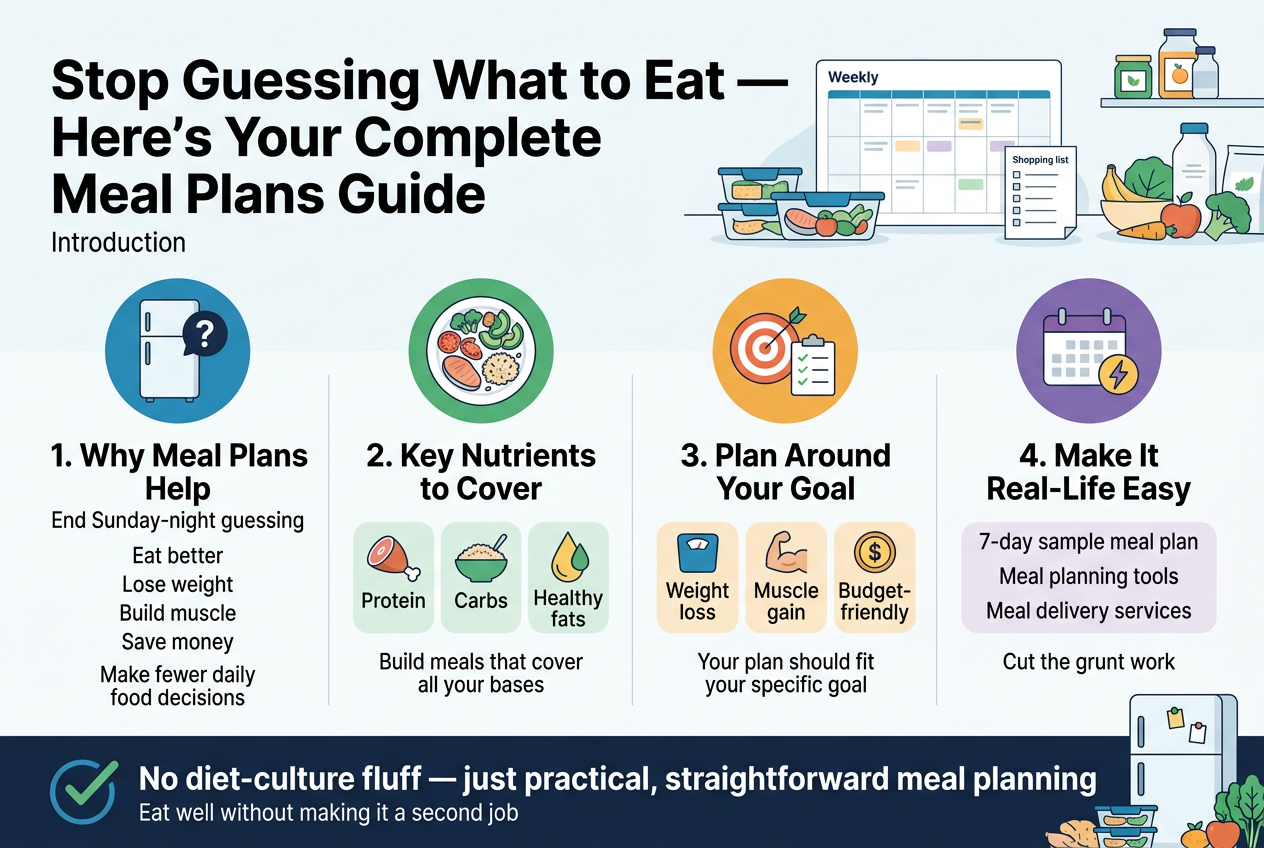
If you’ve ever stared at your fridge on a Sunday night with zero idea what you’re eating this week, this guide is for you.
Healthy weekly meal plans work for anyone trying to eat better — whether you want to lose weight, build muscle, save money on takeout, or just stop making random food decisions every single day. The catch? Most people ditch their plan by Wednesday because it’s too complicated or just doesn’t fit real life.
This guide fixes that. You’ll learn which key nutrients your meals actually need to cover all your bases, how to build a plan around your specific goal (not someone else’s), and get a full 7-day sample meal plan you can use starting this week. We’re also covering the tools and meal delivery services that take most of the grunt work off your plate.
No diet-culture fluff here — just a practical, straightforward approach to eating well without making it a second job.
Why Meal Planning Is Worth Your Time
A. Achieve and Maintain a Healthy Weight
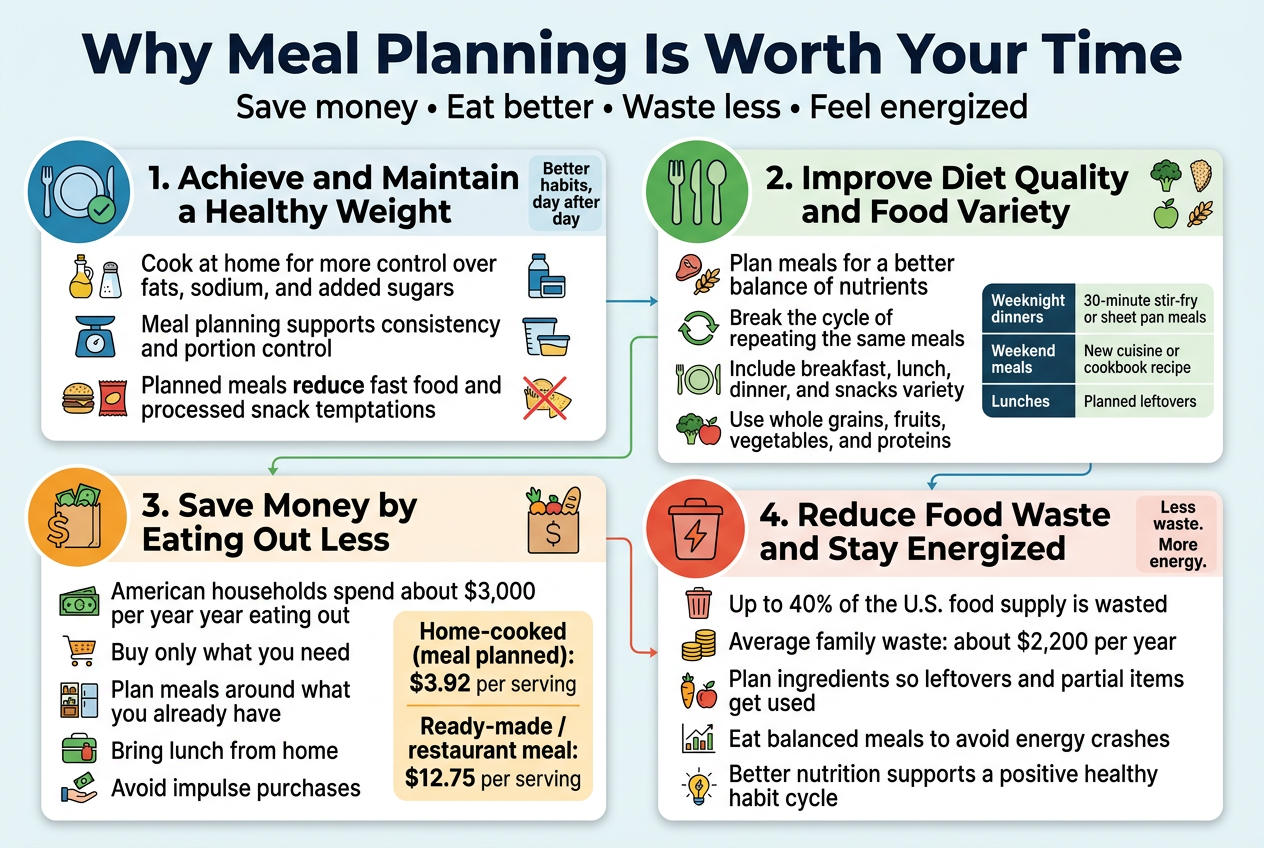
One of the most compelling reasons people turn to meal planning is its direct impact on body weight and overall physical health. When you cook at home, you have complete control over every ingredient that goes into your meals — the quality of fats, the amount of sodium, and the level of added sugars. Restaurant meals, while enjoyable as an occasional treat, are typically loaded with all three of these in quantities that make consistent healthy eating nearly impossible when dining out regularly.
The connection between meal planning and weight management comes down to consistency. It is not just about cooking healthier food; it is the structure of meal planning that keeps you motivated to continue making better choices day after day. When you stick to a meal plan and enjoy more home-cooked meals, your body begins to reflect those choices — whether the goal is losing weight, maintaining a healthy weight, or simply feeling physically and emotionally better overall.
Meal planning also supports portion control in a meaningful way. Each time you sketch out a weekly menu, you are making deliberate decisions about how much of each meal to prepare. This ongoing practice helps you avoid overeating, better understand your body’s needs, and track health metrics more accurately over time. Rather than serving yourself based on hunger or habit, you are guided by thoughtful, pre-made decisions.
Additionally, planning your meals in advance reduces the temptation to reach for fast food or processed snacks during stressful moments in the day. When nutritious food is already planned and prepped, the drive-through loses much of its appeal.
B. Improve Diet Quality and Food Variety
Beyond weight, meal planning is one of the most effective tools for improving the overall quality of your diet. The planning phase gives you a dedicated moment to step back and assess whether you are getting the right balance of nutrients, a variety of foods, and enough flavor to stay satisfied throughout the week.
Here is where many people are surprised: without a meal plan, you are actually more likely to eat the same meals repeatedly. If you are comfortable making spaghetti and tacos, chances are those two meals will rotate endlessly through your week. Meal planning breaks that cycle by deliberately introducing new recipes and a wider range of ingredients into your routine.
Consider organizing your weekly variety with this kind of intentional balance:
| Meal Type | Variety Goal | Example |
|---|---|---|
| Weeknight dinners | Quick, familiar recipes | 30-minute stir-fry or sheet pan meals |
| Weekend meals | New or exploratory dishes | Trying a new cuisine or cookbook recipe |
| Lunches | Planned leftovers | Repurposed dinner components |
| Breakfasts | Nutrient-dense options | Overnight oats, egg-based dishes |
The planning phase is also the right time to think critically about portion sizes and how you divide your plate — ensuring an adequate blend of fruits, vegetables, whole grains, and proteins. Rather than assembling meals impulsively at the end of a long day, you are building them thoughtfully when you have the mental energy to make smart nutritional decisions.
Meal planning and healthy eating go hand in hand precisely because of this deliberate, proactive approach. It allows you to consistently eat more mindfully without the added expense of prepared foods or restaurant orders.
C. Save Money by Eating Out Less
The financial case for meal planning is difficult to ignore. American households spend an average of $3,000 per year eating out — a figure that reflects not just weekend dinners at restaurants, but the daily lunches purchased near work, the last-minute takeout orders, and the delivery app charges that accumulate quickly throughout the month.
Meal planning addresses this from multiple angles:
- You buy only what you need. Because your grocery list is built around a specific weekly menu, you are not filling your cart with random ingredients that may never get used.
- You plan meals around what you already have. Checking your pantry and fridge before making your list means you spend less on groceries overall.
- You avoid impulse purchases. Walking into a store with a focused list reduces the temptation of unplanned buys.
- You bring lunch from home. Planned leftovers mean you are not spending money on food near the office every weekday.
The cost difference between a home-cooked meal and a restaurant or takeout meal is substantial. Data from Cook Smarts highlights this clearly:
| Meal Type | Average Cost Per Serving |
|---|---|
| Home-cooked (meal planned) | $3.92 |
| Ready-made / restaurant meal | $12.75 |
That gap adds up quickly across an entire family and an entire year. By catching sales, buying in bulk for planned meals, and clipping coupons with a focused shopping list, meal planning transforms grocery shopping from a reactive, expensive task into a strategic, budget-conscious habit.
D. Reduce Food Waste and Stay Energized
Food waste is a significant problem, with the USDA estimating that the United States wastes up to 40% of its food supply. For the average family, this translates to approximately $2,200 worth of food thrown away every single year — wilted produce, forgotten leftovers, half-used cans, and expired ingredients that were bought with good intentions but never incorporated into a meal.
Meal planning directly combats this waste by ensuring that every ingredient you purchase has a designated purpose within your weekly menu. When meals are planned thoughtfully, ingredients that are not fully used in one dish appear again in another later in the week — a partial can of coconut milk, a bunch of fresh herbs, or half a head of lettuce all find their way into meals rather than into the trash.
Beyond the financial and environmental benefits, reducing food waste also keeps your kitchen less chaotic and your refrigerator better organized — which in turn makes cooking less stressful and more efficient.
The energy benefits of meal planning extend well beyond the kitchen. When you consistently eat well-balanced, home-cooked meals, you avoid the energy crashes associated with fast food, processed snacks, and high-sodium restaurant meals. Proactively planning breakfast, lunch, dinner, and snacks puts better-for-you ingredients at your fingertips throughout the day, helping you feel fuller and more nourished between meals. Over time, better nutrition reduces stress and promotes a positive, self-reinforcing cycle of healthy habits.
With this in mind, it becomes clear that the advantages of meal planning are interconnected — saving money, eating better, wasting less, and feeling more energized are all outcomes of the same disciplined, forward-thinking approach to food.
Key Nutrients Every Healthy Meal Plan Should Include
Fill Half Your Plate with Colorful Vegetables
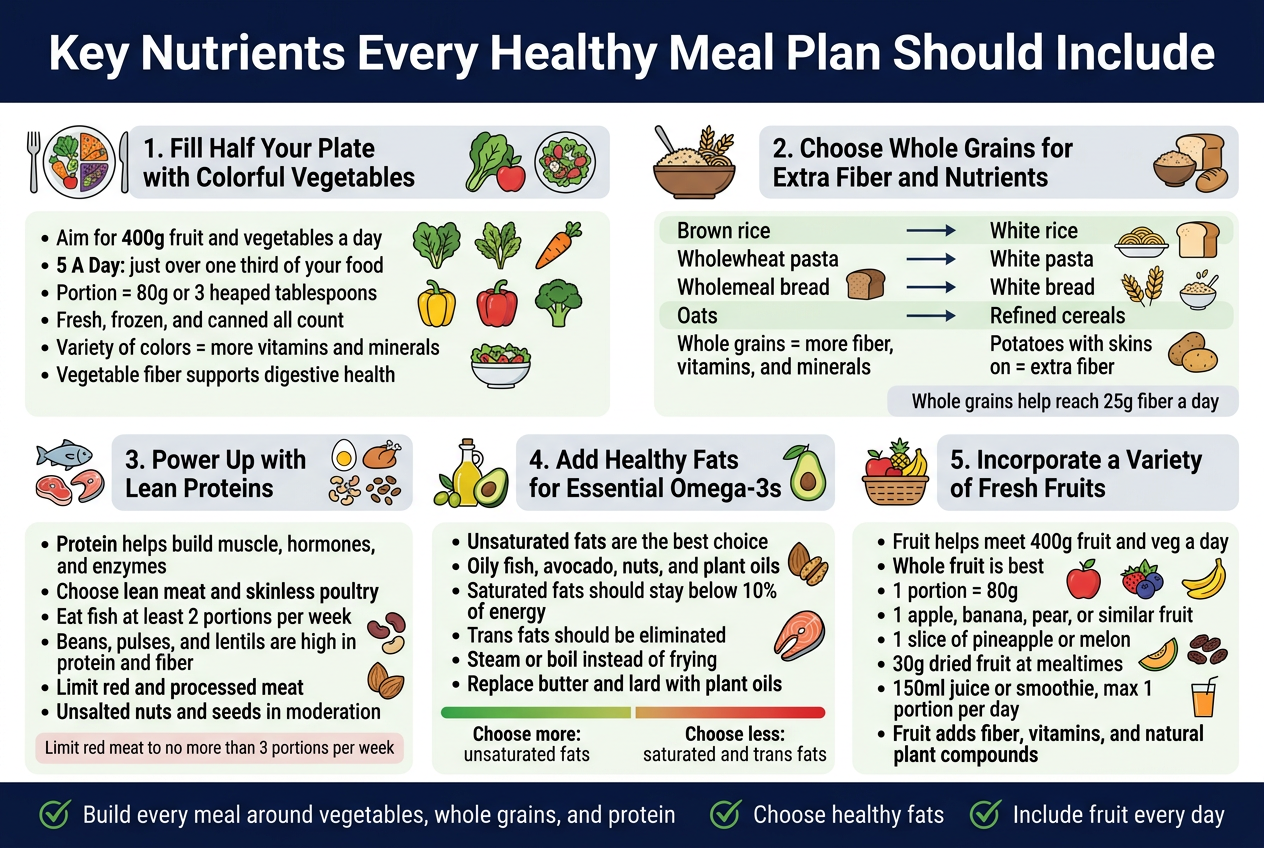
Vegetables are the cornerstone of any healthy meal plan, and for good reason. According to WHO guidelines, everyone older than 10 years of age should aim for at least 400 grams of fruits and vegetables combined per day. The NHS Eatwell Guide reinforces this by recommending at least 5 portions of a variety of fruit and vegetables every day, noting that fruit and vegetables should make up just over a third of the food you eat each day.
The evidence behind this recommendation is compelling. People who eat at least 5 portions of fruit and vegetables a day have been shown to have a lower risk of heart disease, stroke, and some cancers. When you fill half your plate with colorful vegetables at each meal, you are automatically building in a wide range of vitamins, minerals, and dietary fiber without dramatically increasing calorie intake.
Here are key points to keep in mind when incorporating vegetables into your meal plan:
- Variety matters: Different colored vegetables provide different micronutrients. Dark green leafy vegetables, for example, are particularly valuable for improving vitamin A status.
- All forms count: Fresh, frozen, and canned vegetables are all valid choices, provided canned versions do not contain added sugars or excess sodium.
- Portion guidance: A portion equals 80g of fresh, canned, or frozen vegetables, or 3 heaped tablespoons — a simple benchmark to hit at every meal.
- Fiber contribution: Vegetables contribute to the daily dietary fiber target of at least 25 grams for adults, which supports digestive health and helps reduce the risk of noncommunicable diseases.
A practical approach is to add a side salad to lunch and a portion of cooked vegetables to dinner every day without fail. These two habits alone move you significantly closer to your daily targets.
Choose Whole Grains for Extra Fiber and Nutrients
With vegetables firmly in place on your plate, the next major building block of a healthy meal plan is your carbohydrate source — and specifically, choosing whole grains over refined alternatives. Starchy foods should make up just over a third of everything you eat, according to the NHS Eatwell Guide, which means your meals should genuinely be based on these foods.
The critical distinction here is quality. Wholegrain and wholemeal varieties of starchy foods contain more fiber and usually more vitamins and minerals than their white or refined counterparts. The WHO guidelines specify that carbohydrates in the diet should come primarily from whole grains, vegetables, fruits, and pulses, with examples including:
| Whole Grain Option | Refined Alternative to Replace |
|---|---|
| Brown rice | White rice |
| Wholewheat pasta | Regular white pasta |
| Wholemeal or higher-fibre bread | White bread |
| Oats | Processed breakfast cereals |
| Unprocessed millet or maize | Refined grain products |
Potatoes with their skins on deserve a special mention as an excellent source of both fiber and vitamins. When you prepare boiled potatoes or a jacket potato, eating the skin is an easy way to preserve that nutritional value.
From a fiber standpoint, whole grains play a significant role in helping adults reach the recommended daily intake of at least 25 grams of naturally occurring dietary fiber. Diets that consistently include whole grains are associated with reduced risk of diet-related noncommunicable diseases, including type 2 diabetes and cardiovascular disease. Replacing refined carbohydrates with whole grain options is one of the most impactful and straightforward swaps you can make when building a meal plan.
Power Up with Lean Proteins
Now that we have covered vegetables and whole grains, protein is the third essential pillar of a balanced meal plan. Proteins provide the building blocks for many structural elements of the body, including muscle, as well as functional molecules such as hormones and enzymes. According to WHO guidance, protein intake at 10–15% of total daily energy intake is generally sufficient for adults, approximately 50–75 grams per day for someone consuming around 2,000 calories.
The NHS and WHO both emphasize the importance of choosing a diverse range of protein sources. These include:
- Lean meats and poultry: Meat is a good source of protein, vitamins, and minerals including iron, zinc, and B vitamins, and is one of the main dietary sources of vitamin B12. Choose lean cuts and skinless poultry whenever possible to reduce saturated fat intake.
- Fish and seafood: Aim to eat at least 2 portions of fish per week, including 1 portion of oily fish. Eggs and fish are also good sources of protein and contain many vitamins and minerals.
- Eggs: A versatile, nutrient-rich protein source that fits easily into any meal of the day.
- Beans, pulses, and legumes: Pulses including beans, peas, and lentils are naturally very low in fat and high in fiber, protein, vitamins, and minerals. They represent an excellent plant-based protein option.
- Nuts and seeds: Unsalted nuts make a good snack and are high in fiber, though they should be eaten in moderation due to their high fat content.
One important consideration is to limit red and processed meat consumption. The NHS recommends no more than 3 portions of red meat per week (350–500g of cooked meat per portion), as higher consumption may increase the risk of certain cancers, including bowel cancer. Processed meats such as bacon, ham, and sausages should be eaten less frequently.
For many adults, a gradual shift toward more plant-based sources of protein — particularly away from red meat — can bring meaningful health benefits. Beans and lentils added to soups, stews, and salads are an easy and cost-effective way to increase plant protein in your weekly meal plan.
Add Healthy Fats for Essential Omega-3s
Previously, I’ve highlighted macronutrients that often take center stage — carbohydrates and proteins — but fat is equally essential and should not be overlooked in your meal plan. Fat is an essential nutrient for proper cell functioning, and two fatty acids — linoleic acid and α-linolenic acid — can only be obtained through diet. According to WHO, a minimum of 15% of daily energy should come from fat, with total fat ideally kept to 30% or less of total daily energy intake.
The quality of fat is what truly determines its impact on health. Unsaturated fats are preferable to saturated and trans fats, and this distinction should guide every meal planning decision involving fats. Swapping to unsaturated fats can help lower cholesterol and reduce cardiovascular risk.
Best sources of healthy unsaturated fats to include in your meal plan:
- Oily fish (such as salmon, mackerel, sardines) — rich in omega-3 fatty acids
- Avocado — a source of monounsaturated fat
- Nuts — high in polyunsaturated and monounsaturated fats
- Plant-based oils — sunflower, soybean, canola (rapeseed), corn, and olive oils are all rich in unsaturated fat
Fats to limit or avoid:
- Saturated fats found in fatty meat, butter, palm oil, coconut oil, cream, cheese, ghee, and lard — no more than 10% of total energy intake
- Industrially-produced trans fats found in baked goods, fried foods, and pre-packaged snacks — ideally eliminated entirely, as they are not part of a healthy diet
Practical cooking strategies that support healthy fat intake include steaming or boiling instead of frying, replacing butter and lard with plant-based oils rich in polyunsaturated fat, choosing reduced-fat dairy products, and limiting pre-packaged snacks and baked goods. These are simple adjustments that make a measurable difference over the course of a week.
Incorporate a Variety of Fresh Fruits
With this in mind, the final essential component of a nutrient-rich meal plan is fresh fruit. Fruit works alongside vegetables to help you meet the daily target of at least 400 grams of combined fruit and vegetable intake recommended by WHO, or the 5 A Day target outlined by the NHS. Fruit provides vitamins, minerals, fiber, and natural plant compounds that support overall health and help protect against noncommunicable diseases.
The NHS provides clear guidance on what constitutes a single portion of fruit:
- 80g of fresh, canned, or frozen fruit
- 1 whole apple, banana, pear, or similar-sized fruit
- 1 slice of pineapple or melon
- 30g of dried fruit — though this should be limited to mealtimes due to its concentrated sugar content
- 150ml glass of fruit juice or smoothie — but no more than 1 portion per day, as these drinks contain free sugars
One important nuance from WHO guidance is that while fresh and frozen fruits are excellent choices, fruit juice — even without added sugar — contains significant amounts of free sugars, which should be limited to less than 10% of total daily energy intake. Whole fruit is always the preferred option because it retains its natural fiber content, which slows sugar absorption and supports digestive health.
Incorporating fruit into your meal plan is straightforward. Adding dried fruit such as raisins to morning cereal counts as a portion, swapping a mid-morning biscuit for a banana adds another, and finishing dinner with fresh fruit alongside plain lower-fat yogurt is an easy way to round out your daily intake. A diverse selection of fruits across the week also ensures you are drawing from a wider range of vitamins and minerals, supporting the dietary principle of diversity that WHO identifies as one of the four core foundations of a healthy diet.
How to Set Up a Meal Plan That Fits Your Goals
Define Your Specific Health and Lifestyle Goals
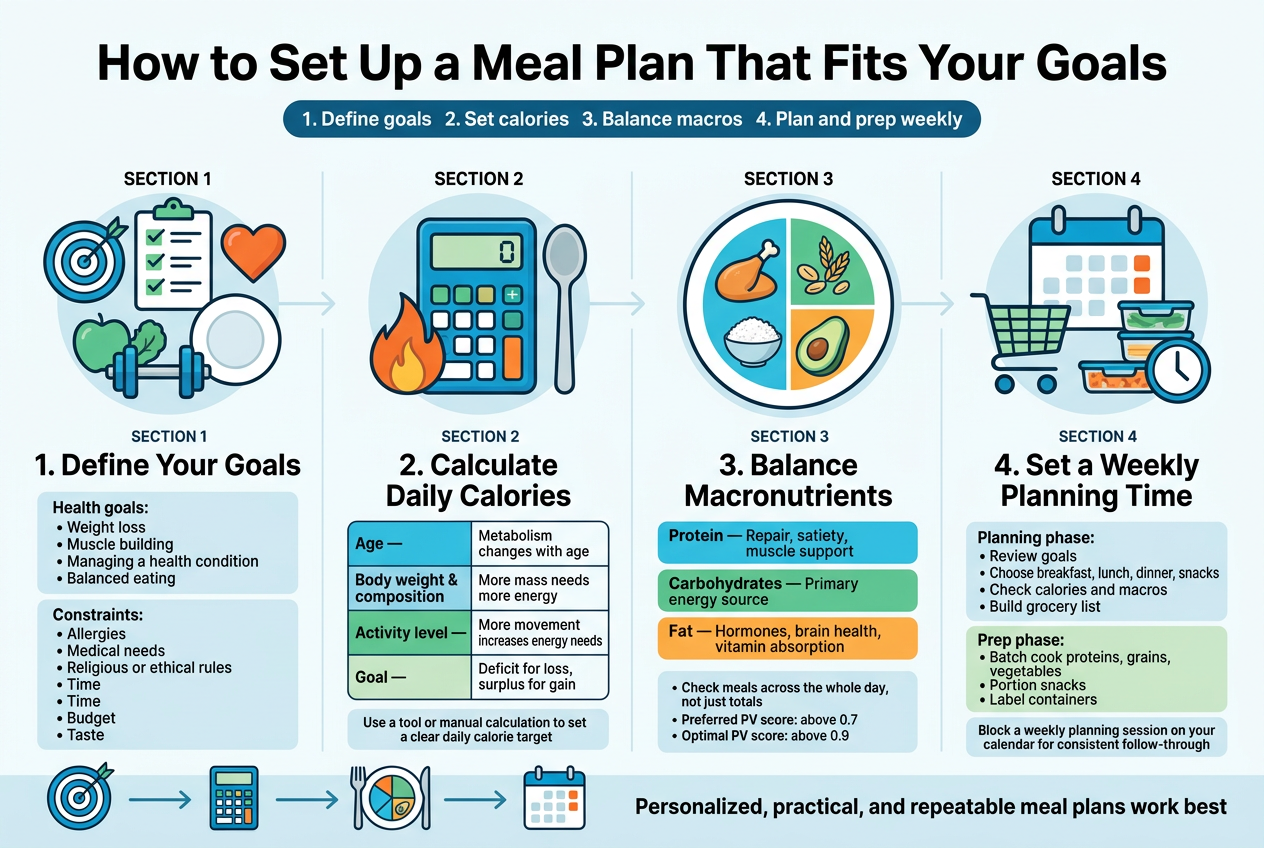
Before you map out a single meal, the most important step is getting crystal clear on why you are creating a meal plan in the first place. Your goals act as the foundation for every decision that follows — from the foods you choose to the portion sizes you set.
Health and lifestyle goals typically fall into a few broad categories:
- Weight loss – reducing overall calorie intake while maintaining adequate nutrition
- Muscle building – increasing protein and total calories to support lean mass gains
- Managing a health condition – following dietary guidelines for conditions such as diabetes, where organizations like the American Diabetes Association and the World Health Organization provide specific nutritional frameworks
- General balanced eating – maintaining energy, supporting immunity, and eating a wide variety of whole foods
Beyond broad health goals, you also need to account for personal constraints that shape what a realistic plan looks like for you. These include:
- Food allergies and intolerances – any food that triggers an adverse reaction must be eliminated outright before planning begins
- Medical conditions – certain diagnoses require mandatory dietary restrictions that override other preferences
- Religious or ethical dietary restrictions – such as halal, kosher, or vegetarian requirements
- Lifestyle factors – how much time you have to cook, your budget, and your flavor preferences
A well-designed meal plan uses a rule-based screening process to first remove all foods that violate these mandatory constraints. Only after that filtering step should you move into selecting the foods that best serve your goals. Skipping this step leads to plans that are theoretically optimized but practically unusable.
Calculate Your Daily Calorie Needs
With your goals clearly defined, the next step is determining how many calories your body needs each day. This number becomes the anchor for your entire plan — it tells you how much food you need to eat to either lose weight, gain muscle, or maintain your current state.
Calorie needs are highly individual and depend on several personal factors, including:
| Factor | Why It Matters |
|---|---|
| Age | Metabolic rate generally slows with age |
| Body weight and composition | Larger bodies and more muscle mass require more energy |
| Activity level | More movement means a higher daily energy expenditure |
| Health goals | Weight loss requires a deficit; muscle gain requires a surplus |
Modern AI-powered diet plan generators, such as those used by fitness professionals, streamline this step significantly. By entering your profile information — including your weight, activity level, and specific macro or calorie goals — these tools can calculate a personalized daily calorie target instantly. The output is a daily diet plan built around your exact nutritional needs, which you can then adjust and customize further.
Whether you use a tool or calculate manually, the key output you are working toward is a clear daily calorie number tied directly to your stated goal. This prevents vague or inconsistent eating and replaces guesswork with a concrete, actionable target.
Balance Macronutrients Across Every Meal and Snack
Now that we have covered calorie targets, the next layer of setup is distributing those calories across the three primary macronutrients — protein, carbohydrates, and fat — in a way that supports your specific goal.
A strong meal plan does not just hit a calorie number; it ensures those calories come from the right sources in the right proportions. Each macronutrient plays a distinct role:
- Protein – essential for muscle repair, satiety, and metabolic function; higher protein targets are critical for muscle-building goals
- Carbohydrates – the body’s primary energy source; amounts are often adjusted for conditions like diabetes or for weight loss strategies
- Fat – supports hormone function, brain health, and absorption of fat-soluble vitamins; healthy fats are a staple in balanced eating patterns
Sophisticated meal planning systems model nutritional desirability using what are known as fuzzy membership functions. These functions provide flexibility when handling uncertain or variable nutritional data, allowing for a range of acceptable intake rather than a rigid single number. The goal is to evaluate how closely a meal’s actual nutrient profile matches the optimal recommended values — with a Prerow Value (PV) score above 0.7 considered preferred and a PV above 0.9 considered optimal.
In practical terms, you do not need to calculate PV scores yourself. What this concept teaches you is that your macronutrient distribution should be evaluated across the entire day and each individual meal or snack — not just in total. A breakfast that is entirely carbohydrate-heavy, for example, may throw off your blood sugar and hunger levels for the rest of the day, even if your daily totals look fine on paper.
To distribute macros effectively across meals and snacks:
- Set daily macro targets based on your calorie goal and health objective
- Divide those targets roughly across three main meals and any planned snacks
- Evaluate each meal to ensure it contributes meaningfully to protein, carbohydrates, and fat rather than being imbalanced in any single macronutrient
- Adjust as needed based on your food preferences, budget, and preparation time — all of which are legitimate factors in building a plan you will realistically follow
This iterative process of generating meals, evaluating their nutritional quality, and refining selections is at the core of any well-structured meal planning system, whether you are doing it manually or with the help of a digital tool.
Schedule a Set Time Each Week for Planning and Prepping
With this in mind, next we’ll see how consistent execution — not just smart design — determines whether your meal plan actually works. Even the most nutritionally optimized plan will fail if it is never acted upon, and the single most effective habit you can build is scheduling a fixed weekly time for both planning and preparation.
Treating your meal plan like an appointment on your calendar removes the decision fatigue that typically derails good intentions. When Sunday evening (or whichever day works for you) is already blocked off for planning, you are not relying on motivation or willpower — you are relying on structure.
Here is what a productive weekly planning and prep session looks like:
Planning Phase:
- Review your goals for the coming week
- Select your meals from your recipe database or meal planning tool, aiming to cover three meals per day — breakfast, lunch, and dinner — along with any snacks
- Check that your selected meals meet your calorie and macro targets
- Build your grocery list based on the finalized plan
Prep Phase:
- Batch cook proteins, grains, or roasted vegetables that can be used across multiple meals
- Portion snacks in advance to avoid overeating during the week
- Store prepped ingredients in clearly labeled containers to speed up weekday cooking
Modern meal planning tools support this habit by generating complete weekly meal plans in seconds. AI-powered generators allow you to input your profile, click generate, and receive a full seven-day menu that accounts for your nutritional needs, food preferences, allergies, and specific macro or calorie goals. Once the plan is generated, you can swap out individual meals until the plan feels right for your taste and lifestyle before locking in your grocery list.
The key insight here is that the planning process itself should be as low-friction as possible. The more personalized and practical your plan feels — accounting for your cuisine preferences, preparation time, and budget — the more likely you are to follow through consistently, week after week.
Practical Tips to Build a Meal Plan You Will Stick To
A. Keep Meals Simple and Easy to Prepare
One of the biggest reasons meal plans fall apart is that they become too ambitious too quickly. Consistent meal planners are more concerned with getting the meal plan made than making it super detailed. A plan you actually follow is infinitely more valuable than a perfect plan you abandon by Wednesday.
Think of “simple” in practical terms:
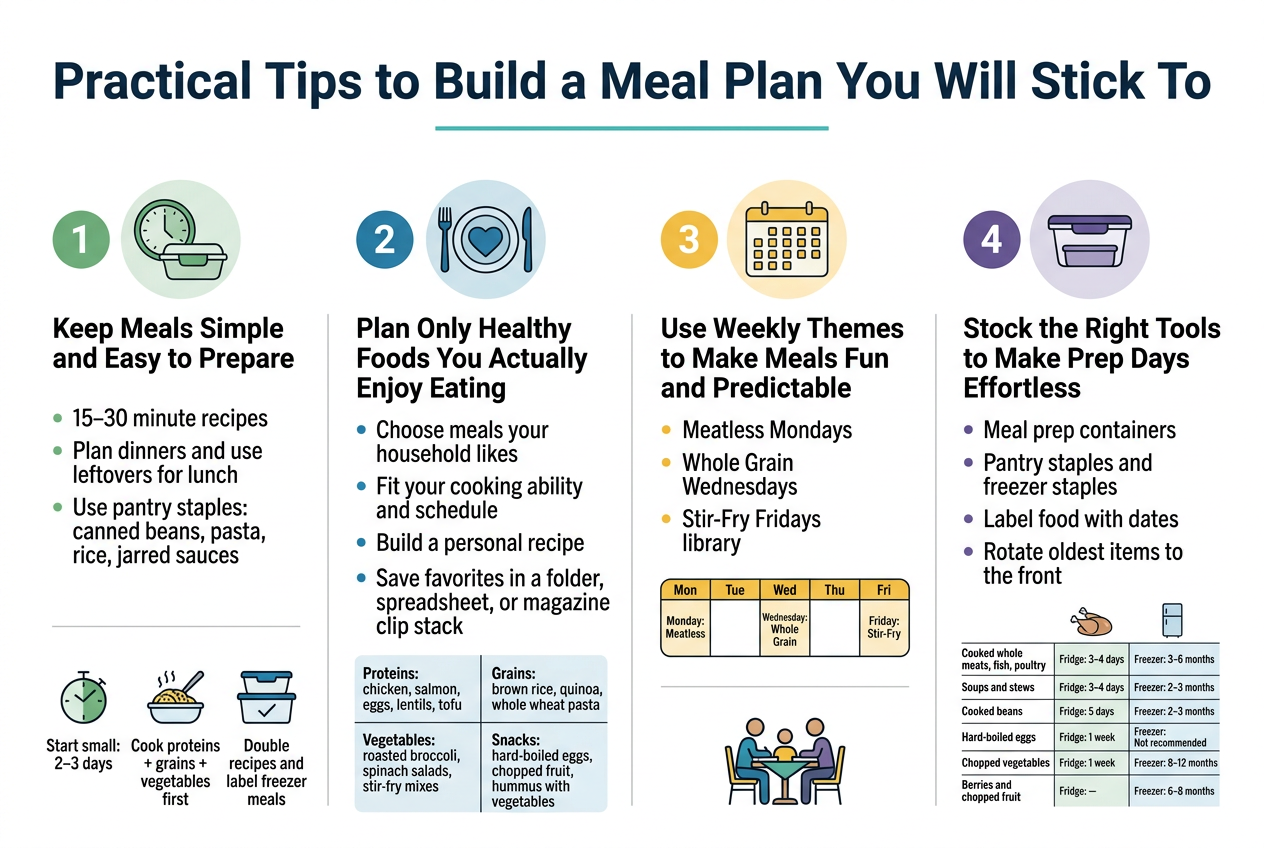
- Simple recipes — meals that come together in 15–30 minutes with minimal steps
- Simple structure — planning only dinners and relying on leftovers for lunch rather than scheduling every single meal
- Simple ingredients — leaning on pantry staples like canned beans, pasta, rice, and jarred sauces that you can stock up on when they go on sale
A helpful approach is to start small. Aim to plan and prep meals for just two to three days of the week before expanding to a full week. On your dedicated prep day, focus first on foods that take the longest to cook — proteins like chicken and fish, whole grains like brown rice or quinoa, and roasted vegetables. While those are in the oven, use that time to chop fresh vegetables, wash salad greens, or portion snacks into containers. This kind of multitasking turns a potentially overwhelming session into a streamlined routine.
Another time-saving strategy is to make extra portions whenever you cook. Doubling a recipe gives you meals for another day or two — or something to freeze for a future week. When you freeze items, always date and label them so nothing gets lost or wasted.
B. Plan Only Healthy Foods You Actually Enjoy Eating
A meal plan built around foods you genuinely like eating is one you will actually follow. Before you start mapping out a week of meals, take a moment to discuss with everyone in your household which foods and favorite meals they enjoy. This simple step dramatically increases the chances that meals get eaten rather than skipped in favor of takeout.
The goal is not to design a nutritionally perfect plan on paper — it is to build a realistic plan that fits your actual food preferences, cooking ability, and daily schedule. There is no single correct method for meal planning. What works beautifully for one household may feel completely impractical for another.
Here is a practical way to organize your preferences before planning:
| Category | Examples to Consider |
|---|---|
| Proteins you enjoy | Chicken, salmon, eggs, lentils, tofu |
| Grains you regularly eat | Brown rice, quinoa, whole wheat pasta |
| Vegetables you actually eat | Roasted broccoli, spinach salads, stir-fry mixes |
| Staple snacks | Hard-boiled eggs, chopped fruit, hummus with vegetables |
Once you have a clear picture of what your household genuinely likes, collecting recipes becomes easier. Clip recipes from magazines, save links to an online spreadsheet, or bookmark favorites in a dedicated folder. Over time, this becomes your personal recipe library — a resource you can return to each week without starting from scratch.
C. Use Weekly Themes to Make Meals Fun and Predictable
With your preferred foods identified, the next step is to bring consistency and a little fun to the week with themed meal nights. Assigning a loose theme to specific days of the week removes the mental load of deciding what to cook each night, which is one of the most draining parts of feeding a household.
Some families have enjoyed this approach for generations — remember “Prince Spaghetti Day” on Wednesdays? The concept still holds up because it works. Popular weekly themes include:
- Meatless Mondays — plant-based meals featuring beans, lentils, or tofu
- Whole Grain Wednesdays — dishes built around farro, brown rice, or whole wheat pasta
- Stir-Fry Fridays — quick wok meals using whatever vegetables need to be used up
Weekly themes provide a framework that makes planning faster and grocery shopping more predictable. Instead of staring at a blank weekly calendar each Sunday, you already know that Tuesday is pasta night and Thursday is fish night. You simply rotate the specific recipes within those themes to keep variety alive without adding decision fatigue.
This consistency also benefits households with children, who often respond well to predictable meal rhythms. When everyone knows what to expect on certain nights, there is less negotiation at the dinner table and less stress in the kitchen.
D. Stock the Right Tools to Make Prep Days Effortless
Previously, we covered what to plan and how to theme your meals. Now, making those plans a reality on prep day depends heavily on having the right tools and storage systems in place.
Start with individual meal prep containers. Dividing cooked food into portioned containers on prep day means that grabbing lunch the next morning takes seconds rather than minutes. This single habit can be the difference between eating a home-cooked meal and reaching for a less healthy convenience option.
Beyond containers, keeping the right shelf-stable ingredients stocked in your pantry is one of the most powerful tools available to a consistent meal planner. As your menus become more familiar, watch for sales and coupons to stock up on frequently used items:
- Whole grains: pasta, brown rice, quinoa, farro
- Legumes: canned or dried beans, lentils
- Flavor builders: jarred sauces, healthy oils, spices
- Freezer staples: blanched vegetables, frozen fruit, cooked and labeled batch proteins
Proper storage is equally important. Label all prepped items with the date they were made, and rotate stored items so the oldest foods are at the front of the refrigerator or freezer. Store highly perishable items like greens, herbs, and chopped fruit at eye level so they are seen and used before they spoil.
Here is a quick reference for how long common prepped foods stay fresh and safe:
| Food | Refrigerator (40°F or lower) | Freezer (0°F or lower) |
|---|---|---|
| Cooked ground poultry or beef | 1–2 days | 3–6 months |
| Cooked whole meats, fish, poultry | 3–4 days | 3–6 months |
| Soups and stews | 3–4 days | 2–3 months |
| Cooked beans | 5 days | 2–3 months |
| Hard-boiled eggs | 1 week | Not recommended |
| Chopped vegetables (airtight) | 1 week | 8–12 months (blanched first) |
| Berries and chopped fruit | — | 6–8 months |
With this in mind, treating your prep day as a dedicated, organized session — rather than a chaotic scramble — transforms it from a chore into a highly productive habit. Having a clear plan for which foods to cook first, the right containers to store them in, and a labeled system to track freshness means that the entire week flows more smoothly. The investment of a few hours on one day pays back in saved time, reduced stress, and far fewer last-minute decisions during the busy weekdays ahead.
Complete 7-Day Sample Meal Plan for a Balanced Diet
Day 1: Grilled Chicken, Halibut, and Fresh Produce
Kicking off the week with a strong nutritional foundation sets the tone for the days ahead. On Day 1, the focus is on lean protein, fiber-rich produce, and heart-healthy fats spread across every meal and snack.
- Breakfast: A Banana-Peanut Butter Yogurt Parfait (~301 calories) delivers a satisfying combination of protein and natural sugars to fuel your morning.
- Morning Snack: A Cottage Cheese-Berry Bowl (~170 calories) keeps energy levels steady between meals.
- Lunch: A Tomato, Cucumber & White-Bean Salad with Basil Vinaigrette paired with 3 oz. of cooked chicken breast and a medium orange (~430 calories) provides a fiber-forward midday meal.
- Afternoon Snack: Cranberry-Almond Energy Balls (~170 calories) offer a balanced mix of healthy fats and slow-releasing carbohydrates.
- Dinner: Sheet-Pan Teriyaki Salmon with Green Beans (~441 calories) rounds out the day with omega-3-rich fish and nutrient-dense vegetables.
- Evening Snack: A medium apple with 2 tablespoons of natural peanut butter (~305 calories) closes the day with fiber and healthy fat.
Daily Totals: ~1,817 calories, 106g protein, 33g fiber, 1,190mg sodium.
Day 2: Turkey Sandwich, Sirloin Steak, and Whole Grains
With Day 1 behind you, Day 2 introduces variety in both flavor and nutrient profile while maintaining a heart-healthy approach.
- Breakfast: Apple-Pomegranate Overnight Oats (~346 calories) — prepped in advance — make for a no-fuss, antioxidant-packed morning meal.
- Morning Snack: A Cottage Cheese-Berry Bowl (~170 calories) provides an easy hit of protein.
- Lunch: Turkey Chili with a large pear (~510 calories) is rich in fiber, protein, and complex carbohydrates.
- Afternoon Snack: Cranberry-Almond Energy Balls (~170 calories) continue to be a go-to snack for sustained energy.
- Dinner: Homemade Chicken Tenders with Everything Bagel Seasoning over Salad (~394 calories) delivers a satisfying, protein-dense evening meal.
- Evening Snack: ¼ cup of dry-roasted unsalted almonds (~206 calories) provides heart-healthy monounsaturated fats.
Daily Totals: ~1,796 calories, 97g protein, 33g fiber, 1,192mg sodium.
Tip: If you are targeting 1,500 calories, swap the pear for a medium orange at lunch and skip the evening snack.
Day 3: Overnight Oats, Turkey Burger, and Veggie Snacks
Now that we have covered the first two days, Day 3 keeps prep effort minimal by leaning on leftovers and pre-made items from earlier in the week.
- Breakfast: Apple-Pomegranate Overnight Oats (~346 calories) — the same prep batch from Day 2 carries through seamlessly.
- Morning Snack: A Cottage Cheese-Berry Bowl (~170 calories) again offers a quick, protein-rich snack.
- Lunch: Turkey Chili with a large pear (~510 calories) — leftover chili from the batch prep makes lunch effortless.
- Afternoon Snack: Cranberry-Almond Energy Balls (~170 calories).
- Dinner: Peanut-Ginger Tofu Scramble with ½ cup cooked brown rice (~398 calories) introduces a plant-based protein option for dinner variety.
- Evening Snack: A medium apple with 1 tablespoon of natural peanut butter (~200 calories).
Daily Totals: ~1,794 calories, 84g protein, 41g fiber, 1,299mg sodium.
| Meal | Key Nutrients Delivered |
|---|---|
| Overnight Oats | Fiber, complex carbs |
| Turkey Chili | Protein, legume fiber |
| Tofu Scramble + Brown Rice | Plant protein, whole grains |
| Apple + Peanut Butter | Fiber, healthy fats |
Day 4: Tuna Wrap, Whole Wheat Pasta, and Cottage Cheese
The midweek push on Day 4 is all about sustaining momentum with easy-to-assemble meals that are still nutritionally complete.
- Breakfast: Apple-Pomegranate Overnight Oats (~346 calories) — another serving from the pre-made batch.
- Morning Snack: A medium apple with 2 tablespoons of natural peanut butter (~305 calories) offers a more substantial mid-morning option.
- Lunch: Turkey Chili with a large pear (~510 calories) keeps the batch-cooking strategy working hard.
- Afternoon Snack: Cranberry-Almond Energy Balls (~170 calories).
- Dinner: 5-Ingredient Roasted Lemon Chicken & Vegetables with ½ cup of whole-wheat orzo (~447 calories) provides lean protein alongside fiber-rich whole grains and colorful vegetables.
Daily Totals: ~1,777 calories, 85g protein, 40g fiber, 1,476mg sodium.
Tip: To bring this day to 1,500 calories, simply swap the morning snack for a single plum.
Day 5: Veggie Burger, Trout Filet, and Brown Rice
Previously, the meal plan has leaned heavily on batch-cooked Turkey Chili and Overnight Oats. Day 5 wraps up those staples and introduces a new dinner that also sets up lunches for Days 6 and 7.
- Breakfast: Apple-Pomegranate Overnight Oats (~346 calories) — the final serving from the week’s batch.
- Morning Snack: A Cottage Cheese Snack Jar with Fruit (~215 calories).
- Lunch: Turkey Chili with a large pear (~510 calories) — the last portion of the batch-cooked chili.
- Afternoon Snack: Cranberry-Almond Energy Balls (~170 calories).
- Dinner: One-Pot White Bean, Spinach & Sun-Dried Tomato Orzo with Lemon & Feta (~496 calories) is a fiber-rich, plant-forward dinner that also yields leftovers for the next two days.
- Evening Snack: A medium orange (~62 calories).
Daily Totals: ~1,798 calories, 81g protein, 43g fiber, 1,224mg sodium.
Meal Prep Tip: Reserve 2 servings of the One-Pot White Bean Orzo to have for lunch on Days 6 and 7 — this single step saves significant time mid-week.
Day 6: Greek Yogurt Breakfast, Pork Loin, and Turkey Wrap
With this in mind, Day 6 shifts back to the yogurt-based breakfast and introduces a seafood-forward dinner that feels like a weekend treat without straying from the plan’s nutritional parameters.
- Breakfast: A Banana-Peanut Butter Yogurt Parfait (~301 calories) returns after a multi-day run of overnight oats, adding variety.
- Morning Snack: ¼ cup of dry-roasted unsalted almonds (~206 calories) provides a satisfying crunch alongside heart-healthy fats.
- Lunch: One-Pot White Bean, Spinach & Sun-Dried Tomato Orzo with Lemon & Feta (~496 calories) — the pre-reserved serving makes this completely hands-off.
- Afternoon Snack: A Cottage Cheese Snack Jar with Fruit (~215 calories).
- Dinner: Creamy Pesto Shrimp with Gnocchi & Peas (~398 calories) is a flavorful, satisfying meal with lean seafood protein.
- Evening Snack: Cranberry-Almond Energy Balls (~170 calories).
Daily Totals: ~1,786 calories, 78g protein, 29g fiber, 1,110mg sodium.
Day 7: Oatmeal, Baked Chicken, and Grilled Salmon
Wrapping up the week, Day 7 brings together familiar favorites with a dinner that feels both celebratory and nutritionally complete — a fitting end to seven days of intentional eating.
- Breakfast: A Banana-Peanut Butter Yogurt Parfait (~301 calories) keeps the morning routine simple and satisfying.
- Morning Snack: A Cottage Cheese Snack Jar with Fruit (~215 calories).
- Lunch: One-Pot White Bean, Spinach & Sun-Dried Tomato Orzo with Lemon & Feta (~496 calories) — the final pre-reserved portion closes out the lunch rotation.
- Afternoon Snack: Cranberry-Almond Energy Balls (~170 calories).
- Dinner: Grilled Chicken Breasts with Tomato-Caper Sauce, Carolina Gelen’s Shaved Cauliflower Salad with Lemon Vinaigrette & Parmesan, and ½ cup cooked quinoa (~459 calories) rounds out the week with lean protein, complex carbohydrates, and a generous helping of vegetables.
- Evening Snack: ¼ cup of dry-roasted unsalted shelled pistachios (~176 calories).
Daily Totals: ~1,816 calories, 89g protein, 33g fiber, 1,132mg sodium.
Full Week at a Glance
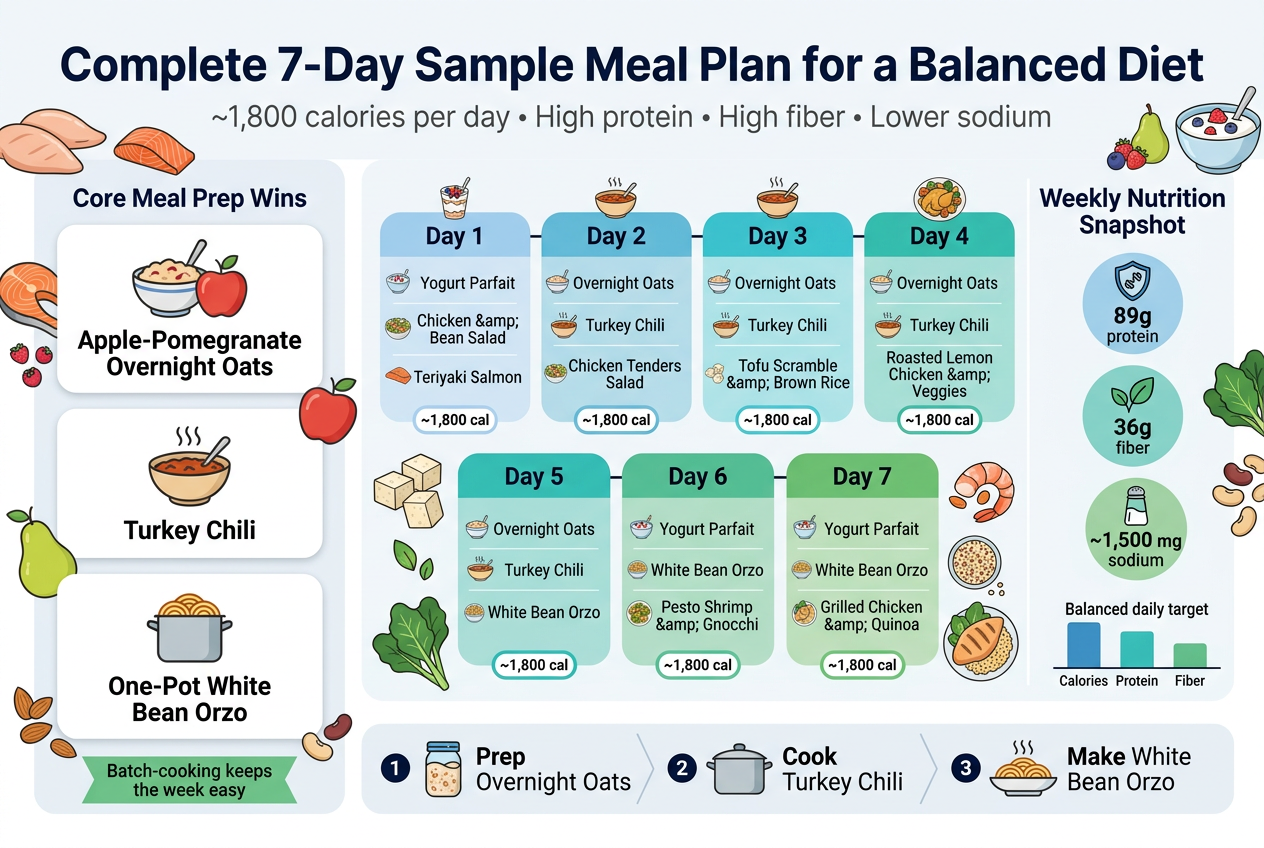
| Day | Breakfast | Lunch | Dinner |
|---|---|---|---|
| Day 1 | Yogurt Parfait | Chicken & Bean Salad | Teriyaki Salmon |
| Day 2 | Overnight Oats | Turkey Chili | Chicken Tenders Salad |
| Day 3 | Overnight Oats | Turkey Chili | Tofu Scramble & Brown Rice |
| Day 4 | Overnight Oats | Turkey Chili | Roasted Lemon Chicken & Veggies |
| Day 5 | Overnight Oats | Turkey Chili | White Bean Orzo |
| Day 6 | Yogurt Parfait | White Bean Orzo | Pesto Shrimp & Gnocchi |
| Day 7 | Yogurt Parfait | White Bean Orzo | Grilled Chicken & Quinoa |
This 7-day plan is structured around three core batch-cooking wins — Apple-Pomegranate Overnight Oats (Days 2–5), Turkey Chili (Days 2–5), and One-Pot White Bean Orzo (Days 5–7) — meaning you are never starting entirely from scratch each day. The plan targets approximately 1,800 calories per day, averaging 89 grams of protein and 36 grams of fiber daily, with sodium capped at around 1,500 milligrams to support healthy blood pressure and cholesterol levels.
Smart Strategies for Each Meal of the Day
Start the Day with a Protein and Fiber-Rich Breakfast
Now that we have covered the full 7-day sample meal plan, it is time to zoom in on the strategies that make each meal of the day work harder for your health goals. Breakfast sets the metabolic tone for everything that follows, and the single most effective upgrade you can make is pairing protein with fiber at your first meal.
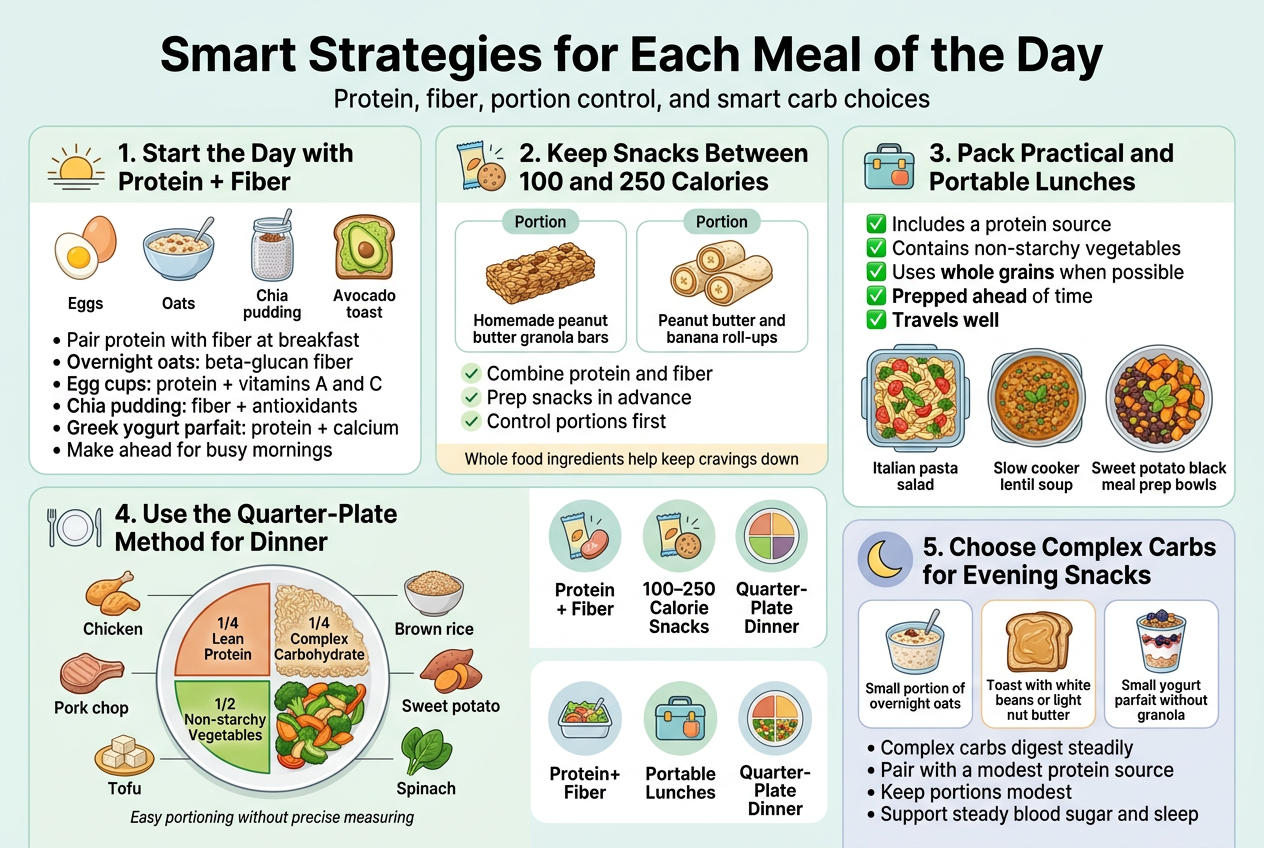
Eggs are one of the most reliable sources of protein you can build breakfast around. Bell pepper egg cups, for example, deliver protein from eggs alongside vitamins A and C from the peppers, all in a single baking dish. If you prefer a no-cook option, overnight oats offer beta-glucan fiber, which has been linked to lower cholesterol levels and a reduced risk of heart disease. For variety, chocolate cherry chia pudding is another fiber-forward breakfast you can assemble the night before, since chia seeds are loaded with antioxidant compounds that help fight cell-damaging free radicals.
Loaded avocado toast built on 100% whole grain or sourdough bread covers both bases neatly — healthy fats from avocado and protein from eggs or white beans. Greek yogurt parfaits layered with fresh fruit, nuts, and granola provide calcium for bone health alongside protein and fiber, and they can be prepped in individual jars ahead of time for a hassle-free morning.
The table below summarizes high-protein, high-fiber breakfast options and their standout nutritional benefits:
| Breakfast Option | Key Protein Source | Key Fiber Source | Notable Nutrient Benefit |
|---|---|---|---|
| Overnight oats | Milk or yogurt | Oats (beta-glucan) | May lower cholesterol |
| Bell pepper egg cups | Eggs | Bell peppers | Vitamins A and C for immunity |
| Chia pudding | Chia seeds | Chia seeds | Antioxidant compounds |
| Avocado toast with egg | Egg or white beans | Whole grain bread | Healthy fats and sustained energy |
| Greek yogurt parfait | Greek yogurt | Granola, fruit | Calcium for bone health |
| Broccoli and cheese egg bake | Eggs | Broccoli | Make-ahead for the whole week |
A practical tip: preparing items like the broccoli and cheese egg bake or individual parfait jars on the weekend means that even on the busiest mornings, a nutrient-dense breakfast is ready in seconds.
Keep Snacks Between 100 and 250 Calories
With breakfast covered, smart snacking becomes the next lever to control energy levels and prevent overeating at main meals. Keeping snacks within the 100-to-250-calorie range helps you bridge the gap between meals without undermining your daily targets.
Homemade peanut butter granola bars are an excellent snack option that fits this window when portioned correctly. Unlike store-bought bars that are often loaded with added sugar, homemade versions let you control exactly what goes in. Research also suggests that compounds in peanuts can block the absorption of dietary cholesterol, which is a meaningful bonus for cardiovascular health.
Peanut butter and banana roll-ups sliced into bite-sized pieces offer another portable, portion-friendly snack. Bananas are one of the richest dietary sources of potassium, a mineral that supports healthy blood pressure. Using a measured 2 tablespoons of peanut butter keeps the calorie count in check while still delivering protein and healthy fat to tide you over.
Key principles for snacks in the 100–250 calorie range:
- Combine protein and fiber so the snack actually satisfies hunger rather than triggering more cravings
- Prepare snacks in advance so convenience does not push you toward high-sugar packaged options
- Control portions at the start rather than eating from a large bag or container
- Choose whole food ingredients that also contribute vitamins, minerals, or beneficial plant compounds
Pack Practical and Portable Lunches
Previously, the meal plan section outlined full lunch ideas for each day of the week. Here, the focus is on the practical architecture that makes lunch portable, satisfying, and easy to prepare in advance.
Italian pasta salad exemplifies everything a portable lunch should be. It is served cold, holds up well in a lunch box, and can be built around 100% whole wheat pasta for extra fiber and diced chicken, mozzarella, or white beans for protein. The olive oil in the dressing contributes heart-healthy monounsaturated fats that make the meal more nutritionally complete.
Slow cooker lentil soup is another lunch workhorse. Make a batch on the weekend, portion it into containers, and you have hot lunches ready for the entire week. Lentils deliver plant-based protein and fiber, both of which contribute to lasting fullness and help stabilize blood sugar levels between meals.
For lunches that assemble quickly, sweet potato black bean meal prep bowls follow a simple formula: cook the components separately, store them in individual containers, and combine them at lunchtime. The healthy fats from avocado in these bowls also enhance the absorption of fat-soluble nutrients like the vitamin A carotenoids found in sweet potatoes.
Portable lunch checklist:
- ✅ Includes a protein source (chicken, tuna, beans, lentils, eggs, cheese)
- ✅ Contains at least one non-starchy vegetable
- ✅ Uses a whole grain carbohydrate where possible
- ✅ Can be prepped at least partially in advance
- ✅ Travels well without requiring reheating (or reheats quickly and safely)
Healthy tuna salad with cranberries checks multiple boxes — canned tuna is affordable, rich in protein and healthy fats, and requires almost no cooking. Veggie quesadillas with beans added for protein are equally portable and kid-friendly.
Use the Quarter-Plate Method for Easy Dinner Portioning
With this in mind, next, we look at dinner — the meal where portion sizes most commonly go off track. The quarter-plate method is a straightforward visual tool: fill one quarter of the plate with protein, one quarter with a complex carbohydrate, and the remaining half with non-starchy vegetables.
Sheet pan pork chops with sweet potatoes naturally map onto this structure. Pork provides protein along with selenium, an essential mineral for thyroid function and healthy reproduction. Sweet potatoes contribute energizing complex carbohydrates alongside vitamins and minerals, while adding a green vegetable on the side completes the half-plate of vegetables.
Stir-fries follow the same proportional logic almost automatically. A balanced stir-fry combines diced chicken, sliced sirloin, shrimp, or tofu as the protein; two to three cups of non-starchy vegetables; and brown rice or whole wheat noodles as the carbohydrate. The dish is genuinely difficult to overload with any single macronutrient when the cooking process is followed as described.
For plant-based dinners, easy chickpea curry served over a modest portion of rice demonstrates the quarter-plate method well. Chickpeas provide both protein and fiber and have been associated with beneficial effects on blood sugar levels. Lentil bolognese over pasta with a side salad or steamed green beans is another option where the plate naturally divides itself into appropriate proportions.
| Plate Section | What Goes Here | Example Foods |
|---|---|---|
| First quarter | Lean protein | Chicken, pork, salmon, tofu, chickpeas, lentils |
| Second quarter | Complex carbohydrate | Brown rice, sweet potato, whole wheat pasta, pita |
| Half the plate | Non-starchy vegetables | Broccoli, spinach, zucchini, tomatoes, green beans |
Caprese chicken breasts on a bed of pasta and salmon burgers served over cabbage slaw both demonstrate how a well-structured dinner naturally lands in the right proportions without requiring precise measuring.
Choose Complex Carbs for Evening Snacks to Support Sleep
The final meal strategy of the day addresses evening snacks, where the goal shifts slightly from fueling activity to supporting recovery and sleep. Choosing complex carbohydrates in the evening rather than simple sugars or heavily processed foods helps sustain steady blood sugar levels as you wind down.
Brown rice, whole grain bread, oats, and sweet potatoes are all examples of complex carbohydrates drawn from the meal ideas throughout this post. A small portion of one of these foods paired with a modest protein source in the evening avoids the blood sugar spike and crash associated with refined carbohydrates.
Consider these evening snack approaches based on ingredients already featured:
- A small portion of overnight oats prepared ahead of time — oats provide beta-glucan fiber and complex carbohydrates that digest steadily
- A slice of whole grain or sourdough toast with a light topping — the bread delivers complex carbs while toppings like white beans or a small amount of nut butter add protein
- A small yogurt parfait without granola — Greek yogurt contributes protein and calcium, with fruit adding natural sweetness and fiber without a sugar spike
The key distinction between an evening snack that supports sleep and one that disrupts it comes down to carbohydrate quality and portion size. Complex carbohydrates provide energy that is released gradually, whereas refined sugars create rapid fluctuations that can interfere with rest.
Keeping evening snacks modest in size — consistent with the 100-to-250-calorie guidance from the snacking section — also prevents the calorie surplus that accumulates when late-night eating becomes a habit. Planning these snacks in advance, just as you would any other meal, removes the decision-making that often leads to reaching for convenient but low-quality options.
Tools and Services That Make Meal Planning Easier
A. Essential Kitchen Tools for Efficient Meal Prep
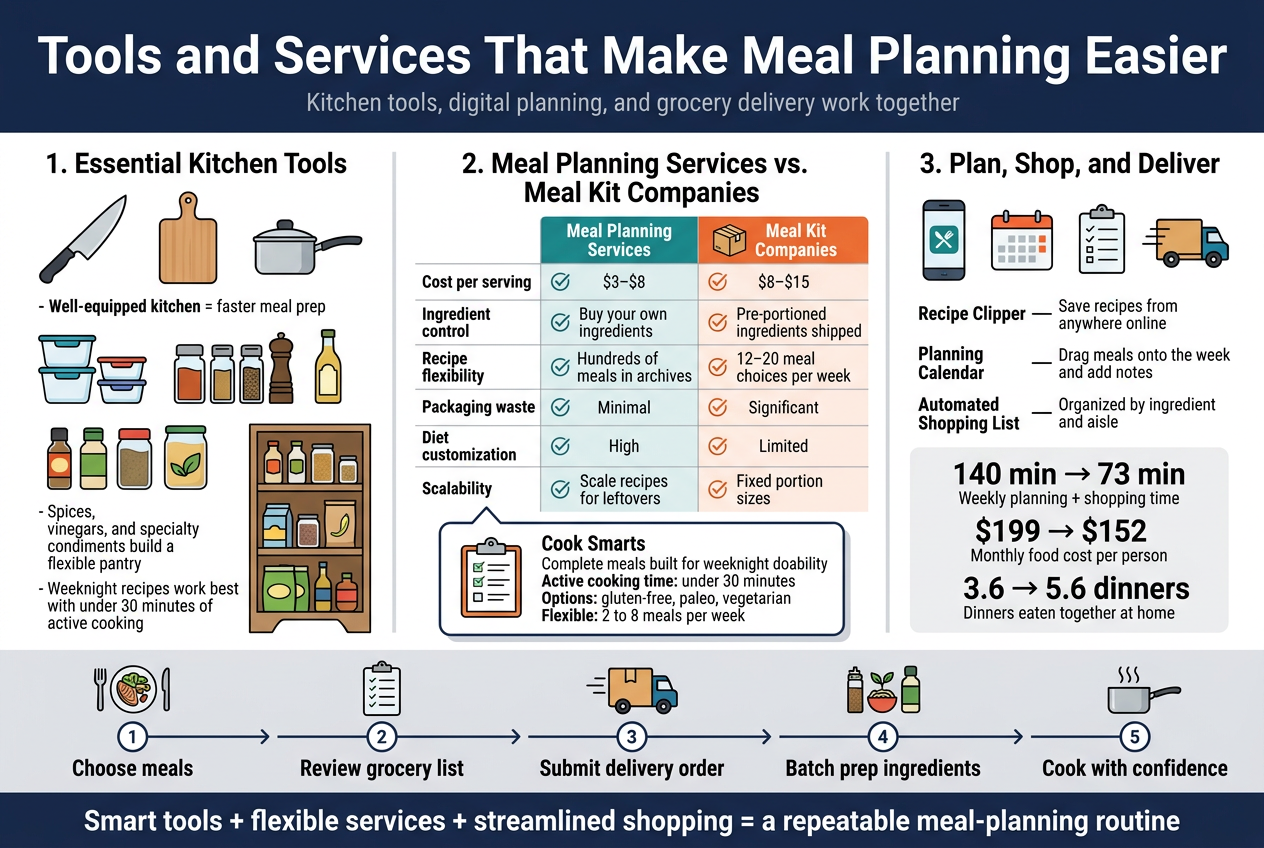
Having the right kitchen tools in place is the foundation of any successful meal planning routine. When your workspace is organized and well-equipped, the physical act of cooking becomes less of a chore and more of a streamlined process you can actually look forward to.
A few key items that consistently make meal prep faster and more efficient include:
- A reliable set of sharp knives – Chopping vegetables, proteins, and herbs becomes significantly quicker with proper knives, cutting down your active prep time considerably.
- Meal prep containers – Airtight, stackable containers allow you to batch cook and store individual portions safely, keeping your refrigerator organized throughout the week.
- A large cutting board – More surface area means fewer interruptions when prepping multiple ingredients at once.
- A slow cooker or Instant Pot – These appliances let you set meals and walk away, making hands-off cooking a reality even on the busiest weeknights.
- Sheet pans and a Dutch oven – Ideal for roasting large batches of vegetables or proteins with minimal cleanup.
- A digital food scale – Particularly useful when following specific nutritional goals, helping you portion accurately without guesswork.
Services like Cook Smarts are specifically designed with weeknight doability in mind, targeting active hands-on cook times of under 30 minutes per meal. Pairing that kind of thoughtful recipe design with a well-stocked kitchen makes hitting that target far more realistic.
One thing worth noting: you don’t need to overhaul your entire kitchen overnight. Most people who start meal planning find that the main pantry additions are spices, vinegars, and a few specialty condiments — all of which are easily sourced online. Start with what you have, and build from there.
B. Use Meal Delivery Services to Save Time and Stay on Track
Now that we’ve covered the physical setup of your kitchen, let’s look at the digital and service-based tools that can dramatically reduce the mental load of meal planning.
Meal planning services have evolved well beyond simple recipe blogs. Today’s platforms offer curated weekly menus, dietary customization, automated shopping lists, and recipe archives that number in the thousands. The result is a system that thinks ahead so you don’t have to.
Cook Smarts: A Flexible Meal Plan Membership
Cook Smarts is a meal plan membership service built around flexibility and real-life cooking constraints. Here’s what sets it apart:
| Feature | Details |
|---|---|
| Diet options | Gluten-free, paleo, and vegetarian alternatives for every meal |
| Hands-on cook time | Under 30 minutes for most meals |
| Recipe archive | Available from 2013 onward — thousands of meals to choose from |
| Customization | Swap ingredients to accommodate allergies, preferences, or budgets |
| Meal frequency | Make as few as 2 meals or as many as 8 per week — entirely your choice |
| Cost per serving | Approximately $3 to $8, compared to $8 to $15 at meal kit companies |
| App availability | Native iOS app; Android-compatible via mobile shortcut |
| Community support | Active Facebook Group for member questions and tips |
Unlike traditional meal kit companies that ship pre-portioned ingredients, Cook Smarts puts you in control of what you buy. You choose the ingredients, which means you can scale recipes up for leftovers, substitute based on what’s in season or on sale, and avoid unnecessary packaging waste. Members on specialized diets — including FODMAP, keto, and more — report successfully adapting the recipes with minor tweaks.
For families with picky eaters, Cook Smarts encourages a deconstructed approach to serving meals, giving children control over what they eat while still exposing them to a wide variety of flavors without requiring the adult to cook an entirely separate meal.
The service also stands out for its ingredient efficiency — even recipes with longer ingredient lists tend to be spice-heavy rather than requiring many unique produce items, and menus are designed so ingredients overlap between meals to minimize waste and shopping complexity.
Plan to Eat: Your Digital Recipe and Meal Planning Hub
Plan to Eat takes a different but equally powerful approach. Rather than providing you with pre-built menus, it gives you the infrastructure to build and manage your own meal planning system using recipes you already love.
Key features include:
- Recipe Clipper – Save recipes from anywhere online directly into your personal digital recipe book in a single click, so you never lose a recipe again.
- Planning Calendar – Drag and drop meals onto a visual calendar, plan as far ahead as you like, save reusable meal plans, and add notes for other weekly obligations.
- Automated Shopping List – The standout feature: once you add recipes to your calendar, the app automatically generates an organized, aisle-by-aisle shopping list. You can add household staples and other items to the same list for a fully consolidated grocery run.
The numbers behind Plan to Eat’s impact speak for themselves. Based on a survey of 2,568 users:
| Metric | Before Plan to Eat | After Plan to Eat |
|---|---|---|
| Time spent planning & shopping | 140 minutes/week | 73 minutes/week |
| Monthly food cost per person | $199 | $152 |
| Dinners eaten at home per week | 3.6 | 5.6 |
Beyond time and cost savings, users also reported eating healthier foods more consistently and experiencing less anxiety around what to cook each day. The platform is available on all devices under a single account, and pricing sits at $5.95 per month or $49 per year — with a free 14-day trial that requires no payment information upfront.
C. Consider Grocery Delivery for Faster Shopping
With this in mind, next we’ll see how pairing your meal planning tools with grocery delivery can close the loop on your entire weekly food system.
Once you have a meal plan in place and a finalized shopping list — whether built manually or auto-generated by a tool like Plan to Eat — grocery delivery removes one of the most time-consuming steps from the equation entirely. Instead of navigating store aisles, you can submit your list online and have everything arrive at your door or ready for curbside pickup.
This approach pairs exceptionally well with digital meal planning tools. Plan to Eat, for example, is specifically noted by users for integrating smoothly into online grocery ordering workflows. One user described building their entire weekly grocery order directly from the app’s shopping list in under 30 minutes on the weekend — a task that previously took far longer.
Here are the primary benefits of incorporating grocery delivery into your meal planning routine:
- Time savings – Eliminate the commute, in-store browsing, and checkout lines entirely.
- Reduced impulse purchases – Shopping from a structured list online naturally limits off-plan buying, which supports both your budget and your nutrition goals.
- Consistency – When grocery shopping feels effortless, you’re far more likely to stick to your meal plan week after week rather than defaulting to takeout.
- Flexibility – Most grocery delivery services allow you to schedule pickups or drop-offs around your schedule, so you never have to compromise on fresh ingredients because you didn’t have time to shop.
When your meal planning service generates a shopping list, your grocery delivery platform fulfills it — and your week is essentially set before it begins. That kind of seamless coordination between planning tools and shopping logistics is what separates a meal plan that looks good on paper from one you actually follow through on every single week.
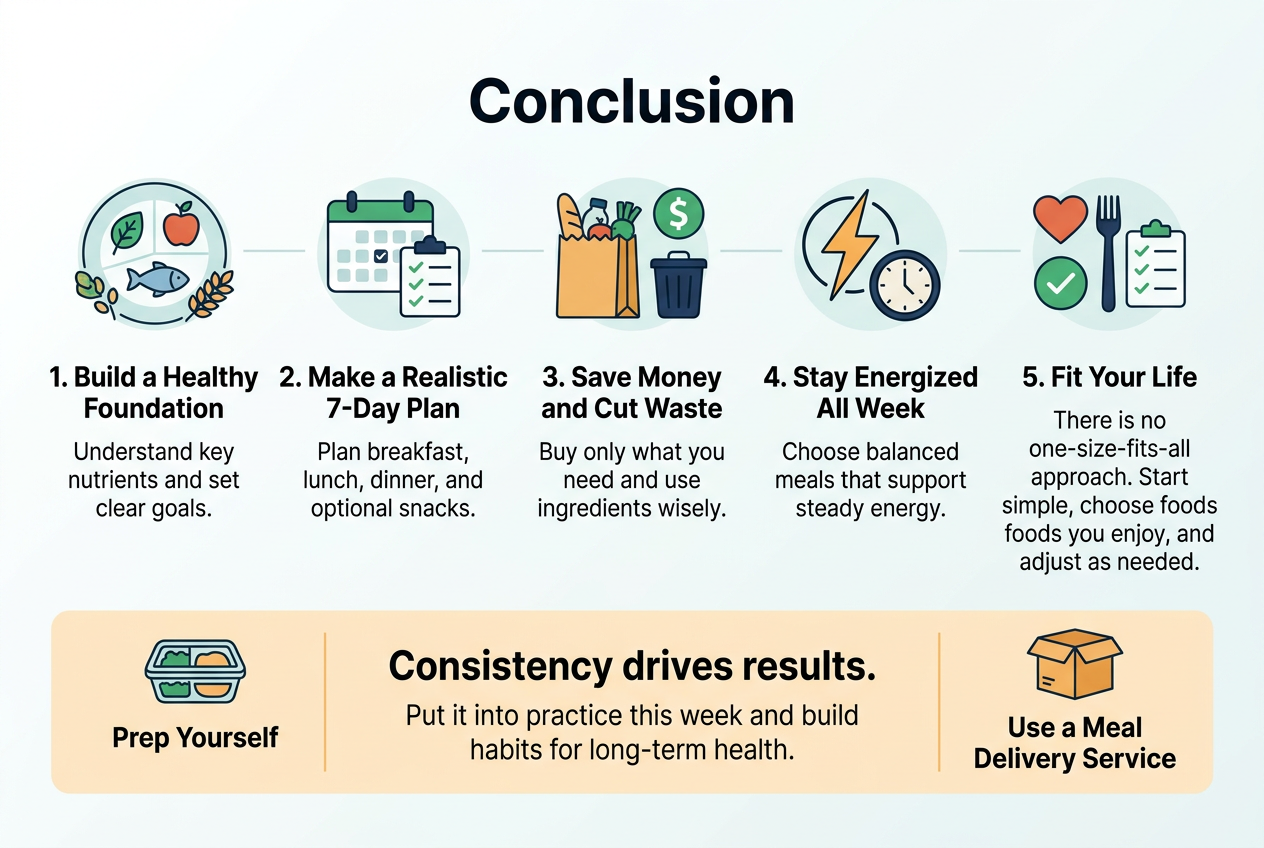
Meal planning is one of the most practical steps you can take toward a healthier lifestyle. From understanding key nutrients and setting clear goals to building a realistic 7-day plan and using the right tools, every piece of the process works together to help you eat better, save money, reduce food waste, and stay energized throughout the week. The strategies covered in this guide — from smart breakfast choices to balanced dinners and optional snacks — give you a solid framework to build on, no matter what your health goals are.
The most important thing to remember is that there is no one-size-fits-all approach. A good meal plan is one that fits your tastes, schedule, and nutritional needs. Start simple, choose healthy foods you actually enjoy, and don’t be discouraged if you need to make adjustments along the way. Whether you prep meals yourself or use a meal delivery service to make things easier, consistency is what drives results. Take what you have learned here, put it into practice this week, and build habits that support your health for the long term.