
How Much Weight Can Your Floor Hold? A Home Gym Safety Guide

Building a home gym is exciting. You can work out anytime, save money, and stay healthy. But many people forget one important thing: floor weight limits. If you put heavy equipment or weights in your house, can your floor handle it? Ignoring this question can lead to problems, from sagging floors to safety risks. Let’s explore how much weight your floor can really hold, and how to keep your home gym safe.
Many people love the convenience of exercising at home. You save time because you don’t need to drive to the gym. You also get privacy, which can make workouts more comfortable. However, most homes are not designed for the heavy, concentrated loads that gym equipment creates.
It’s easy to focus on which squat rack or treadmill to buy and forget about what’s underneath—the floor that must hold all that weight, plus the impact from dropped weights or jumping exercises.
Some problems with floors are obvious, like big cracks or sagging. Others are hidden, such as slow bending or loosening joints inside the floor structure. Over time, even strong floors can become weaker, especially if heavy loads are placed in the same spot for months or years.
Many homeowners don’t notice issues until damage is already serious.
If you want your home gym to last—and stay safe for everyone in your house—it’s important to understand how much weight your floor can really support. Let’s break down what you need to know, step by step.
Why Floor Weight Matters For Home Gyms
Many people think their floors are strong enough for any gym equipment. But that’s not always true. Most homes are designed for regular use—not for heavy weights or machines. Putting too much weight in one spot can cause floors to bend, crack, or even collapse.
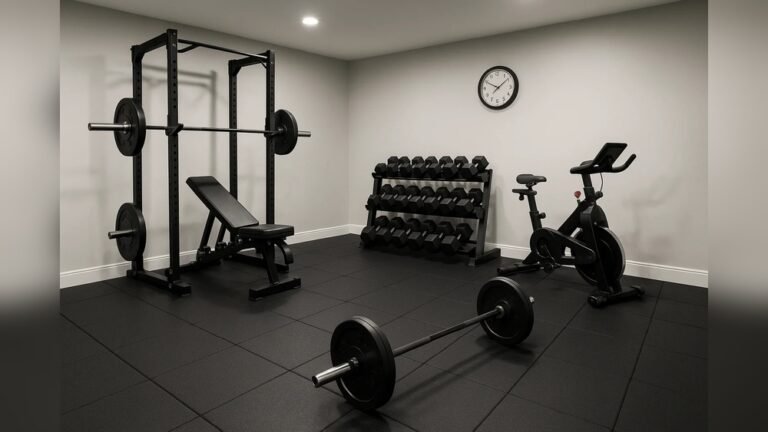
Home gym equipment like treadmills, ellipticals, racks, and free weights can be very heavy. For example, a loaded squat rack or weight bench may weigh hundreds of pounds. If you stack weights together, the load adds up fast. If you live in an apartment or older house, floors may be weaker than you expect.
Ignoring floor strength can lead to:
- Structural damage: Floors may sag or break. Even small cracks can grow larger over time, leading to permanent problems.
- Safety hazards: Injuries from falling equipment or sudden floor failure. If a floor gives way, it can lead to serious accidents.
- Costly repairs: Fixing damaged floors can be expensive. Repairs might require lifting carpets, replacing damaged wood, or even reinforcing the entire structure.
- Insurance issues: Some damage may not be covered. If your insurance policy excludes damage from “overloading,” you could pay out-of-pocket.
A strong floor is the foundation of a safe, effective gym. If the floor fails, your equipment and your safety are at risk. For example, a heavy treadmill or power rack placed near a weak floor spot might cause not only floor damage but also equipment to tip or fall, raising the risk of injury.
Non-obvious insight: Even if your floor seems fine at first, repeated stress—like dropping weights or moving equipment—can slowly weaken it. Small shifts and flexing can loosen nails and joints, making future problems more likely.
Understanding your floor’s limits before building your gym can save trouble later.
How Much Weight Can Residential Floors Hold?
Most home floors are built to handle everyday loads. Builders follow codes to make sure floors are safe, but these codes don’t account for heavy gym equipment. Here’s what you need to know.
Typical Floor Load Ratings
In the US, the standard for residential floors is:
- Live load: 40 pounds per square foot (psf)
- Dead load: 10-15 psf (weight of the floor itself)
Total: 50-55 Psf
Live load is weight from people, furniture, and movable objects. Dead load is the permanent weight of the floor, walls, and ceiling.
These numbers are not just random values. Building codes are made to keep you safe under normal living conditions—think beds, couches, a few people walking around—not for the specialized, heavy loads that gym equipment brings. In some regions, codes might be stricter, but the typical numbers remain close to these values.
What Does This Mean?
If your room is 10 feet by 10 feet (100 square feet):
- Maximum live load = 100 sq ft x 40 psf = 4,000 pounds
But this doesn’t mean you can put 4,000 pounds in one spot! The weight must be spread out. Concentrating too much weight in a small area is risky.
For example, if you stack several 45-pound weight plates in a small corner, the load is much higher per square foot than if you spread them out. That’s why location and distribution matter just as much as total weight.
Floor Load Table Example
Here’s a quick comparison of floor load limits for different room sizes:
| Room Size (ft) | Area (sq ft) | Max Live Load (lbs) |
|---|---|---|
| 10 x 10 | 100 | 4,000 |
| 12 x 12 | 144 | 5,760 |
| 15 x 15 | 225 | 9,000 |
Remember: These numbers are for evenly spread weight. Placing a 400-pound treadmill in the middle of a small room is different from spreading 400 pounds of furniture across the whole floor.
Non-obvious Insight
Most beginners don’t realize that floor strength decreases with age. Older homes may have weaker wood, loose nails, or damaged joists. If your house is more than 30 years old, check for signs of wear before adding heavy loads.
Also, environmental factors like water damage, termites, or previous renovations can weaken floors without you noticing. A floor that has been exposed to leaks or humidity may have hidden rot or mold, which reduces its strength dramatically. If you are not the first owner of your home, consider getting an inspection before adding a home gym.
Common Home Gym Equipment Weights
Knowing the weight of your equipment is key. Let’s look at typical home gym items.
Equipment Weight Chart
| Equipment | Approx. Weight (lbs) |
|---|---|
| Treadmill | 200–300 |
| Elliptical | 150–250 |
| Power rack | 200–400 |
| Weight bench | 40–70 |
| Set of dumbbells | 100–500 |
| Barbell & plates | 100–500+ |
| Smith machine | 400–800 |
A full gym setup can easily weigh 1,000–2,000 pounds. If all this weight is in a small area, your floor may struggle.
Real-life Example
If you have a power rack (300 lbs), a barbell with plates (250 lbs), and a bench (50 lbs), plus you (180 lbs), the total is 780 lbs. If all this sits on a 4-foot by 4-foot mat (16 sq ft):
- 780 lbs ÷ 16 sq ft = 48.75 lbs/sq ft
This is right at the typical floor limit. Dropping weights or moving equipment can add even more force.
Consider another example: You have a set of dumbbells on a vertical rack, and all the dumbbells together weigh 400 lbs. If the base of the rack is only 2 feet by 2 feet (4 sq ft):
- 400 lbs ÷ 4 sq ft = 100 lbs/sq ft
This is *double* what a normal wood floor is designed to handle—just from one rack. That’s why how you arrange and store your equipment is just as important as the equipment itself.
Non-obvious insight: Gym flooring mats do not add strength to the floor, but they help by spreading weight and absorbing shock. Many people think thick rubber mats make floors “stronger,” but they only help with distribution and protection from impact.
Types Of Floors And Their Strength
Floors are not all the same. Let’s look at different types.
Wood-framed Floors
Most homes use wood joists covered by plywood and carpet. These floors are strong but flexible. They can handle normal loads, but heavy weights may cause:
- Bending: Joists may flex and floors may feel “soft.” Too much bending can loosen nails and cause floorboards to squeak.
- Sagging: Over time, the floor may dip. This can lead to uneven surfaces and even visible cracks in the ceiling below.
- Noise: Creaks and groans from stress. These noises are not just annoying—they can signal growing structural problems.
If you’re putting heavy equipment, place it over joists, not in between. Joists are the main “beams” under the floor that carry most of the load. You can find joist locations by looking for rows of nails or using a stud finder.
Concrete Floors
Basements and some ground-floor rooms use concrete. Concrete is very strong, often handling 100+ psf. It’s ideal for home gyms. However, concrete can crack if overloaded or if there are hidden defects.
Concrete is not indestructible. Very heavy equipment or impact (like dropping a loaded barbell) can cause cracks, especially if the slab is thin or poorly supported underneath. To avoid this, always check slab thickness and condition before installing heavy gym equipment.
Tile And Laminate
These floors are decorative and sit on plywood or concrete. They don’t add strength. Heavy weights can crack tile or dent laminate.
Laminate and tile are especially at risk if you drop weights. Even if the subfloor is strong, the tile or laminate surface can crack, chip, or become uneven. If you want to keep these surfaces safe, always use thick mats and avoid dropping weights.
Floor Type Comparison Table
| Floor Type | Strength | Risks | Best For Gym? |
|---|---|---|---|
| Wood Joist | 40–50 psf | Sagging, flexing | Maybe, with caution |
| Concrete | 100+ psf | Cracking (rare) | Yes |
| Tile/Laminate | Depends on subfloor | Cracking, denting | No |
Non-obvious Insight
Some basements have thin concrete slabs (less than 4 inches). These can crack under heavy gym loads. Always check slab thickness before adding equipment.
If you live in a region with poor soil or previous water problems, even concrete floors can shift or crack over time. If you see old cracks in your basement, have them checked before adding a gym.
How To Check Your Floor’s Load Capacity
Don’t guess. There are safe ways to check your floor’s strength.
1. Find Your Floor Type
Is your gym on the first floor, second floor, or basement? Check what’s under the carpet or tile. Wood joists are common upstairs; concrete is common downstairs.
If you can access an unfinished space below (like a basement or crawlspace), look for the size and spacing of the wooden beams. For finished areas, sometimes you can find floor plans or ask the previous owner or builder.
2. Measure Joist Size And Spacing
For wood floors, measure the joists under your room. Typical joists are:
- 2×8 or 2×10 inches
- Spaced 16 inches apart
Older homes may have smaller or wider-spaced joists.
The bigger and closer together the joists, the more weight they can support. For example, 2×10 joists spaced 12 inches apart are much stronger than 2×8 joists spaced 24 inches apart.
3. Calculate Load Capacity
You can use online calculators or consult building codes. Here’s a simple formula:
- Joist span (feet)
- Joist size (inches)
- Spacing (inches)
Example: 2×10 Joists, 16-inch Spacing, 12-foot Span
- Capacity: About 50 psf
If your joist span is longer, or joists are smaller, the strength decreases. Shorter spans and larger joists increase strength.
4. Inspect For Damage
Look for cracks, sagging, or soft spots in the floor. These are signs of weakness.
Also, check for old water stains, which can mean past leaks and possible rot. If you feel bouncing when you walk or see cracks in the wall, your floor may already be overloaded.
5. Ask A Professional
If in doubt, hire a structural engineer or contractor. They can inspect and give you a real answer.
A professional can also suggest upgrades if needed. They might recommend adding support beams, sistering joists (attaching new boards to existing ones), or even reinforcing the foundation if you want a very heavy gym.
6. Check Local Codes
Building codes may vary. Some newer homes have stronger floors. Check your local rules for details.
Local codes may be more strict in areas with earthquake or snow risks, which could mean your floor is stronger than average. Still, always confirm before adding heavy equipment.
Non-obvious insight: Some home inspectors can offer a quick opinion, but only a licensed structural engineer can give you a precise answer with calculations.
Where To Place Your Home Gym
Choosing the right spot can make a big difference.
Basement Or Ground Floor
These are safest. Concrete floors can handle more weight. Basements also keep noise and vibration lower.
Basements are also cooler, which can make workouts more comfortable. However, always check for moisture problems, as dampness can damage equipment and weaken even concrete over time.
First Or Second Floor
Use caution. Spread out equipment and avoid placing all weights in one spot. Place heavy items near walls or over joists.
If you have to use an upper floor, pick a room with shorter joist spans and thicker flooring. Avoid rooms with large open spaces underneath, like living rooms or dining rooms, as these often have less support.
Garage
Garages often have concrete floors. They are strong, but check for cracks or slope.
Garages can be good home gym spaces, but they may not be as comfortable year-round due to temperature swings. Also, garage floors sometimes slope for drainage, which can affect equipment stability.
Room Placement Tips
- Avoid rooms above living spaces (noise travels). The sound of weights or machines can disturb others in the house.
- Pick rooms with easy access to exits (for safety).
- Make sure the floor is level and not sloped. Uneven floors can make equipment wobble or tip.
Also, consider the ceiling height. Some gym equipment (like racks or cable machines) need more headroom. If you plan to do overhead lifts, make sure you can do them safely without hitting lights or the ceiling.
Non-obvious insight: Rooms with load-bearing walls underneath are the safest. These walls help carry the weight down to the foundation.

Credit: www.amazon.com
How To Spread Weight Safely
Even strong floors can fail if overloaded in one spot. Here’s how to spread weight:
1. Use Mats And Platforms
Thick rubber mats or wooden platforms help distribute weight. This is especially important for dropped weights.
Commercial gym mats are usually 3/4 inch thick or more. For heavy lifts, consider building a wooden lifting platform with rubber on top. These platforms can be 4×8 feet or larger, spreading the load and absorbing shock.
2. Move Equipment Apart
Don’t stack all weights or machines together. Leave space between items.
Try to leave at least 2-3 feet between large equipment. This not only spreads weight but also makes your gym safer and more comfortable to use.
3. Store Weights Low
Keep dumbbells and plates on low racks, not high shelves. This reduces risk if they fall.
Low storage also keeps the center of gravity close to the floor, reducing stress on floorboards and making accidents less likely.
4. Place Over Joists
If you can, place equipment directly above floor joists. This is the strongest part of the floor.
Use a stud finder or check from below to find joist locations. Align your heaviest equipment so its feet or base sit right over the joists.
5. Avoid Corners
Corners may be weaker. Place equipment near the center or along walls supported by joists.
Corners sometimes have less support, especially in older homes. If you must use a corner, double-check for support from walls underneath.
Spreading Weight Example
If you have 500 pounds of weights, spread them over a 25 sq ft mat:
- 500 ÷ 25 = 20 lbs/sq ft
This is much safer than 500 lbs on a 4 sq ft spot (125 lbs/sq ft).
This principle also applies to heavy cardio machines. If your treadmill weighs 300 lbs, using a mat that’s 6 feet by 3 feet (18 sq ft) drops the pressure to about 16. 7 lbs/sq ft.
Non-obvious insight: For heavy lifters, consider rotating equipment every few months. This prevents long-term stress in one spot, which can lead to hidden damage.
Signs Your Floor Is Struggling
Floors often give warning signs before failure. Watch for:
- Sagging: Floor dips or feels uneven. Sometimes you’ll see a gap under baseboards or doors.
- Creaking: Loud noises when walking or lifting.
- Cracks: Visible cracks in floor or walls. Even small cracks can signal stress.
- Doors sticking: Doors in the room start to jam. This means the frame is moving.
- Bouncing: Floor moves or shakes during exercise.
Some other clues: nails popping out, paint cracking near the base of walls, or visible movement in light fixtures when you jump or drop weights.
If you notice these, stop using heavy equipment and check for damage.
Non-obvious insight: Sometimes the first sign of trouble is in the ceiling below, not the gym room. Check for new cracks, water stains, or sagging drywall in the room underneath your gym.

Credit: omstars.com
Real-life Home Gym Floor Failures
Many people have faced problems when ignoring floor limits.
Case 1: Apartment Collapse
A user on a fitness forum placed a full power rack and 600 pounds of weights on a second-floor apartment. The floor started sagging and eventually cracked. Repairs cost over $4,000, and the landlord banned gym equipment.
Case 2: Dropped Dumbbells
A home gym owner dropped a 60-pound dumbbell on a wood floor. The floor cracked, and repairs required replacing the entire section. Insurance did not cover the damage.
Case 3: Basement Gym Success
Another user built a gym in a basement with a concrete floor. They placed equipment on thick mats and spread out weights. No damage occurred, and the gym has lasted for years.
Case 4: Old House, New Problems
A homeowner set up a gym in a 100-year-old house. After several months, they noticed sloping floors and cracks in the walls. An inspector found that the joists were too small and had old termite damage. They had to move the gym and pay for expensive repairs.
Case 5: Improper Storage
One person stacked all their weight plates on a small vertical rack in the corner of a wood-floored room. The concentrated load caused the floor to bow and eventually crack. Spreading the plates across several low racks would have prevented this.
Lesson: Always check your floor type and spread weight.
Upgrading Your Floor For A Home Gym
If your floor isn’t strong enough, you can upgrade it.
1. Add Support
Install extra joists or beams under the floor. This increases capacity. A contractor can do this for you.
Adding a support post in the basement or crawlspace beneath your gym can make a huge difference. Even one new post can double the strength of the floor above it.
2. Strengthen Subfloor
Add thicker plywood under carpet or mats. This spreads weight and reduces flex.
Standard subfloor is usually 5/8 inch thick. Upgrading to 3/4 inch or adding a second layer can help protect against sagging.
3. Use Floor Bracing
Install cross-bracing between joists. This helps distribute weight more evenly.
Cross-bracing looks like small “X” shapes between joists and helps prevent twisting, which can make floors feel firmer under heavy loads.
4. Thicker Mats
Use commercial gym mats, at least 3/4 inch thick. These help with shock and weight spread.
Mats also protect your equipment from hard impacts and reduce noise.
5. Concrete Overlay
If your basement slab is thin, add a concrete overlay for extra strength.
A contractor can pour a new layer of concrete, usually 2-3 inches thick, to increase load capacity. This is sometimes needed in older homes or homes with damaged slabs.
Upgrade Cost Guide
Upgrades can cost from $500 to $5,000 depending on the work. Always get professional advice.
A simple support post might cost a few hundred dollars. Large upgrades, like replacing joists or pouring new concrete, are more expensive but can save you thousands by preventing serious damage.
Non-obvious insight: Sometimes, you can rent equipment to reinforce your floor temporarily, like portable support columns, if you only plan to use very heavy loads occasionally.

Credit: www.ritfitsports.com
Practical Safety Tips For Home Gyms
Here are some simple ways to keep your gym safe:
- Check floor strength before adding equipment.
- Spread out weight with mats and platforms.
- Avoid heavy equipment upstairs if possible.
- Inspect floors regularly for damage.
- Don’t overload one spot—move weights apart.
- Hire a contractor if you’re unsure.
- Follow manufacturer guidelines for equipment placement.
- Use bumpers for dropped weights.
- Keep gym near exits for emergencies.
- Limit total weight if your floor is old or damaged.
- Clean up sweat and spills quickly to prevent water damage.
- Ventilate the room to avoid moisture buildup, which can weaken floors.
- Keep a fire extinguisher nearby if you use electrical equipment like treadmills.
Non-obvious insight: Consider using WiFi cameras or motion sensors in your gym room if it’s in a remote part of the house. This helps monitor for accidents or unauthorized use, especially if you have kids.
Insurance And Liability Issues
Not all home insurance covers gym damage. If your floor breaks or someone is hurt, you may face costs.
- Check your policy: Some insurers exclude “intentional overload.” If you don’t tell your insurer about your gym, claims may be denied.
- Take photos: Document your gym setup for proof.
- Ask your agent: Tell them about your gym and ask if you’re covered.
If your gym causes damage to neighbors (in apartments), you may be liable.
Some insurance companies offer special riders (extra coverage) for home gyms. If you have expensive equipment or live above other people, getting extra protection is a smart idea.
Expert Advice And Resources
If you want more details, there are great resources online. For building code info, see the International Code Council. Their guides explain floor load ratings and safe practices.
You can also find helpful calculators and forums where homeowners share their experiences. Websites like Home Gym Community or Garage Gym Reviews often have stories and advice from people who have built gyms in many types of homes.
Frequently Asked Questions
How Do I Know If My Floor Can Hold Gym Equipment?
Measure your equipment’s weight, find your floor type, and check joist size and spacing. Compare the total weight spread over the area with the floor’s rating (usually 40 psf for wood, 100+ psf for concrete). If unsure, ask a structural engineer.
Can I Put A Power Rack On The Second Floor?
It’s risky. Second-floor wood joists may handle the weight if spread out, but concentrated loads can cause sagging or damage. Place over joists, use thick mats, and check for signs of weakness. Basement or ground floor is safer.
What Happens If I Overload My Floor?
The floor may bend, sag, or crack. In worst cases, it can collapse. Early signs include creaking, unevenness, and doors sticking. Stop using heavy equipment if you notice these signs and call a professional.
How Can I Make My Floor Stronger?
Add extra joists or beams, use thicker plywood, install cross-bracing, and use thick gym mats. For concrete floors, check slab thickness and consider overlays. Professional upgrades improve safety.
Will Insurance Cover Gym Floor Damage?
Not always. Many policies exclude damage from “intentional overload. ” Check your policy, ask your agent, and document your setup. If you’re in an apartment, you may be liable for neighbor damage.
Should I Worry About Noise And Vibration?
Yes. Heavy workouts can send vibrations through floors and walls. Use thick mats, platforms, and anti-vibration pads to reduce noise. This is especially important in apartments or rooms above living spaces.
What If I Rent My Home?
Always ask your landlord before building a gym. Unauthorized changes or damage can cost you your security deposit—or more.
Can I Use Carpet Under Gym Equipment?
Carpet does not protect your floor from heavy loads or dropped weights. Always use proper gym mats or platforms on top of carpet for safety.

Final Thoughts
Building a home gym is a great way to stay fit, but floor safety is often overlooked. Your floor has limits. Check your floor type, measure your equipment’s weight, and spread out loads. Basements and concrete floors are best for heavy gyms. If you’re unsure, ask an expert. Ignoring floor limits can cause costly damage and safety risks. With careful planning, you can enjoy a safe, strong home gym for years.
Remember, your gym is only as strong as the floor it sits on. Take the time to check, upgrade, and maintain your floor. It’s an investment in your safety and the value of your home. Whether you’re a beginner or an experienced lifter, respecting floor weight limits is key to a long-lasting, trouble-free home gym.