Strength Training Equipment: Complete Buyer’s Guide
Strength Training Equipment: Complete Buyer’s Guide
You want to build strength at home, but walking into the world of barbells, dumbbells, and cable machines for the first time can feel overwhelming fast. This strength training equipment buyer’s guide cuts through the noise and helps you find the right gear — no matter your fitness level, budget, or available space.
This guide is for you if you’re setting up your first home gym, upgrading your current setup, or just tired of paying monthly gym fees. It doesn’t matter if you’re a total beginner or someone who’s been lifting for years.
Here’s what you’ll get out of this guide:
- The right questions to ask before you spend a dollar — so your gear actually matches your goals
- A clear breakdown of essential weight lifting equipment, key features to look for, and the best strength training equipment brands worth your money
- Smart tips for space-saving gym equipment setups and how to maintain gym equipment so it lasts for years
By the end, you’ll know exactly what to buy, what to skip, and how to build an affordable home gym setup that works hard for you.
Understand Your Strength Training Goals Before You Buy
Build Muscle Mass With the Right Equipment Choices
Before you spend a single dollar on strength training equipment, get crystal clear on what you actually want from your training. If building muscle mass is your primary goal, your equipment choices need to match that specific demand — and not every piece of gear on the market is designed with hypertrophy in mind.
To grow muscle effectively, your body needs progressive overload — the ability to gradually increase resistance over time. That means the strength training equipment you choose should give you a wide enough weight range to keep challenging your muscles as they adapt and grow stronger.
Here’s what works best for muscle-building goals:
- Adjustable dumbbells – They let you scale resistance incrementally without cluttering your space with dozens of fixed-weight pairs. For beginners, a set that ranges from 5 to 50 lbs covers most exercises well.
- Barbell and weight plate sets – A standard Olympic barbell paired with a solid plate collection is arguably the most effective muscle-building tool you can own. Compound lifts like squats, deadlifts, bench presses, and rows recruit the most muscle fibers and drive serious hypertrophy.
- Adjustable bench – A flat bench limits you. An adjustable bench opens up incline and decline variations, allowing you to hit different angles of the chest, shoulders, and triceps for more complete development.
- Cable machine or cable attachments – Cables maintain constant tension throughout the movement, which is something free weights can’t always replicate. That sustained tension is a powerful driver of muscle growth.
| Equipment | Best For | Beginner-Friendly |
|---|---|---|
| Olympic barbell + plates | Compound lifts, maximum loading | Moderate |
| Adjustable dumbbells | Isolation and compound movements | Yes |
| Adjustable bench | Chest, shoulders, back variety | Yes |
| Cable machine | Constant tension, isolation work | Moderate |
| Resistance bands | Supplemental overload | Yes |
If you’re setting up a home gym for muscle building, you don’t need everything at once. Start with a barbell, a rack, a bench, and a good plate collection. That combination alone covers 80% of what serious muscle-building training requires.
Improve Functional Strength for Everyday Performance
Functional strength is a different animal. It’s not about how much you can bench press or what your biceps look like — it’s about how well your body moves through real-life tasks. Think carrying groceries, lifting children, climbing stairs without your knees aching, or getting up off the floor with ease. If this sounds like what you’re after, your equipment choices should reflect movement patterns, not just muscle isolation.
Functional strength training prioritizes multi-joint movements that mimic how your body naturally operates — pushing, pulling, hinging, squatting, rotating, and carrying.
The best equipment for building functional strength includes:
- Kettlebells – These are arguably the king of functional training tools. Swings, Turkish get-ups, goblet squats, and single-arm presses all build real-world strength while improving coordination, core stability, and mobility simultaneously. A set of two or three kettlebells in varying weights gets you a lot of mileage.
- Resistance bands – Bands train your body through variable resistance and are excellent for rehabilitation, mobility work, and accessory movements that reinforce joint health. They’re also a great addition to any affordable home gym setup.
- Pull-up bar – Bodyweight pulling strength is one of the best indicators of functional upper body power. A doorframe or wall-mounted pull-up bar is a low-cost investment with high returns.
- Suspension trainer (like a TRX) – Your body weight becomes the resistance, and subtle shifts in angle alter the difficulty. Suspension trainers are highly effective for core stability, balance, and total-body functional movement.
- Medicine balls – Rotational power is a cornerstone of functional strength. Medicine ball slams, throws, and rotational presses train movement patterns that transfer directly into everyday activities and athletic performance.
Key movements to prioritize with functional training gear:
- Hip hinges (kettlebell swings, Romanian deadlifts)
- Loaded carries (farmer’s walks, suitcase carries)
- Rotational work (medicine ball throws, band rotations)
- Bodyweight pulling (pull-ups, inverted rows)
- Single-leg training (step-ups, single-leg deadlifts)
If your goal is moving better and feeling stronger in daily life, you don’t need a rack full of heavy barbells. A couple of kettlebells, a pull-up bar, resistance bands, and a suspension trainer can build impressive functional capacity in a relatively small space — making this setup one of the most practical space-saving gym equipment choices available.
Train for Sport-Specific Power and Endurance
If you play a sport competitively — or even recreationally — your strength training equipment needs to support performance on the field, court, or track, not just aesthetics in front of a mirror. Sport-specific training is about developing explosive power, muscular endurance, speed, agility, and resilience in the patterns your sport demands.
This is where your equipment selection gets more specialized compared to general fitness goals.
Power and Explosiveness
Athletes who need explosive output — sprinters, basketball players, football players, combat sports athletes — benefit heavily from:
- Olympic lifting platforms with bumper plates – Power cleans, hang cleans, snatches, and push presses develop the rapid force production that directly translates to athletic explosiveness. Bumper plates are essential here because drops from overhead are a regular part of the training.
- Plyo boxes – Box jumps, depth drops, and step-ups train your fast-twitch muscle fibers. Look for adjustable boxes that give you multiple height options.
- Trap bar (hex bar) – The trap bar deadlift is one of the safest and most effective movements for developing lower body power. Many strength coaches prefer it over straight bar deadlifts for athletes because it reduces spinal loading while still training explosive hip extension.
Muscular Endurance
Endurance athletes — cyclists, swimmers, rowers, and distance runners — need strength training that complements high-volume aerobic work without adding excessive muscle bulk:
- Light-to-moderate dumbbells and cables – Circuit training with these tools builds endurance-specific strength without the heavy loading that can compromise aerobic performance.
- Resistance bands – Perfect for high-rep accessory work that reinforces joint stability without excessive fatigue.
- Rowing ergometers or battle ropes – These bridge the gap between strength and cardiovascular conditioning, targeting muscular endurance in the posterior chain, arms, and shoulders.
Sport-Specific Equipment Matching
| Sport | Priority | Recommended Equipment |
|---|---|---|
| Football / Rugby | Explosive power, strength | Olympic barbell, bumper plates, trap bar, sleds |
| Basketball | Jumping, agility, core | Plyo boxes, kettlebells, resistance bands |
| Tennis / Golf | Rotational power | Medicine balls, cable machine, resistance bands |
| Swimming | Upper body endurance, core | Pull-up bar, suspension trainer, resistance bands |
| Distance Running | Lower body resilience, core | Dumbbells, resistance bands, kettlebells |
| Combat Sports | Full-body power + endurance | Kettlebells, battle ropes, Olympic barbell |
One thing many athletes overlook is unilateral training — exercises performed on one limb at a time. Most sports involve single-leg or single-arm actions, and imbalances between sides can lead to performance deficits and injuries. Equipment like dumbbells, kettlebells, and cable machines make unilateral training easy to program.
Your strength training equipment choices for sport should always reflect the demands of your activity. Think about the primary movement patterns your sport requires, the energy systems it challenges, and the injury vulnerabilities common in your sport. Then build your home gym equipment guide around those answers, not around what looks impressive on social media.
Essential Strength Training Equipment Every Home Gym Needs
Barbells and Weight Plates for Foundational Lifts
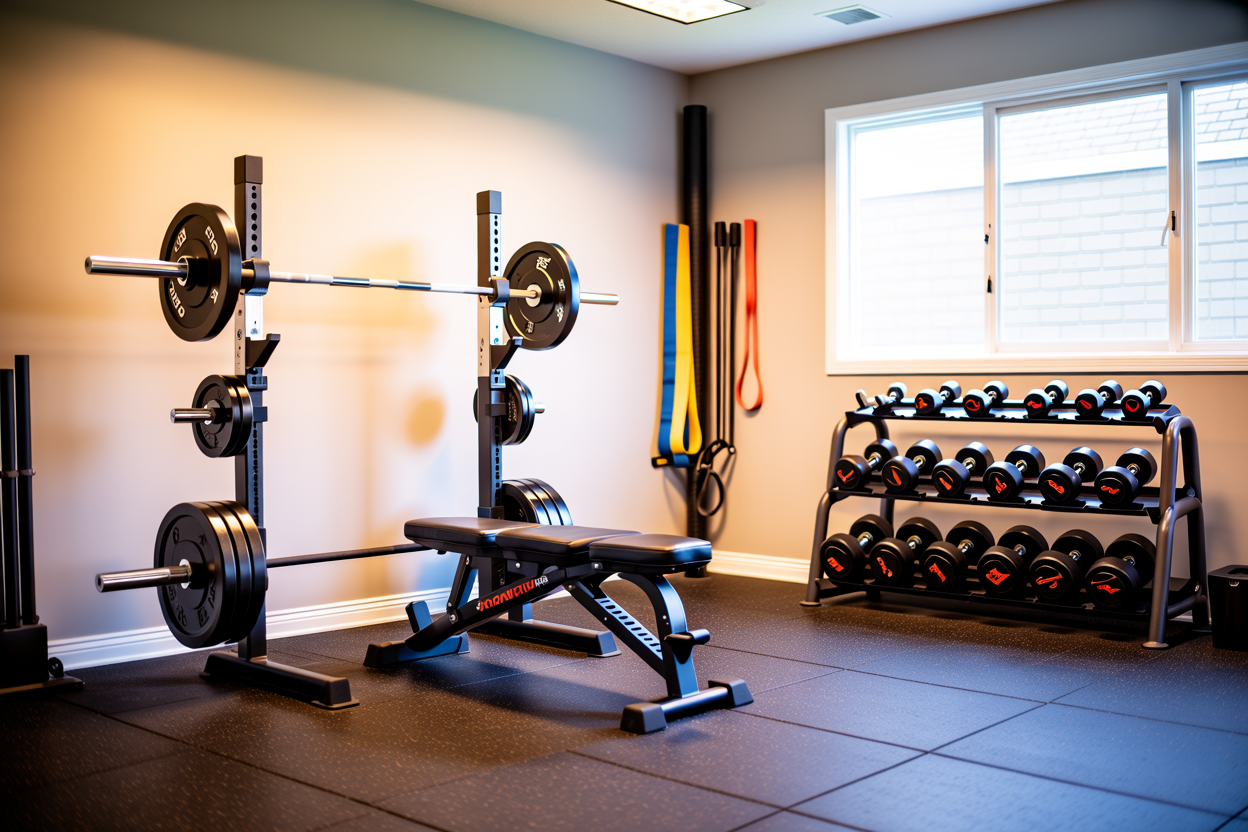
If you’re serious about building strength, a barbell and a set of weight plates are the foundation your home gym absolutely cannot skip. Nearly every major compound movement — squats, deadlifts, bench press, overhead press, and rows — is built around a barbell. Getting this piece of strength training equipment right from the start saves you time, money, and frustration down the road.
What to look for in a barbell:
- Length: A standard Olympic barbell is 7 feet long and designed to fit Olympic weight plates with a 2-inch hole diameter. This is the format most home gyms should go with.
- Weight capacity: Quality barbells typically handle 700–1,500 lbs. Even if you’re a beginner, don’t cut corners here — a cheap barbell can bend or snap under heavy loads.
- Knurling: This is the textured grip pattern on the bar. Medium knurling gives you a solid grip without tearing your hands apart during long sessions.
- Spin: Look for barbells with decent bushing or bearing systems so the sleeves rotate smoothly. This matters most during Olympic lifts and heavy deadlifts.
Choosing your weight plates:
| Plate Type | Best For | Pros | Cons |
|---|---|---|---|
| Cast Iron | Budget home gyms | Affordable, durable | Can damage floors if dropped |
| Rubber-Coated | Most home gym setups | Floor-friendly, quieter | Slightly pricier |
| Bumper Plates | Olympic lifting, deadlifts | Safe to drop from height | Higher cost |
Start with a basic set — a barbell plus 200–300 lbs of plates is plenty to work with as a beginner and intermediate lifter. You can always add more plates as your strength grows.
Dumbbells for Versatile Full-Body Training
Dumbbells might be the single most versatile piece of weight lifting equipment you can own. Whether you’re targeting your biceps, working your shoulders, or adding accessory work after heavy barbell lifts, dumbbells fill the gaps that a barbell simply can’t reach.
Your main options when buying dumbbells:
- Fixed dumbbells: These come pre-loaded and are incredibly convenient — grab and go, no adjusting needed. The downside is cost and space. A full rack of fixed dumbbells from 5 lbs to 50 lbs can run you hundreds of dollars and take up serious floor space.
- Adjustable dumbbells: A game-changer for home gyms. With a single pair of adjustable dumbbells, you can replicate a full rack by simply turning a dial or sliding a pin. Brands like Bowflex and PowerBlock have made this technology reliable and fast to switch between weights.
- Hex dumbbells: Named for their hexagonal shape, these rubber-coated dumbbells won’t roll away and are ideal if you’re doing floor-based exercises like renegade rows or push-up variations.
Recommended starting weights for beginners:
- Women: 5 lbs, 10 lbs, 15 lbs, 20 lbs
- Men: 10 lbs, 20 lbs, 30 lbs, 40 lbs
If space is tight, a pair of adjustable dumbbells covering a range from 5 lbs to 52.5 lbs is one of the smartest purchases you can make for an affordable home gym setup. You get the flexibility of dozens of fixed dumbbells without the clutter.
Key exercises you can knock out with dumbbells:
- Dumbbell bench press and flyes (chest)
- Bent-over rows and single-arm rows (back)
- Lateral raises and shoulder press (shoulders)
- Goblet squats and lunges (lower body)
- Bicep curls, tricep kickbacks, skull crushers (arms)
Resistance Bands for Flexible and Joint-Friendly Workouts
Resistance bands often get written off as beginner gear, but that’s a huge mistake. Serious athletes and strength coaches swear by them because they add a type of resistance called accommodating resistance — meaning the tension increases as you move through a range of motion. This challenges your muscles differently than free weights alone and can push your strength gains to a new level.
Types of resistance bands you’ll encounter:
| Band Type | Look | Best Use |
|---|---|---|
| Loop Bands (Mini Bands) | Small, flat loops | Hip activation, glute work, rehab exercises |
| Resistance Tube Bands | Tubes with handles | Upper body pulling/pushing exercises |
| Flat Therapy Bands | Long, flat strips | Physical therapy, stretching, mobility |
| Pull-Up Assist Bands | Large, thick loops | Assisted pull-ups, barbell banding for strength |
Why resistance bands deserve a spot in your home gym:
- They’re incredibly affordable — you can get a complete set of pull-up assist bands for under $30.
- They’re easy on your joints, making them perfect if you’re working around a shoulder tweak or knee discomfort.
- They travel well — toss a few in your bag and you have a full workout anywhere.
- You can combine them with barbells and dumbbells. Attaching bands to a loaded barbell, for example, is a classic powerlifting technique to build explosive strength.
When buying resistance bands, look for sets that include multiple resistance levels — typically ranging from extra-light (around 5–15 lbs of tension) all the way up to heavy (50–120 lbs). This gives you options whether you’re warming up your hips before squats or using them to add challenge to pull-ups.
Pull-Up Bars for Upper Body Strength Gains
A pull-up bar is one of the most cost-effective pieces of best strength training gear you can add to your home gym. For less than $50 in many cases, you gain access to one of the most demanding and rewarding upper body movements out there. Pull-ups and chin-ups build your lats, biceps, rear delts, and core in a way that very few other exercises can match.
Types of pull-up bars for home use:
- Doorframe pull-up bars: These mount in a standard doorframe using leverage or screws. They’re the most affordable option and work well for most people. Look for one that supports at least 300 lbs and fits your doorframe width without wobbling.
- Wall-mounted pull-up bars: If you want something more permanent and stable, a wall-mounted bar is worth the extra installation effort. These allow you to hang freely, add resistance bands for assisted reps, or attach gymnastics rings.
- Ceiling-mounted bars or rigs: Part of a larger power rack or squat rack setup. If you’re building out a full home gym, your squat rack likely already has a pull-up attachment built in.
- Freestanding pull-up towers: These standalone units often include dip bars and knee raise stations. They’re bulkier but don’t require any drilling or permanent installation.
Movements you can do with a pull-up bar:
- Standard pull-ups and chin-ups
- Wide-grip pull-ups (target outer lats)
- Neutral-grip pull-ups (easier on the shoulders)
- Hanging leg raises and knee tucks (core work)
- Bar muscle-ups (advanced)
- Assisted pull-ups using resistance bands looped over the bar
Tips for choosing the right pull-up bar:
- Check the weight limit — many budget bars only support 250 lbs, which is too low for heavier lifters or explosive movements.
- Consider grip diameter. A thicker bar is harder to grip and will build forearm strength; a standard 1.25-inch bar is the go-to for most people.
- If you’re buying a doorframe model, measure your door trim carefully. Some bars don’t fit doors with thick molding.
- Look for foam or rubber grips to protect your hands during longer sets.
A pull-up bar pairs brilliantly with resistance bands. Loop a heavy band over the bar, step into it, and it offloads some of your body weight — giving you a practical, joint-friendly way to work toward your first unassisted pull-up or add extra volume on training days when your grip and lats are already taxed.
Choose the Right Strength Equipment for Your Budget
Best Budget-Friendly Options That Deliver Real Results
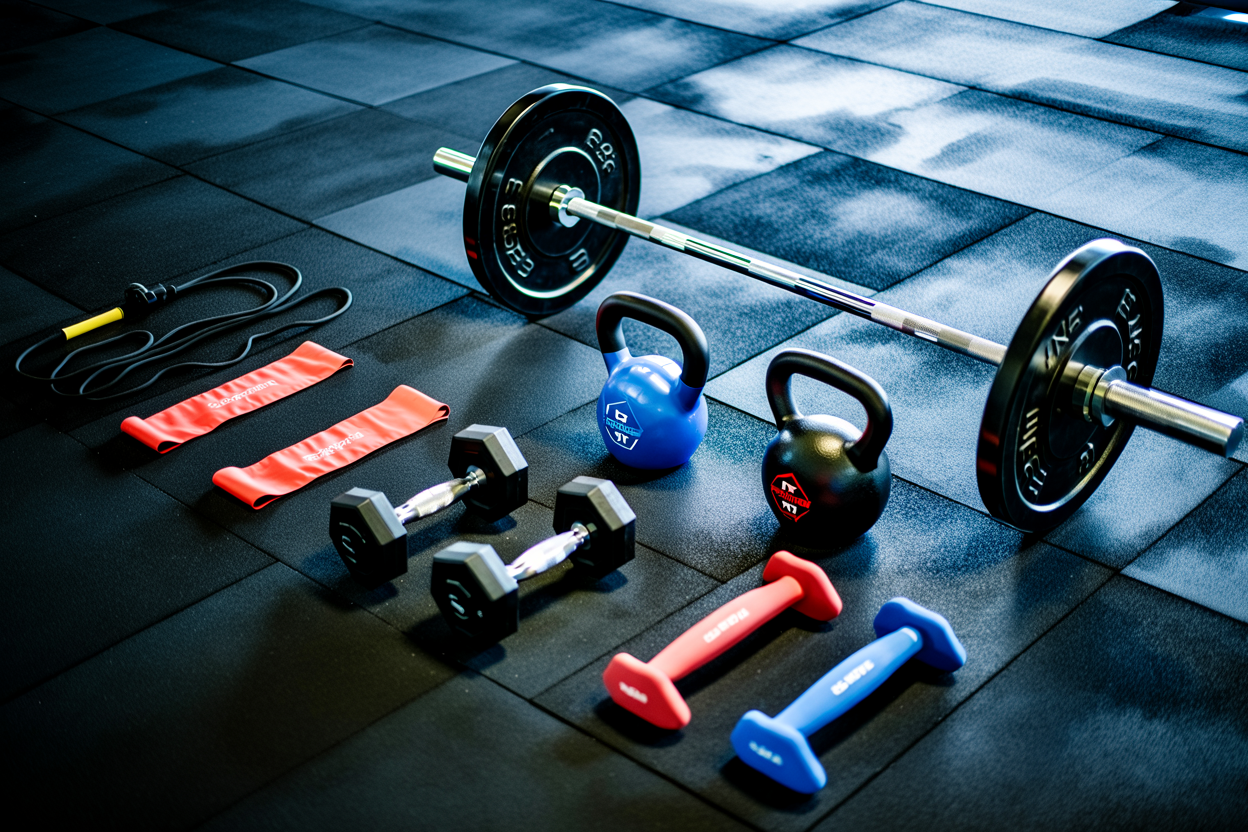
You don’t need to spend a fortune to build real strength. Some of the most effective strength training equipment sits comfortably under the $100–$200 mark, and if you shop smart, your wallet won’t take much of a hit at all.
Here’s where your money goes furthest on a tight budget:
- Resistance Bands – A full set of resistance bands (light to heavy) typically costs between $20–$50. They’re surprisingly versatile, allowing you to train your entire body with progressive overload. Brands like Fit Simplify and Serious Steel offer solid durability at entry-level prices.
- Adjustable Dumbbells (Budget Tier) – Sets from brands like CAP Barbell or Amazon Basics give you fixed-weight pairs at affordable prices. Buying a pair of 10s, 20s, and 30s will cover most beginner programming needs.
- Pull-Up Bar – A doorframe pull-up bar costs $25–$40 and gives you access to one of the most effective upper body exercises on the planet. Iron Gym and ProSource make reliable options.
- Kettlebell – A single cast-iron kettlebell in the 16kg–24kg range runs $40–$70 depending on weight. You can build a serious conditioning and strength base with just one.
- Jump Rope – For under $20, a quality jump rope adds a warm-up and cardio element without eating up floor space.
The goal at this budget level isn’t to build a complete gym overnight. It’s to start moving, build habits, and generate results while you grow your setup over time.
Mid-Range Equipment That Balances Quality and Cost
Once your budget stretches to the $300–$1,000 range, your options improve dramatically — both in quality and variety. This is where most home gym setups hit a real sweet spot between affordability and functionality.
Adjustable Dumbbell Sets ($150–$400)
Adjustable dumbbells are one of the smartest buys you can make for an affordable home gym setup. Instead of buying 10 separate pairs, one adjustable set replaces them all.
| Brand | Weight Range | Price (Approx.) | Best For |
|---|---|---|---|
| Bowflex SelectTech 552 | 5–52.5 lbs | ~$350 | General home training |
| PowerBlock Sport 24 | 3–24 lbs | ~$150 | Beginners to intermediate |
| Nuobell 50lb Set | 5–50 lbs | ~$280 | Smooth adjustment, compact |
| NordicTrack Select-A-Weight | 10–55 lbs | ~$300 | Budget-conscious buyers |
Barbells and Weight Plates ($200–$500)
A standard 7-foot barbell paired with 200–300 lbs of Olympic plates gives you access to squats, deadlifts, bench press, overhead press, and rows — essentially every major compound lift. Look for barbells with at least a 700 lb static weight rating if you’re planning to press or squat heavy.
Good options at this price range include:
- Titan Fitness – Excellent quality-to-price ratio, ships fast, widely trusted
- CAP Barbell Olympic Bar – Solid entry-level bar that holds up well under regular use
- Rogue Ohio Bar (if stretching the budget) – A step up in quality, but absolutely worth every dollar
A Basic Power Rack or Squat Stand ($250–$600)
Even a simple squat stand opens up your training significantly. You can safely load heavy squats, bench press with J-hooks, and store your barbell properly. Titan Fitness, Rep Fitness, and Rogue all offer reliable options in this price window.
Premium Investments Worth the Price for Serious Lifters
If strength training is a long-term commitment for you — not just a passing phase — putting real money into premium gear pays off in ways you’ll feel every single session.
Rogue Fitness Equipment
Rogue is the gold standard for home gym and commercial gym equipment. Their barbells, racks, and accessories are built to last decades, not years. The Rogue Monster series squat racks, Ohio Power Bar, and Echo Bumper Plates are trusted by competitive powerlifters and Olympic athletes worldwide.
Yes, a Rogue rack might cost you $800–$1,500. But you’ll likely never replace it.
Eleiko and Ivanko Barbells
If you’re competing in powerlifting or Olympic weightlifting, your barbell matters more than you think. Eleiko bars (used at the Olympics) and Ivanko precision bars offer the kind of spin, whip, and knurling that actually improves your performance. These run $600–$1,200, but they’re lifetime tools.
Cable Machines and Functional Trainers ($800–$2,500)
A high-quality cable machine from brands like REP Fitness, Force USA, or Inspire Fitness gives you access to cable flyes, tricep pushdowns, lat pulldowns, and hundreds of accessory exercises you simply can’t replicate with free weights alone. For serious lifters, a dual cable machine is one of the most complete pieces of strength training equipment you can own.
Specialty Bars and Attachments
- Safety Squat Bar – Reduces shoulder stress during heavy squats
- Hex/Trap Bar – Ideal for trap bar deadlifts and loaded carries
- Swiss Bar (Multi-Grip Bar) – Great for pressing variation and elbow-friendly bench work
Premium gear isn’t about status — it’s about training without equipment being the limiting factor.
Save Money by Prioritizing Multi-Use Equipment
One of the biggest budget mistakes you can make when building a home gym is buying equipment that only does one thing. The more movement patterns a single piece of equipment covers, the more value you’re getting per square foot and per dollar.
Here’s how to think about multi-use value:
| Equipment | Movement Patterns Covered | Replaces |
|---|---|---|
| Barbell + Plates + Rack | Squat, hinge, push, pull | Leg press, chest press, row machines |
| Adjustable Dumbbells | Push, pull, hinge, isolation | 10+ fixed dumbbell pairs |
| Resistance Bands | All major patterns + mobility | Cable machine (partially) |
| Pull-Up Bar | Vertical pull, core | Lat pulldown machine |
| Kettlebell | Hinge, carry, swing, press | Multiple machines |
| Gymnastics Rings | Push, pull, core stability | Several cable attachments |
The barbell is the single best example of this principle. When you buy a barbell and enough plates, you gain access to arguably the most complete training tool in existence — squats, deadlifts, presses, rows, cleans, and more. That’s why it’s the centerpiece recommendation of nearly every home gym equipment guide.
Before buying anything new, ask yourself: “Does this do something my current equipment can’t do, or does it just do the same things differently?” That one question will save you hundreds of dollars.
Avoid Costly Mistakes by Skipping Gimmicky Products
The fitness industry is full of products designed to look impressive in a 30-second commercial and disappoint you by week three. Knowing what to skip is just as important as knowing what to buy when you’re putting together an affordable home gym setup.
Red Flags to Watch For
- “As Seen on TV” resistance gadgets – Rubber tubes with plastic handles, ab rollers that claim to “shred” your core, and mini band systems that come in cheap nylon bags are almost always low-quality and short-lived.
- Extremely cheap barbells – A $50 barbell is a liability, not a deal. If the knurling is uneven, the sleeves don’t spin properly, or the steel bends under moderate load, you’re risking injury and wasting money.
- Vibration plates – Despite what the packaging says, there’s limited evidence that vibration training produces meaningful strength gains for most people.
- Shake-weight-style products – Any product that promises “the workout of a lifetime in 6 minutes” while bypassing fundamental movement patterns is marketing fluff.
- Single-use machines with limited weight capacity – Machines that only target one muscle group and max out at 40 lbs will stop being useful within a few months of consistent training.
Questions to Ask Before Buying
- Can I find independent reviews from real users (not just sponsored posts)?
- Does this piece of equipment support progressive overload — meaning, can I make it harder over time?
- Is this brand known in the strength training community, or is it a generic drop-ship product?
- Will I still be using this in 2 years?
Sticking to trusted strength training equipment brands and established gear categories — free weights, racks, cables, and bodyweight tools — keeps your investment focused on what actually works. Your training progress depends on consistency and smart programming, not on the latest gadget that promises shortcuts.
Key Features to Look for When Buying Strength Equipment
Durability and Build Quality That Stands the Test of Time
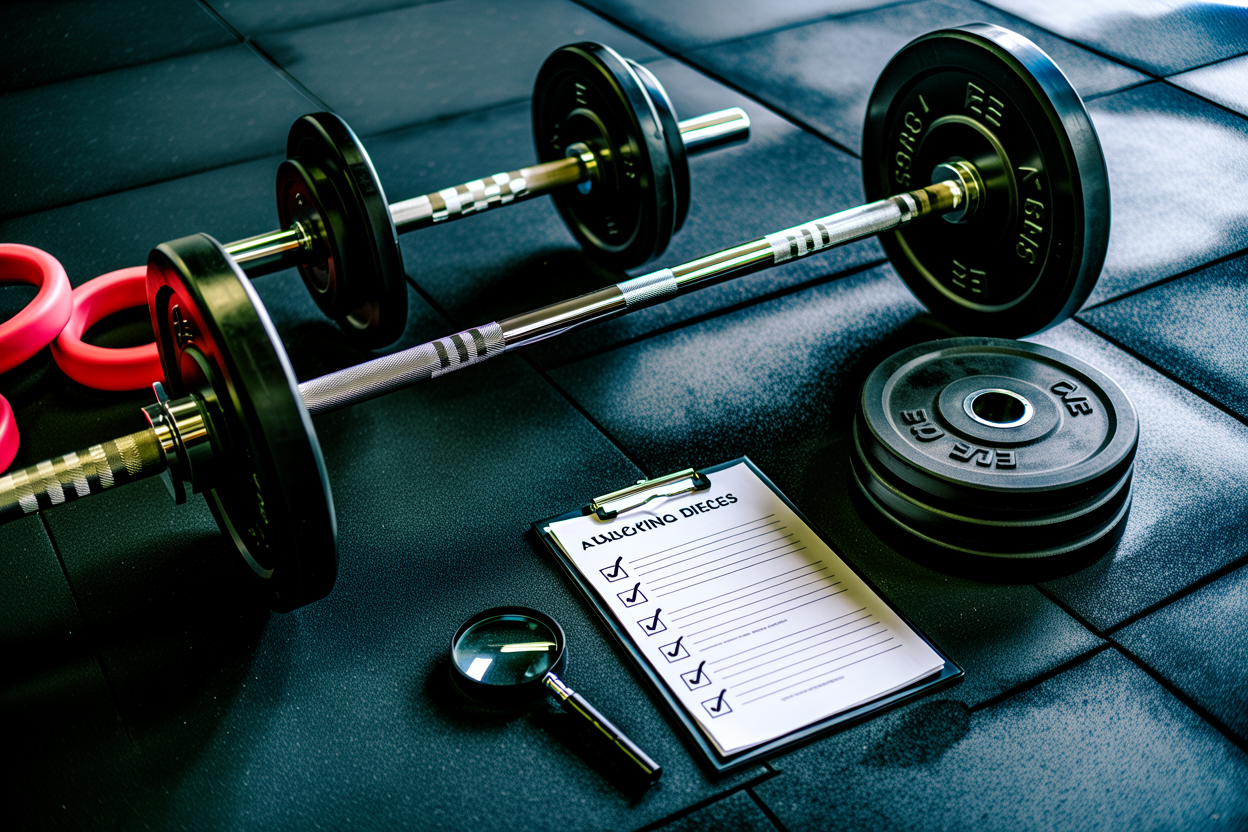
When you’re dropping money on strength training equipment, the last thing you want is a rack that wobbles after six months or a barbell that starts bending under heavy loads. Build quality isn’t just a nice-to-have — it’s the difference between equipment that lasts a decade and gear that ends up as an expensive clothes hanger.
Here’s what to pay close attention to when evaluating build quality:
- Steel gauge: For power racks and squat stands, look for 11-gauge or 12-gauge steel as a minimum. Thicker steel (lower gauge numbers) means a stiffer, more stable structure. Cheaper units often sneak by with 14-gauge or higher, which flexes noticeably under heavy loads.
- Weld quality: Run your hand along the welds. Clean, consistent welds without gaps or rough edges signal that the manufacturer actually cares about how the product is built. Sloppy welds are a red flag you shouldn’t ignore.
- Knurling on barbells: Good knurling on a barbell should feel aggressive enough to grip your hands without shredding them. Passive, slippery knurling tells you the bar was made quickly and cheaply.
- Powder coat finish: A solid powder coat doesn’t just look good — it protects against rust, especially if your home gym is in a garage or basement where humidity is an issue.
- Bolt and hardware quality: Check whether the manufacturer uses grade-8 bolts or generic hardware. Low-quality bolts back out over time and turn a solid piece of equipment into a safety hazard.
What to Look for in Weight Benches Specifically
If you’re shopping for a weight bench, push on the padding and check the frame from underneath. Foam that compresses too easily won’t support you properly under a loaded barbell. The legs should sit flat on the floor without rocking. A bench that rocks is a bench that will eventually fail — and that’s a problem you do not want to discover mid-set.
Red Flags to Walk Away From
| Warning Sign | What It Means |
|---|---|
| Unusually low price for a full rack | Cut corners in steel quality or welds |
| No listed steel gauge or specs | Manufacturer is hiding weak specs |
| Plastic components on structural parts | These will crack under consistent load |
| Warranty under one year | Brand doesn’t trust its own product |
| No weight capacity listed | Liability concerns are telling you something |
Your safety depends on this equipment holding up under real-world stress. Prioritize build quality over aesthetics every single time.
Weight Capacity Ratings That Match Your Strength Level
Weight capacity is one of those specs that beginner lifters skip over and experienced lifters always check first. Understanding what these numbers actually mean — and how much headroom you need — keeps you safe and helps you buy equipment you won’t outgrow in a year.
Understanding Stated Weight Capacities
Manufacturers list a maximum weight capacity for every piece of equipment. But here’s something worth knowing: these ratings are often tested under static load conditions, not dynamic ones. When you drop a barbell, perform explosive movements, or shift your body weight unevenly, you’re creating forces that exceed the static weight on the bar.
A good rule of thumb is to choose equipment rated for at least 20–30% more than your current working loads. If you’re currently squatting 300 lbs, don’t buy a rack rated for 300 lbs. Look for one rated at 400 lbs or more.
Breaking Down Capacity by Equipment Type
| Equipment Type | Beginner Range | Intermediate Range | Advanced Range |
|---|---|---|---|
| Weight Bench | 600–800 lbs | 800–1,000 lbs | 1,000+ lbs |
| Power Rack | 700–1,000 lbs | 1,000–1,500 lbs | 1,500–2,000+ lbs |
| Barbell | 300–500 lbs | 500–1,000 lbs | 1,000–1,500 lbs |
| Dumbbells | Up to 50 lbs | Up to 100 lbs | 100+ lbs |
| Pull-Up Bar | 250–300 lbs | 300–400 lbs | 400+ lbs |
If you’re just getting started with weight lifting equipment as a beginner, you might think you’ll never need a rack rated for 1,000 lbs. But strength gains happen faster than most people expect, especially in the first one to two years. Buy with your future self in mind, not just your current numbers.
Weight Capacity for Specialty Equipment
Adjustable dumbbells and cable machines sometimes have separate ratings for the selector mechanism versus the actual load-bearing components. Read the fine print. A cable machine might be rated for 200 lbs of plates, but the cable and pulley system might only be rated for 150 lbs of functional tension. Knowing the difference prevents equipment failure.
For resistance training equipment, pay attention to band ratings as well. Quality resistance bands list their tension levels clearly, and you want bands that are rated higher than your typical working resistance to avoid snapping mid-workout.
Adjustability Features That Grow With Your Progress
One of the smartest decisions you can make when building out your home gym is choosing equipment that adjusts. Your strength, your body, your goals — they all change. Equipment that adapts alongside you is always a better investment than single-purpose gear you’ll replace in a year.
Adjustable Benches: What the Settings Actually Mean
A flat bench is fine when you’re starting out, but an adjustable bench opens up your entire training program. Here’s what to look for:
- Incline range: Look for at least 0°, 30°, 45°, and 90° (upright) positions. The more granular the adjustment, the more variety you can create.
- Decline capability: Not every bench declines, but if yours does, make sure it locks securely in that position. A bench that slips out of decline is dangerous.
- Seat angle adjustment: A bench that lets you independently adjust both the backrest and seat angle prevents “butt slide” during incline pressing — a small but meaningful feature.
- Adjustment mechanism: Pull-pin systems are fast and easy. Ladder-style (ratchet) adjustments are more stable but slower to change. Choose based on how often you’ll be switching positions mid-workout.
Barbell and Dumbbell Adjustability
If space or budget is a concern, adjustable dumbbells deserve serious consideration. The best models let you change weight in 2.5–5 lb increments, covering a range that would otherwise require a full dumbbell rack.
| Adjustable Dumbbell Type | Best For | Adjustment Speed | Weight Range |
|---|---|---|---|
| Selector Pin (e.g., Bowflex) | Fast workouts, circuits | Very fast | 5–90 lbs typical |
| Spinlock | Budget-conscious setups | Slow | Varies by plates |
| Dial/Twist System (e.g., PowerBlock) | Compact spaces | Fast | 5–70 lbs typical |
For barbells, sleeve diameter matters for adjustability. Standard sleeves (1 inch) limit you to standard plates. Olympic sleeves (2 inches) give you access to the full range of Olympic plates available on the market, which is what most serious setups rely on.
Rack Adjustability Features to Prioritize
When you’re evaluating a power rack or squat stand, look for these adjustable elements:
- J-hook height settings: More hole spacing options mean more precise bar positioning for your specific proportions. 1-inch hole spacing near the bench and squat zones is ideal.
- Safeties and spotter arms: These should adjust independently of the J-hooks and be easy to set at different heights for squats versus bench press.
- Pull-up bar grip options: Some racks include multiple grip positions (neutral, wide, narrow). This adds exercise variety without taking up extra space.
- Accessory compatibility: Racks from reputable brands in the home gym equipment space often support additional attachments — dip bars, cable systems, landmine units. Choosing a rack with an open accessory ecosystem gives you room to grow without buying entirely new equipment.
Resistance Bands and Their Adjustability Advantage
Resistance bands are one of the most adjustable pieces of strength equipment you can own. By combining bands of different tensions, you can create a nearly infinite range of resistance. Look for sets that include:
- Light bands (5–15 lbs): Warm-ups, mobility, upper body isolation
- Medium bands (30–50 lbs): Assisted pull-ups, rows, lateral work
- Heavy bands (60–100+ lbs): Squats, deadlifts, banded barbell work
Quality bands are color-coded by resistance level and made from layered latex rather than a single rubber tube — the layered construction is far more durable and snaps less frequently under tension.
The more your equipment can adapt to where you are today and where you’re headed six months from now, the more value you’re actually getting from every dollar you spend on your home gym setup.
Maximize Your Space With Smart Equipment Selection
Compact Equipment Picks for Small Home Gyms
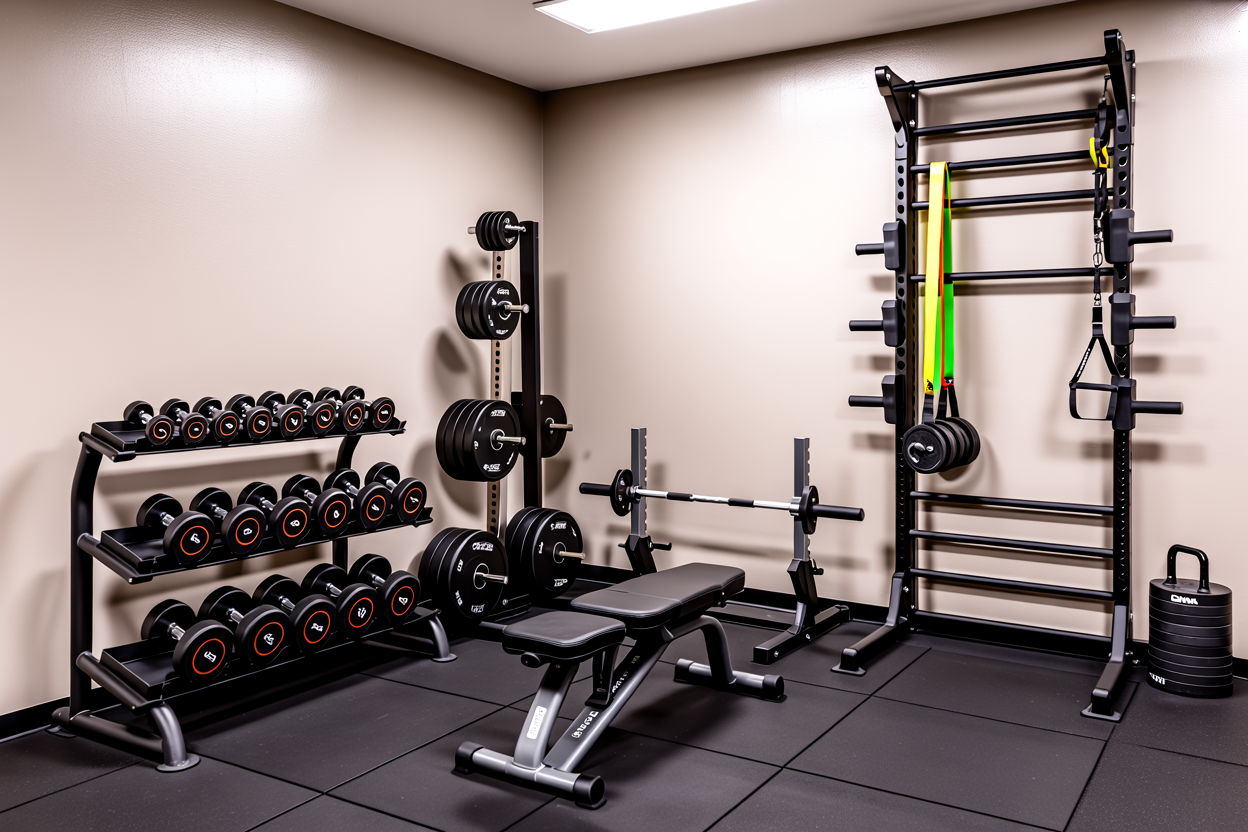
Working out in a tight space doesn’t mean you have to skip any part of your training. Some of the most effective strength training equipment is surprisingly small, and with the right picks, you can build serious strength without sacrificing your living room.
Here are some of the best compact pieces to consider:
- Adjustable Dumbbells – A single set of adjustable dumbbells can replace an entire rack of fixed weights. Brands like Bowflex and PowerBlock let you switch between weight increments in seconds, and the entire set fits neatly in a corner or under a bench.
- Kettlebells – These are incredibly versatile and take up almost no floor space. Even two or three kettlebells of different weights can cover swings, presses, rows, deadlifts, and more.
- Resistance Bands – Don’t underestimate these. A full set of resistance bands can go head-to-head with free weights for muscle activation and takes up less space than a shoebox. They’re perfect for a small apartment gym setup.
- Pull-Up Bar (Doorframe Style) – A doorframe pull-up bar requires zero floor space and can be removed when not in use. It’s one of the highest value-to-space pieces of home gym equipment you can own.
- Flat/Adjustable Bench – Look for a bench that folds flat or has a slim profile. When not in use, it can slide under a bed or stand vertically against a wall.
If you’re building an affordable home gym setup in a small apartment or spare bedroom, start with adjustable dumbbells and a resistance band set. That combination alone can handle hundreds of exercises.
Foldable and Wall-Mounted Solutions to Save Floor Space
When floor space is your most valuable resource, going vertical is your best move. Wall-mounted and foldable equipment has come a long way, and some of it is genuinely impressive in terms of what it can do without eating up your square footage.
Wall-Mounted Options Worth Considering
| Equipment | Space Saved | Best For |
|---|---|---|
| Wall-mounted pull-up bar | Full floor clearance | Upper body strength |
| Folding squat rack | Up to 50% vs. standard rack | Squats, bench, overhead press |
| Wall-mounted cable system | Replaces standalone cable tower | Full-body cable exercises |
| Pegboard/weight storage | Keeps floor clear | Organizing dumbbells, kettlebells |
| Folding weight bench | Stands vertical against wall | Pressing, rows, step-ups |
A folding squat rack is one of the smartest investments you can make if you’re serious about strength training but tight on space. You get full barbell functionality — squats, bench press, overhead press — and when you’re done, the rack folds flat against the wall, giving you your floor back.
Wall-mounted cable systems are another game-changer. A typical cable tower takes up a 4×4 foot footprint minimum. A wall-mounted version takes up almost none, and you can still hit cable flyes, tricep pushdowns, rows, and face pulls without any compromise on exercise quality.
A few practical tips when going the wall-mounted route:
- Check your wall studs carefully. A loaded barbell or cable system puts real stress on the mounting point. Always anchor into studs or use proper masonry anchors if you’re on concrete.
- Measure twice, install once. Map out your full range of motion before drilling anything. You want to make sure you have enough ceiling height and clearance on all sides.
- Look for folding racks with safety catches. If you’re training alone, safety catches on a folding rack are non-negotiable.
All-in-One Machines That Replace Multiple Pieces of Equipment
If you want a single machine that handles everything from chest press to leg curls to lat pulldowns, an all-in-one home gym machine might be exactly what you need. These are particularly smart for people who want structure, guided movement, and space-saving all at once.
Types of All-in-One Machines
Functional Trainers (Dual Cable Machines)
These are probably the most flexible all-in-one option available. A functional trainer has two adjustable cable columns that you can set at any height, giving you access to hundreds of cable exercises. You can train every muscle group, adjust resistance easily, and work unilaterally to fix muscle imbalances.
Power Racks With Cable Attachments
A power rack is already a multi-use piece of strength training equipment — squats, bench press, pull-ups, barbell rows. Add a cable attachment and you’ve now got tricep pushdowns, cable curls, and face pulls covered too. This is a great choice if you’re using a barbell-based training program.
Smith Machines With Cable Columns
If you want guided barbell movement plus cable work, a Smith machine combo unit covers both. It’s not a replacement for free weight training, but for beginners or those training alone, it gives you safety and variety in one footprint.
Multi-Station Home Gyms
These are the classic all-in-one machines with a weight stack, cable, chest press station, lat pulldown, and leg developer all built into one unit. Brands like Body-Solid, Marcy, and Bowflex make popular versions. They’re ideal if you want a self-contained workout system without managing multiple separate pieces.
Quick Comparison: All-in-One Machine Types
| Machine Type | Best For | Space Required | Approx. Cost Range |
|---|---|---|---|
| Functional Trainer | Versatility, cable work | Medium (6×4 ft) | $800–$3,000+ |
| Power Rack + Cable | Barbell + cable training | Medium-Large | $500–$2,500+ |
| Smith Machine Combo | Guided lifts + cables | Medium-Large | $600–$2,000+ |
| Multi-Station Home Gym | Beginners, full-body variety | Medium | $400–$1,500+ |
Before buying any all-in-one machine, measure your ceiling height. Many of these units require 8 to 9 feet of ceiling clearance, and lat pulldown attachments need even more. Walk through the dimensions carefully — the listed footprint often doesn’t account for the space you need to actually move around the machine.
Organize Your Space for Safe and Efficient Workouts
Even the best space-saving gym equipment becomes a hazard if your space is poorly organized. Clutter in a home gym isn’t just annoying — it’s a genuine safety risk. Tripping over a kettlebell mid-set or hunting for a resistance band when you’re trying to maintain workout intensity are problems you can easily avoid with a little planning.
Storage Solutions That Actually Work
- Weight Trees and Dumbbell Racks – If you have multiple sets of dumbbells or plates, a vertical weight tree or tiered dumbbell rack keeps everything visible, accessible, and off the floor. Wall-mounted options are available for even tighter spaces.
- Pegboards and Wall Rails – A pegboard system lets you hang resistance bands, jump ropes, foam rollers, and accessories in a neat, organized row. Everything has a home, nothing piles up on the floor.
- Rubber Flooring Tiles – These aren’t just for cushioning. Laying out interlocking rubber tiles in specific zones helps you mentally define where your lifting area ends and storage begins. It also protects your floor and reduces noise if you’re in an apartment.
- Hooks and Wall Anchors – Heavy-duty hooks can hold resistance bands, suspension trainers (like a TRX), jump ropes, and ab straps without taking up any floor space at all.
Layout Tips for a Safe, Efficient Workout Area
When you’re designing your space, think about your workout flow, not just what fits. Here’s a simple approach:
- Place your primary equipment first. Your power rack, bench, or all-in-one machine goes in first because it’s the biggest footprint.
- Keep free weights close to their rack. Returning weights right after each set is safer and keeps the floor clear for movement.
- Leave a clear stretching and warm-up zone. Even a 6×6 foot open area gives you room to warm up, stretch, or do bodyweight movements without rearranging everything.
- Run cables and cords along walls. If you have any powered equipment, keep cords out of your workout path.
- Use mirrors strategically. A mirror on one wall doesn’t just boost motivation — it helps you check your form without needing a camera setup.
Your home gym should feel like a space that makes you want to train, not one you have to navigate around. A little time spent on layout and organization makes every single workout smoother, safer, and more enjoyable. When your space-saving gym equipment is properly arranged, you spend less time setting up and more time actually lifting.
Top Strength Training Equipment Brands Worth Trusting
Industry-Leading Brands Known for Quality and Reliability
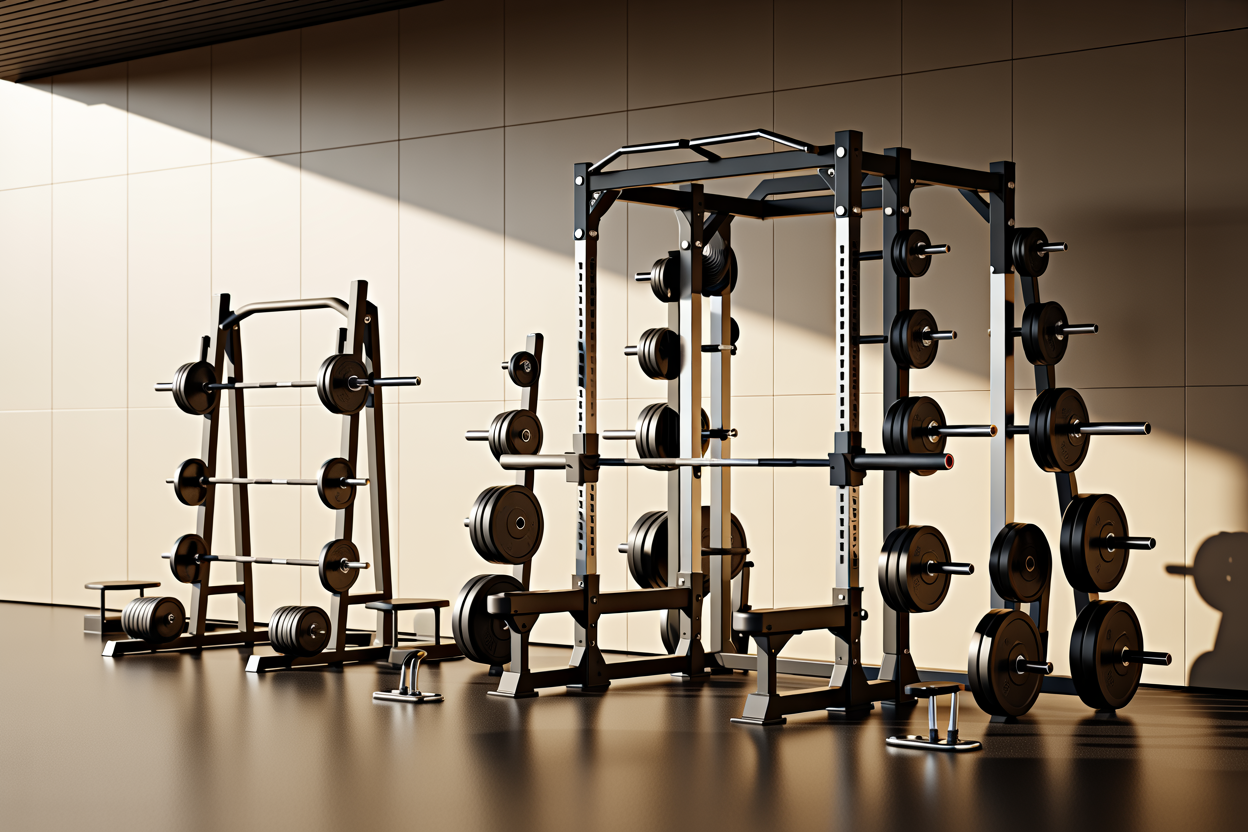
When you’re investing serious money into your home gym, you want to know the equipment will hold up for years — not just months. These brands have earned their reputation through decades of consistent performance, solid warranties, and gear that serious lifters actually trust.
Rogue Fitness
If you spend any time in strength training circles, you’ve heard the name Rogue. Based in Columbus, Ohio, Rogue manufactures some of the most respected barbells, power racks, and accessories in the industry. Their equipment is built for abuse — the kind of abuse that comes from heavy daily use in commercial gyms and competitive weightlifting facilities. Their Monster Series power racks are essentially indestructible, and their Ohio Bar remains one of the best all-around barbells you can buy at any price point. If you’re building a serious home gym and have the budget, Rogue is where most experienced lifters start and end their search.
Eleiko
For Olympic weightlifting equipment, Eleiko is the gold standard. This Swedish brand supplies competition barbells and plates to the highest levels of the sport. If you’re serious about Olympic lifting or powerlifting, owning even one piece of Eleiko equipment changes how training feels. Their barbells spin better, their plates are more accurate in weight, and the craftsmanship is immediately obvious the moment you touch one. Yes, the price reflects all of this — but you’re paying for something that will genuinely outlast you.
Sorinex Exercise Equipment
Sorinex has been building custom strength equipment since 1980, and they’ve outfitted some of the most elite college athletic programs and professional sports teams in the country. Their racks, platforms, and accessories carry a level of engineering you won’t find in mass-market products. If you want something truly built to your specifications with uncompromising quality, Sorinex is worth your attention.
Rep Fitness
Rep Fitness sits in a sweet spot between budget and premium. Their PR-5000 power rack regularly goes up against racks costing twice as much and holds its own. Rep has built a loyal following because they deliver commercial-grade durability at prices that don’t make your eyes water. Their customer service is also genuinely responsive, which matters when you’re assembling a rack alone in your garage.
| Brand | Best For | Price Range | Key Strength |
|---|---|---|---|
| Rogue Fitness | Barbells, power racks, all-around builds | $$$ – $$$$ | American manufacturing, elite durability |
| Eleiko | Olympic and powerlifting equipment | $$$$ | Competition-grade precision |
| Sorinex | Custom builds, institutional quality | $$$$ | Custom fabrication, elite heritage |
| Rep Fitness | Premium performance at mid-range pricing | $$ – $$$ | Value, solid warranty, great support |
Budget Brands That Punch Above Their Weight
You don’t have to spend a fortune to get solid strength training equipment. Several brands have figured out how to deliver real quality at prices that make an affordable home gym setup genuinely achievable. The key is knowing which budget brands actually deliver and which ones will leave you frustrated six months in.
CAP Barbell
CAP Barbell is one of the most widely available budget brands out there, and for a lot of beginners, it’s a perfectly reasonable starting point. Their cast iron plates are consistent, their dumbbells are solid, and you can find their products at most major retailers. Don’t expect competition-level precision or premium finishes, but for general strength training and getting started, CAP does the job without drama.
Marcy
Marcy has been around since the 1970s and built a reputation on making functional, no-frills home gym equipment at accessible prices. Their home gym machines, weight benches, and cable systems are especially popular among beginners who want a complete setup without a massive upfront investment. The build quality won’t impress anyone who’s trained in a high-end commercial gym, but if your goal is consistent training at home, Marcy gets you there.
Titan Fitness
Titan Fitness deserves a special mention here because they genuinely compete with brands that charge significantly more. Their power racks, especially the T-3 series, have developed a cult following in the home gym community. You’ll find slightly rougher welds and less precision than Rogue, but the structural integrity is solid and the price difference is substantial. If your budget is tight but you still want a real rack, Titan should be near the top of your list.
Body-Solid
Body-Solid offers a wide range of strength equipment targeting the home gym market, and their benches and cable machines hold up well over time. They’re not flashy, but their build quality exceeds what you’d expect at their price point. Their warranty coverage is also genuinely strong, which takes some of the risk out of the purchase.
What to watch out for with budget brands:
- Check weight ratings carefully — some budget racks are rated lower than you might assume
- Read user reviews specifically about long-term durability, not just out-of-the-box impressions
- Look for brands that offer replacement parts, since budget equipment can have components that wear out
- Prioritize brands with responsive customer service in case something goes wrong during assembly
Specialty Brands for Specific Training Styles
Your training goals should shape the brands you look at. A powerlifter, a CrossFit athlete, and someone focused on functional fitness all need different equipment — and the brands that serve each group best are not always the same.
For Powerlifting: Kabuki Strength
Kabuki Strength makes some of the most innovative specialty bars available anywhere. Their Transformer Bar and ShoulderSafe Bar solve real problems that powerlifters and strength athletes deal with, including shoulder discomfort during squatting and the need for variety in movement patterns. If you’re serious about powerlifting and want to protect your joints while continuing to move heavy weight, Kabuki is worth every dollar.
For Olympic Weightlifting: American Barbell
American Barbell focuses almost exclusively on high-performance barbells and has built a strong reputation in Olympic weightlifting and functional fitness circles. Their training barbells offer excellent spin, solid construction, and competitive pricing compared to Eleiko. If Olympic lifting is your primary training style and you want a competition-quality feel without paying competition-level prices, American Barbell belongs on your radar.
For CrossFit and Functional Fitness: Again Faster
Again Faster is designed specifically for the CrossFit and functional fitness community. Their equipment is built to handle the high-volume, mixed-modality demands that come with this style of training — things like repeated barbell cycling, heavy conditioning work, and lots of pulling. Their rigs and barbells are tested under real CrossFit conditions, not just theoretical load ratings.
For Bodybuilding and Machine Training: Hammer Strength (Life Fitness)
If you’re drawn to machine-based training or bodybuilding-style isolation work, Hammer Strength is the benchmark. Their plate-loaded machines are legendary in bodybuilding circles for the quality of muscle stimulus they deliver. These machines are primarily found in commercial settings, but if you have the space and budget, adding a Hammer Strength piece to your home gym is like bringing a commercial gym experience home.
For Kettlebell Training: Kettlebell Kings
Kettlebell Kings focuses specifically on kettlebells and has built a reputation for some of the best competition-style and powder coat kettlebells available. If kettlebells are a core part of your training — whether you’re into hardstyle training, RKC methods, or sport kettlebell — the quality of your bell matters more than most people realize. Kettlebell Kings’ competition bells are perfectly sized and balanced regardless of weight, which makes a real difference in your training.
Quick Reference: Specialty Brands by Training Style
| Training Style | Recommended Brand | Standout Product |
|---|---|---|
| Powerlifting | Kabuki Strength | Transformer Bar, ShoulderSafe Bar |
| Olympic Weightlifting | American Barbell | Training barbells with competition-grade spin |
| CrossFit / Functional Fitness | Again Faster | Rigs, barbells, pull-up systems |
| Bodybuilding / Machine Work | Hammer Strength | Plate-loaded isolation machines |
| Kettlebell Training | Kettlebell Kings | Competition and powder coat kettlebells |
| General Strength / Home Gym | Rep Fitness or Rogue | Power racks, flat-to-incline benches |
Knowing which brands specialize in your style of training means you stop wasting time comparing apples to oranges. The best strength training equipment brands for your needs are the ones built specifically with your training methods in mind — and now you know exactly where to look.
Maintain Your Equipment to Protect Your Investment
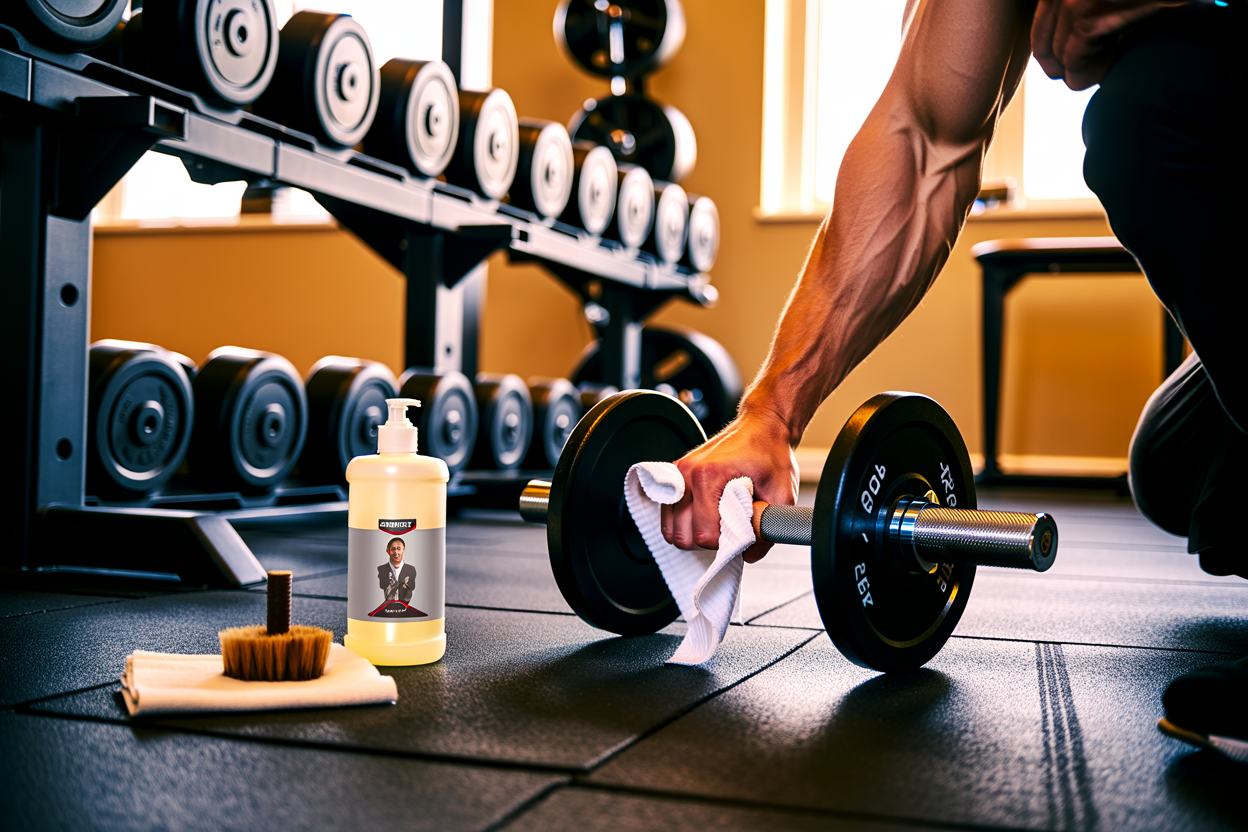
Clean and Inspect Equipment Regularly for Safety
Your strength training equipment takes a beating every single session. Sweat, friction, and repeated loading all wear down your gear over time, and if you’re not keeping an eye on things, small issues can turn into big problems — or worse, injuries.
Make it a habit to wipe down your equipment after every workout. Sweat is surprisingly corrosive. Left sitting on metal bars, cable pulleys, and weight plates, it speeds up rust and weakens the structural integrity of your gear faster than most people expect. A simple microfiber cloth and a mild cleaning spray go a long way.
Beyond the post-workout wipe-down, set aside time every two to four weeks for a more thorough inspection. Here’s what to look for:
- Barbells and dumbbells: Check for cracks, bends, or signs of corrosion on the sleeves and handles. Make sure knurling isn’t worn down to the point where your grip is compromised.
- Weight plates: Look for chips, cracks, or crumbling rubber on bumper plates. Cracked cast iron plates can break apart under load.
- Benches and racks: Inspect welds at every connection point. Wobbling or squeaking usually signals a loose bolt or a developing crack in the frame.
- Cables and pulleys: Check cables for fraying, kinking, or any signs of wear. A snapped cable under tension can cause serious injury.
- Resistance bands: Hold bands up to light and look for micro-tears or thinning sections. When in doubt, replace them — bands are inexpensive, injuries are not.
Getting into a consistent cleaning and inspection routine takes maybe 10 minutes a week, but it can add years to the life of your home gym equipment and keep every session safe.
Lubricate and Tighten Components to Extend Lifespan
Lubrication is one of the most overlooked parts of how to maintain gym equipment, yet it’s one of the simplest ways to protect what you’ve invested in. Moving parts that run dry wear out quickly and can even become dangerous.
What Needs Lubrication?
| Equipment | What to Lubricate | Recommended Lubricant |
|---|---|---|
| Barbell sleeves | Sleeve/bar connection point | Light machine oil or 3-in-1 oil |
| Cable machines | Pulleys and cable guide points | Silicone spray or dry PTFE lubricant |
| Smith machine rails | Guide rails along the full length | Silicone-based spray |
| Adjustable bench pins | Pivot and adjustment pins | Light grease or machine oil |
| Power rack J-hooks | Contact points where bar rests | Light machine oil |
For barbell sleeves specifically, you want them spinning freely. If your sleeves feel stiff or sticky when you give them a spin, it’s time to clean out any built-up grime and apply a fresh coat of light oil. Pull the sleeve off if your barbell allows it, wipe everything down, and apply a thin layer of oil before reassembling.
Cable machines deserve special attention. The cables themselves should never be oiled — you want to keep oil away from the strands since it can actually trap debris and degrade the cable faster. Focus your lubrication on the pulleys and any pivot points where metal meets metal.
Tighten Everything on a Schedule
Bolts and connections loosen over time due to vibration and repeated loading. This is just normal physics — nothing to worry about as long as you stay on top of it. Every month, go over your equipment with the appropriate wrenches and Allen keys:
- Rack uprights and base bolts — these carry the most load and should be checked first
- Bench adjustment pins and frame bolts
- Cable machine frame bolts and pulley mounting bolts
- Lat pulldown seat pads and foot pads
Never overtighten — snug is enough. Stripping threads on a rack or bench frame can create much bigger headaches than a slightly loose bolt. If you notice a bolt backing out repeatedly, apply a small amount of thread-locking compound to keep it in place.
Store Equipment Properly to Prevent Damage
How you store your strength training equipment when it’s not in use matters just as much as how you use it. Poor storage leads to rust, cracking, deformation, and clutter that can create tripping hazards during your workouts.
Control the Environment
Moisture is the biggest enemy of metal equipment. If your home gym is in a garage or basement, humidity can build up quickly, especially during summer months. A few practical steps to protect your gear:
- Use a dehumidifier in any space where humidity regularly climbs above 50%. This single step dramatically slows rust formation on your bars, plates, and racks.
- Keep equipment off bare concrete when possible. Concrete holds moisture, and anything resting directly on it for extended periods will start to rust on the contact points. Rubber flooring or foam mats create a barrier.
- Ensure adequate ventilation — good airflow helps moisture escape rather than settle on your equipment surfaces.
Smart Storage Habits for Different Equipment
Weight plates and dumbbells:
Store plates on a proper weight tree or plate storage post rather than stacking them flat on the floor. Stacked plates can crack, and they’re much harder to grab safely. Keep your dumbbell set on a rack where each pair has a designated spot — this also prevents the handles from banging against each other and chipping the knurling.
Barbells:
The best way to store a barbell long-term is vertically in a dedicated barbell holder. Storing a barbell horizontally on pegs is fine for short-term use between sessions, but horizontal storage on just two contact points can lead to slight bowing over months and years, especially with cheaper bars. If vertical storage isn’t possible, store it horizontally on at least three support points.
Resistance bands:
Keep bands out of direct sunlight. UV light degrades rubber faster than almost anything else. Store them in a cool, dry spot — a drawer, a bag, or a hook away from windows is ideal. Avoid hanging them under tension for long periods, as this stretches them out permanently.
Cables and attachments:
Don’t leave cable attachments piled on the floor where they can get stepped on or rust from contact with concrete. Hang them on a hook rack or store them in a bin. Coil cables loosely — tight coils create kinking points that weaken the cable over time.
A Quick-Reference Storage Checklist
- Weight plates stored upright on a tree or post
- Dumbbells on a proper rack, pairs organized by weight
- Barbell stored vertically or on three-point horizontal support
- Resistance bands stored away from sunlight and heat
- Cables and attachments hung or stored in a container
- All equipment off bare concrete or on rubber flooring
- Dehumidifier running in high-humidity environments
- Gym bag, chalk, and accessories stored out of the workout area
Taking care of your affordable home gym setup doesn’t require a lot of time or expensive products. A small investment in cleaning supplies, a bottle of machine oil, and some basic storage solutions will keep your best strength training gear performing like new for years to come. The people who get the most value from their equipment are the ones who treat maintenance as part of the training habit — not an afterthought.
Getting the right strength training equipment comes down to knowing your goals, understanding your budget, and choosing gear that fits your space and lifestyle. From picking trusted brands to keeping an eye on the features that actually matter, every decision you make shapes the kind of training experience you’ll have at home. The good news is that you don’t need a massive budget or a huge space to build something that works hard for you.
Take your time, do your research, and invest in equipment you’ll actually use. Keep up with basic maintenance so your gear lasts, and remember that even a simple, well-chosen setup can deliver serious results. Your home gym doesn’t have to be perfect from day one — it just has to be right for you.