The Ultimate Guide to Building a Home Gym on Any Budget
The Ultimate Guide to Building a Home Gym on Any Budget
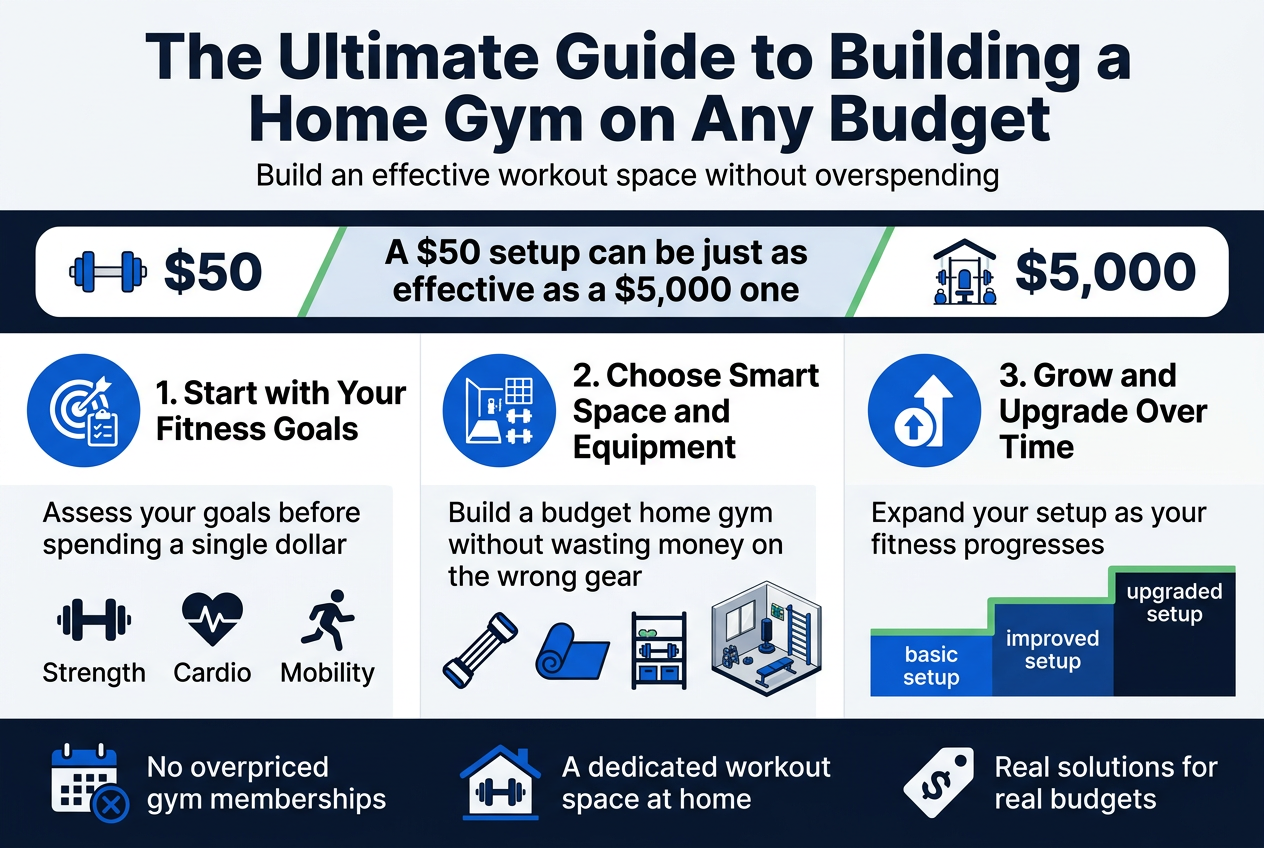
Building a home gym sounds expensive until you realize you don’t need a rack of dumbbells and a commercial-grade treadmill to get a solid workout. A $50 setup can be just as effective as a $5,000 one — if you know what you’re doing.
This guide is for anyone who’s tired of overpriced gym memberships, inconsistent schedules, or simply wants a dedicated workout space at home. Beginners figuring out their first home gym essentials, budget-conscious fitness lovers hunting for affordable home gym equipment, and seasoned lifters ready to upgrade — this covers all of you.
Here’s what you’ll walk away with:
- A clear starting point — how to assess your fitness goals before spending a single dollar
- Smart space and equipment choices — how to build a budget home gym without wasting money on the wrong gear
- A growth plan — how to expand and upgrade your setup as your fitness progresses
No fluff, no “you need to spend big to train hard” nonsense. Just a straightforward, cost-effective home gym solution that actually works for real people with real budgets and real living spaces.
Let’s get into it.
Assess Your Fitness Goals Before Spending a Dime
Identify the Types of Workouts You Actually Enjoy
Before you spend a single dollar on home gym equipment, take an honest look at how you actually like to move your body. This sounds obvious, but it’s the step most people skip — and it’s exactly why so many treadmills end up as expensive clothing racks.
Ask yourself these questions:
- Do you enjoy lifting heavy things, or does the idea of strength training feel like a chore?
- Are you drawn to high-energy cardio sessions, yoga, Pilates, or martial arts?
- Do you prefer solo workouts, or do you thrive with virtual classes and guided programs?
- How long are you realistically willing to work out on a typical weekday?
- Do you get bored doing the same movement patterns, or do you love mastering one discipline?
Your honest answers to these questions should drive every purchasing decision you make. Someone who genuinely loves running will get great value from a quality treadmill. But if you dread running and only do it because you think you should, that machine is going to collect dust within a month.
Think back to the last six months of your fitness life. What workouts did you actually show up for consistently? What felt like a punishment you kept skipping? Build your home gym around the workouts that made you feel good — not the ones you think a “serious” fitness person is supposed to do.
Consider Your Workout Style
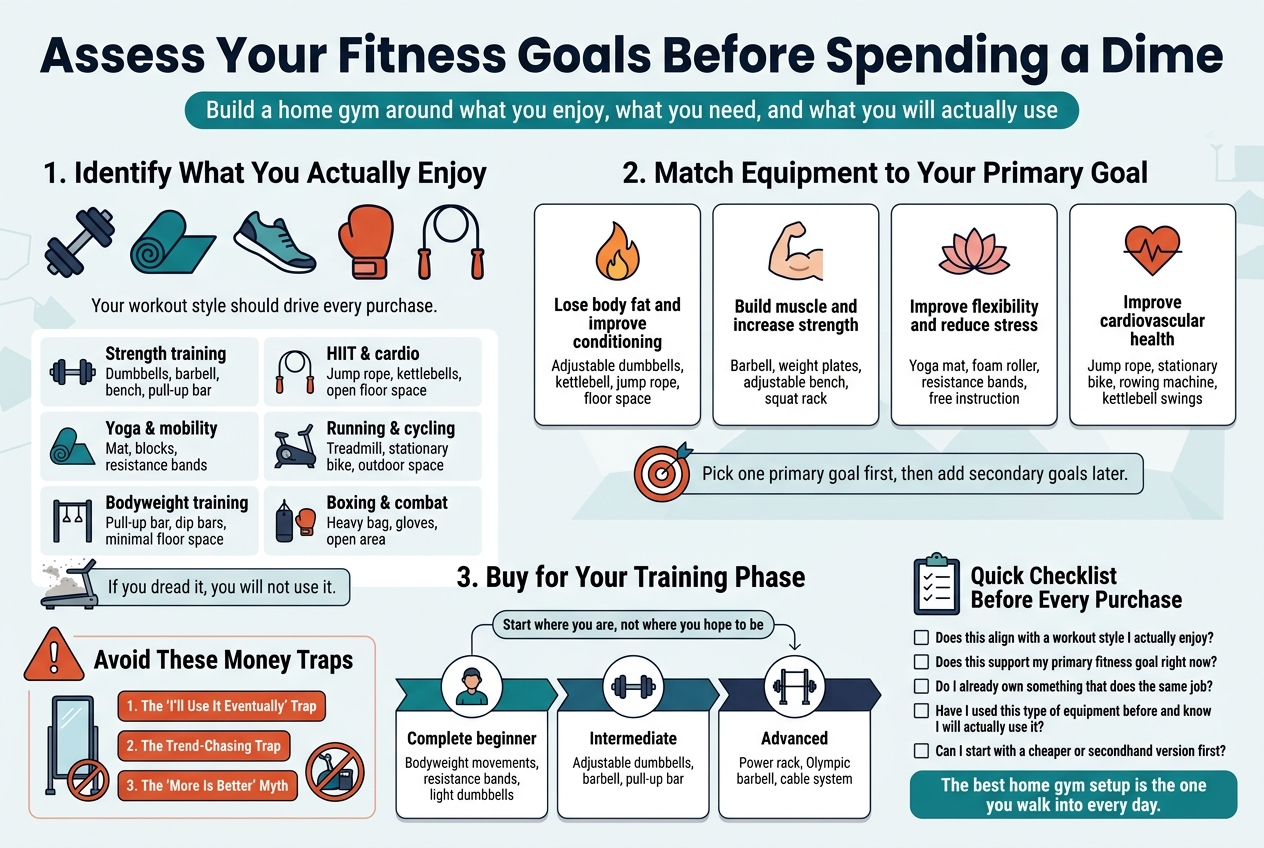
Different workout preferences translate to very different equipment needs:
| Workout Style | What You Actually Need |
|---|---|
| Strength training | Dumbbells, barbell, bench, pull-up bar |
| HIIT & cardio | Jump rope, kettlebells, open floor space |
| Yoga & mobility | Mat, blocks, resistance bands |
| Running & cycling | Treadmill, stationary bike, or outdoor space |
| Bodyweight training | Pull-up bar, dip bars, minimal floor space |
| Boxing & combat | Heavy bag, gloves, open area |
Notice how different each list looks. There’s no universal “must-have” equipment — only equipment that’s right for you.
Match Your Equipment Needs to Your Fitness Objectives
Once you know what you love doing, the next step is connecting your workout style to specific, concrete fitness goals. These two things — enjoyment and objective — need to work together. A workout you enjoy but that doesn’t serve your goal will leave you spinning your wheels. A goal-focused workout you hate will get abandoned in two weeks.
Here’s a practical way to think about it:
Define Your Primary Goal
Pick one primary goal to focus on first. You can layer in secondary goals later, but starting with one keeps your equipment list tight and your budget manageable.
Common fitness goals and what they actually require from a home gym setup:
Goal: Lose body fat and improve conditioning
- You don’t need a full rack of machines. A set of adjustable dumbbells, a kettlebell or two, a jump rope, and enough floor space to move are genuinely all you need. High-intensity interval training done with basic equipment torches calories just as effectively as a commercial gym circuit.
Goal: Build muscle and increase strength
- This is where investing in a solid barbell, a set of weight plates, an adjustable bench, and a squat rack makes sense. Resistance is the stimulus for muscle growth, so you need progressively heavier loads over time.
Goal: Improve flexibility and reduce stress
- A high-quality yoga mat, a few foam rollers, some resistance bands, and access to good instruction (plenty of free YouTube options exist) is genuinely all you need. No bulky machines required.
Goal: Improve cardiovascular health
- You have more options than you think. Jumping rope is one of the most effective cardio tools ever invented and costs under $20. A stationary bike, a rowing machine, or even a solid kettlebell for swings can cover your cardio base without a massive footprint.
Align Equipment with Your Training Phase
Your equipment needs also shift depending on where you are in your fitness journey:
- Complete beginner: Bodyweight movements, resistance bands, and a single set of light dumbbells cover almost everything you need in the first 3–6 months.
- Intermediate: You’ll benefit from added resistance — adjustable dumbbells, a barbell, or a pull-up bar depending on your focus.
- Advanced: Specialty equipment like a power rack, Olympic barbell, or cable system starts making practical sense once your foundational strength is solid.
Buying advanced equipment before you’re ready is one of the most common and costly mistakes in the home gym setup process. Start where you are, not where you hope to be in a year.
Avoid Wasting Money on Gear You Will Never Use
This is where most home gym budgets go sideways. The fitness industry is brilliant at selling you the vision of the person you want to become — and attaching that vision to expensive equipment. A $3,000 smart gym mirror sounds incredible in the ad. But if you’re someone who hates structured video workouts, it’s going to feel like a very expensive picture frame.
Here are the most common money traps to avoid:
The “I’ll Use It Eventually” Trap
Buying equipment for a goal you plan to pursue someday is almost always a bad idea. If you’re not currently doing any strength training, buying a full barbell set “for when you get into lifting” usually results in that equipment sitting untouched for months. Buy gear for what you’re doing now, and upgrade as your habits become real and consistent.
The Trend-Chasing Trap
Every year brings new fitness trends with new specialized equipment. Some of them are genuinely useful. A lot of them are not. Before buying any trending piece of gear, ask:
- Can I achieve the same result with something I already own or something cheaper?
- Have I tried this type of workout and actually stuck with it for more than a few weeks?
- Is there a free or low-cost way to test this training style before investing in equipment?
A cheap resistance band set or a single kettlebell can help you test a new style of training before you go all-in on the gear.
The “More Is Better” Myth
More equipment does not equal better workouts. Some of the most effective training programs in the world are built entirely around a barbell, a pull-up bar, and a floor. Cluttering your space with gear you don’t use regularly makes your gym feel overwhelming and actually reduces how often you’ll use it.
A practical rule of thumb: if you haven’t used a piece of equipment in the last 30 days, it probably didn’t need to be purchased in the first place.
A Quick Checklist Before Every Purchase
Run through this before pulling the trigger on any new equipment:
- Does this align with a workout style I actually enjoy?
- Does this support my primary fitness goal right now?
- Do I already own something that does the same job?
- Have I used this type of equipment at a gym or a friend’s place and know I’ll actually use it?
- Can I start with a cheaper or secondhand version to test it first?
If you can’t check most of those boxes, hold off. The best home gym setup isn’t the most expensive one — it’s the one you walk into every day because it fits how you actually live and train.
Choose the Right Space for Your Home Gym
Transform Small Spaces Into Effective Workout Areas
You don’t need a sprawling mansion to build a killer home gym. Some of the most effective workout setups exist in apartments, spare bedrooms barely big enough for a queen bed, and even walk-in closets that got a second chance at life. The key is working with your space instead of fighting it.
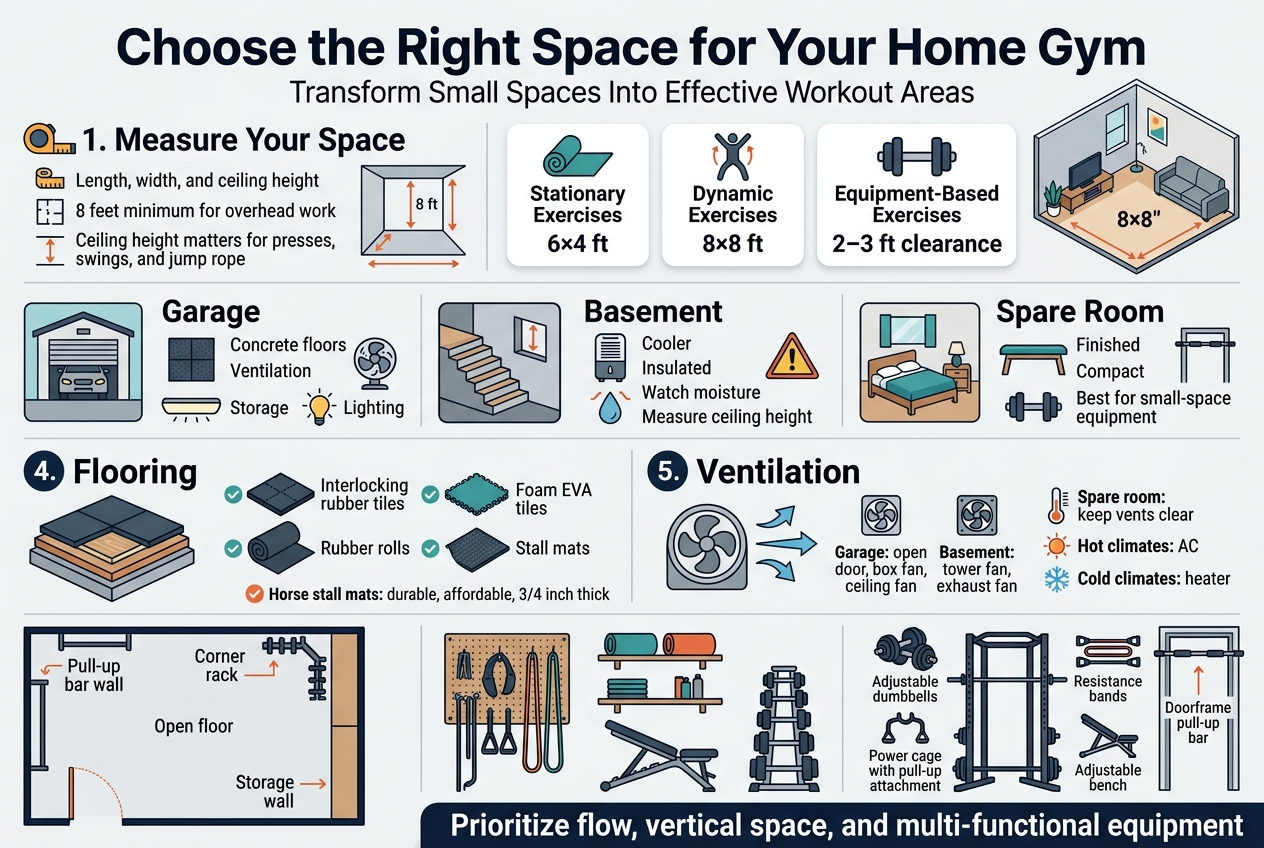
Start by measuring what you actually have. Grab a tape measure and note the length, width, and ceiling height. Ceiling height matters more than people realize — if you plan on doing overhead presses, kettlebell swings, or jump rope, you need at least 8 feet of clearance. Anything lower and you’re constantly ducking or holding back your range of motion.
Next, think about what movements you actually need room for. A basic breakdown looks like this:
- Stationary exercises (planks, push-ups, stretching): You need roughly a 6×4 foot footprint — about the size of a yoga mat with a little breathing room
- Dynamic exercises (lunges, burpees, jumping jacks): Plan for at least 8×8 feet of open floor space
- Equipment-based exercises (dumbbells, a bench, resistance bands): Add 2–3 feet of clearance on each side of the equipment
Even in a compact studio apartment, carving out a dedicated 8×8 foot corner clears the path for a solid full-body routine. Push a couch to one side, roll up a rug, and suddenly you’ve got a functional fitness room setup idea that costs you nothing extra.
Multi-use furniture is your best friend in tight spaces. Adjustable storage ottomans can hold resistance bands and jump ropes. A folding bench pressed against the wall when not in use doubles as seating. Wall-mounted foldable squat racks exist specifically for this scenario and fold flat when you’re done training.
Maximize Garage, Basement, or Spare Room Potential
If you’re lucky enough to have a garage, basement, or a dedicated spare room to work with, you’re sitting on prime real estate for a home gym setup. These spaces have something small rooms often don’t — flexibility. You can go heavier on equipment, make more noise, and set things up without having to break them down after every session.
Garages
Garages are arguably the most popular home gym spaces, and for good reason. They’re typically separated from your main living area (so dropping a weight won’t wake up the whole house), they have concrete floors that handle heavy loads, and they often have good natural ventilation through a main door.
The main challenges with garage gyms:
| Challenge | Solution |
|---|---|
| Temperature extremes (hot summers, cold winters) | Add a portable fan, space heater, or mini-split system depending on climate |
| Hard, unforgiving concrete floors | Lay rubber flooring tiles or foam mats specifically designed for gym use |
| Lack of storage | Install wall-mounted shelving, pegboards, or vertical storage racks |
| Poor lighting | Add LED shop lights or plug-in LED strips — they’re inexpensive and make a big difference |
One practical tip — don’t try to convert the full garage at once. Start with a single functional zone. Set up your main lifting area first, then expand as your budget and collection of equipment grows.
Basements
Basements offer a different set of perks. They stay cooler in summer, are naturally insulated from the rest of the house, and often have more square footage than you’d guess once you clear out old boxes and stored junk.
The ceiling height is the biggest concern in most basements. Older homes especially tend to have ceilings between 6.5 and 7.5 feet, which can limit overhead work and tall equipment like cable machines or full power racks. Measure before you buy anything.
Moisture is the other issue. A damp basement will ruin metal equipment fast — rust spreads quickly on barbells, dumbbells, and rack attachments. Run a dehumidifier and check for water intrusion before investing in serious equipment.
Spare Rooms
A spare room is the most “finished” starting point. It already has flooring, walls, lighting, and usually a comfortable temperature. The trade-off is space — spare rooms are often smaller than a garage or basement — but they’re perfect for best home gym equipment for small spaces like adjustable dumbbells, resistance bands, a compact bench, and a pull-up bar mounted in the doorframe.
Optimize Flooring and Ventilation for Safety and Comfort
Flooring and ventilation are two areas where people consistently cut corners, and both decisions come back to bite them. Getting these right from the start makes your space safer, more comfortable, and a place you’ll actually want to spend time in.
Flooring: Match the Surface to Your Workouts
The floor underneath your feet does more work than you might think. It protects you during high-impact moves, protects your subfloor from equipment damage, reduces noise, and makes the space feel like a real gym rather than a random room with some weights in it.
Here’s a quick guide to the most common home gym flooring options:
| Flooring Type | Best For | Approximate Cost | Pros | Cons |
|---|---|---|---|---|
| Interlocking rubber tiles (3/8″–3/4″) | Most home gym types | $1–$3 per sq ft | Durable, easy to install, great grip | Can smell initially, seams can shift |
| Foam EVA tiles | Yoga, bodyweight workouts, lighter equipment | $0.50–$1.50 per sq ft | Affordable, soft, lightweight | Not suitable for heavy weights |
| Rubber rolls | Large open gym areas | $2–$4 per sq ft | Seamless, professional look | Hard to cut, requires a helper |
| Stall mats (4×6 feet) | Garage gyms, powerlifting | $40–$60 each | Incredibly durable, thick, affordable | Very heavy, strong initial odor |
Horse stall mats are a fan favorite in the home gym community, and the hype is justified. At ¾ inch thick, they handle dropped weights without cracking, provide solid traction for lifting, and at roughly $40–$60 per mat, they’re one of the most budget home gym ideas that genuinely performs like a premium product.
For small spaces, interlocking tiles let you cover exactly the area you need without wasting material or money. You can buy just what covers your workout zone and add more as your space expands.
Ventilation: You Need More Airflow Than You Think
A workout space that gets stuffy or overheated within minutes of starting a session is a workout space you’ll start avoiding. Proper airflow isn’t a luxury — it directly affects your performance, your recovery, and how long you can sustain a session.
Here’s how to tackle ventilation depending on your setup:
- Garage gyms: Keep the main door cracked or open during sessions. Add a box fan or industrial fan aimed across the workout area for cross-ventilation. A ceiling fan is worth the installation cost for year-round use.
- Basement gyms: Basements naturally have limited airflow. A standalone tower fan or oscillating pedestal fan pointed toward you while you work out makes a meaningful difference. If possible, crack a window or add a small exhaust fan.
- Spare rooms: These usually have existing HVAC vents. Make sure they’re not blocked by equipment. If the room still gets stuffy, a portable fan directed toward you works well.
Temperature management goes hand-in-hand with airflow. For hot climates, a window AC unit or portable air conditioner turns an unusable hot garage into a training space you can actually use in July. For cold climates, a propane heater or electric space heater warms up a garage or basement quickly before training — just make sure it’s rated for indoor use and never leave it running unattended.
Work Around Limited Space With Smart Layout Planning
Having a tight footprint doesn’t mean you’re stuck with a mediocre setup. It means you need to be a little more intentional about how you use every square foot. With some strategic thinking, even a cheap home gym workout space can feel organized, efficient, and motivating.
Map Your Layout Before Moving Anything
Before you drag equipment around or buy anything new, sketch a rough floor plan on paper or use a free tool like Roomstyler or Floorplanner. Mark your dimensions, note where doors and windows are, and decide which wall gets what function.
A typical smart layout for a small home gym might look like this:
- One wall: Pull-up bar (doorframe or wall-mounted), resistance band anchor, maybe a mirror
- Corner area: Compact rack or freestanding pull-up station
- Center floor: Clear open space for bodyweight work, stretching, or cardio
- One wall or corner: Storage — dumbbells on a horizontal rack, bands on hooks, foam roller hanging from a pegboard
Vertical Space Is Wasted Space in Most Home Gyms
Most people think horizontally when setting up a gym. They spread everything out at floor level and wonder why it feels cramped. Going vertical changes everything.
- Mount a pegboard on one wall to hang resistance bands, jump ropes, lifting belts, and accessories
- Use wall-mounted shelving above the workout zone for foam rollers, water bottles, and towels
- Install a wall-mounted folding bench that flips up flat against the wall between sessions
- Use vertical dumbbell storage instead of a wide horizontal rack
Prioritize Flow Over Furniture
Think about how you actually move through a workout. You finish a set of dumbbell rows, stand up, and need to move to the pull-up bar. If there’s equipment blocking that path, you’ll be constantly dodging gear, which is annoying at best and dangerous at worst.
Leave at least 3 feet of clear walking space between major pieces of equipment. If your space won’t allow that, rethink what equipment you actually need versus what’s just taking up floor space.
Multi-Functional Equipment Cuts Your Footprint in Half
For small home gym setups, every piece of equipment should earn its place by doing more than one thing. Some smart multi-use picks:
- Adjustable dumbbells replace an entire rack of fixed weights in a fraction of the space
- A power cage or squat stand with pull-up attachment handles squats, bench press, overhead press, and pull-ups in one footprint
- Resistance bands add dozens of exercise variations and store in a small bag
- A quality adjustable bench handles flat, incline, and decline movements without needing three separate pieces
- A pull-up bar (doorframe-mounted) takes up zero floor space
The best home gym equipment for small spaces isn’t always the cheapest or the fanciest — it’s whatever gives you the most training variety per square foot of floor space it occupies. Keep that principle front of mind, and even the most cramped setup becomes genuinely capable.
Build a Budget-Friendly Home Gym Without Sacrificing Quality
Start With the Essential Equipment That Delivers the Most Value
Building a budget home gym isn’t about buying everything at once — it’s about picking the right starting pieces that give you the most training options per dollar spent. Before you swipe your card on anything, ask yourself: what equipment lets me train the most muscle groups, in the least amount of space, for the least amount of money?
Here’s the short answer: resistance, bodyweight support, and cardio.
The following equipment hits that sweet spot perfectly for beginners and experienced lifters alike:
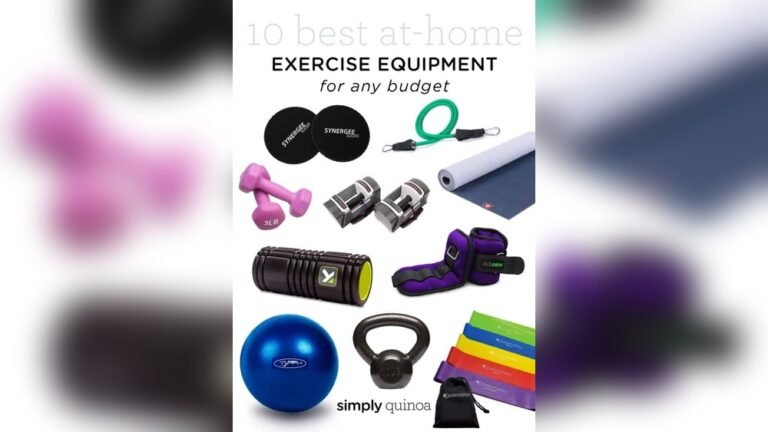
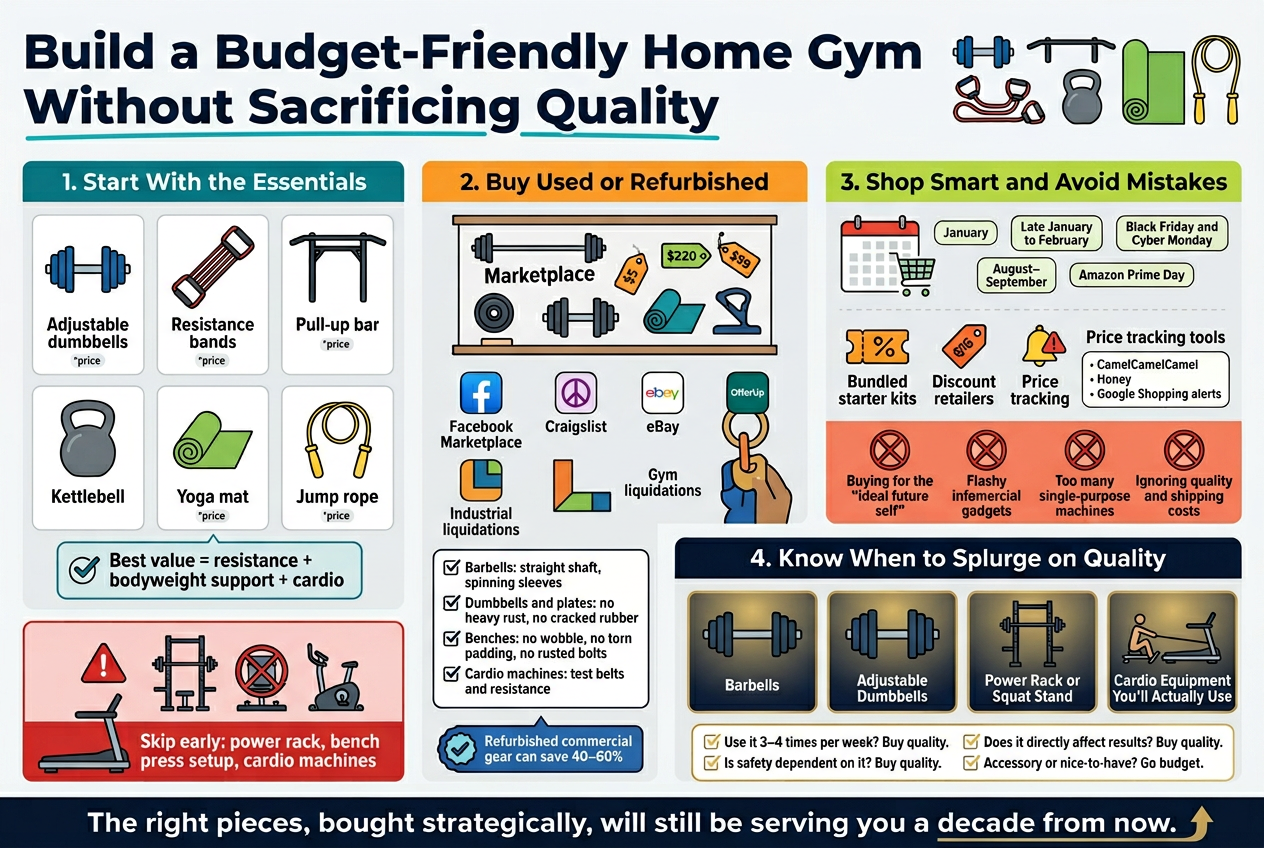
- Adjustable dumbbells — One pair replaces an entire dumbbell rack. Brands like Bowflex SelectTech or PowerBlock allow you to adjust weight in seconds. Yes, they cost more upfront than fixed dumbbells, but the long-term value is unbeatable for small spaces.
- Resistance bands — Extremely cheap, incredibly versatile, and easy to store. A full set (light to heavy) costs under $30 and can challenge every major muscle group.
- Pull-up bar — A doorframe pull-up bar runs about $20–$40 and opens up a huge range of upper-body and core exercises. Few pieces of gear punch above their weight like this one.
- Kettlebell — A single medium-weight kettlebell (around 16–24 kg depending on your fitness level) lets you do swings, goblet squats, presses, and rows. It’s a one-tool full-body workout.
- Yoga mat — For floor work, stretching, and bodyweight training. Non-negotiable if you’re serious about working out at home.
- Jump rope — One of the cheapest, most effective cardio tools ever made. A good weighted jump rope costs $15–$25 and torches calories faster than most people expect.
What to Skip Early On
Don’t rush into buying a full power rack, a bench press setup, or cardio machines until you’ve actually used the basics consistently. A treadmill gathering dust in the corner isn’t a home gym — it’s an expensive clothes hanger.
Buy Used or Refurbished Gear to Cut Costs Significantly
The secondhand fitness equipment market is absolutely booming, and it’s one of the smartest ways to build an affordable home gym without cutting corners on quality.
Think about it — gym equipment is heavy, durable, and built to last for years. A used barbell or a set of cast iron plates from a guy who gave up on his New Year’s resolution in February is just as functional as a brand-new one.
Where to Find Used Gym Equipment
| Platform | What You’ll Find | Tips |
|---|---|---|
| Facebook Marketplace | Dumbbells, benches, barbells, full rack setups | Check daily — deals move fast |
| Craigslist | Cardio machines, weight sets, full gym packages | Always inspect before buying |
| eBay | Branded equipment, adjustable dumbbells | Check seller ratings carefully |
| OfferUp | Local deals on all types of gear | Use filters to narrow your search |
| Gym liquidations | Commercial-grade equipment at steep discounts | Search “[your city] gym liquidation” |
| Garage sales & estate sales | Random but sometimes incredible finds | Go early, bring cash |
What to Look for When Buying Used
- Barbells: Check for straight shafts (roll it on the ground), inspect the knurling for wear, and spin the sleeves to make sure they rotate smoothly.
- Dumbbells and plates: Cast iron and rubber-coated plates hold up extremely well used. Avoid anything with heavy rust or cracked rubber.
- Benches: Check for wobble, torn padding, and rusted bolts. A solid secondhand bench can last another decade.
- Cardio machines: These are trickier. Always test them before buying. Check belts on treadmills and resistance mechanisms on bikes and rowers.
A word on refurbished equipment: many reputable companies sell professionally refurbished commercial gym machines — think Life Fitness treadmills or Concept2 rowers — at 40–60% below retail price. These are often better investments than cheap new machines from budget brands.
Take Advantage of Sales, Bundles, and Discount Retailers
Timing your purchases strategically can save you hundreds of dollars without compromising a single thing on your wish list. The fitness equipment market has very predictable sale cycles, and once you know them, you’ll never pay full price again.
The Best Times to Buy Gym Equipment
- January (post-New Year): Retailers push fitness gear hard, and competition drives prices down. Watch for bundle deals.
- Late January to February: This is when the New Year’s resolution crowd starts selling their barely-used equipment. Secondhand prices drop significantly.
- Black Friday and Cyber Monday: Massive discounts on everything from resistance bands to full home gym systems. Set alerts early.
- End of summer (August–September): Retailers clear out inventory before the fall fitness season ramp-up.
- Amazon Prime Day: Legitimate deals on smaller equipment like dumbbells, bands, jump ropes, and mats.
Bundle Deals Worth Considering
Instead of buying individual pieces at full price, look for starter kits and bundles. Many brands package resistance bands with handles and door anchors together. Others sell adjustable dumbbell sets with a stand. These bundles are almost always cheaper than buying each item separately.
Discount retailers like TJ Maxx, Marshalls, Five Below, and Ross regularly stock yoga mats, foam rollers, resistance bands, and light dumbbells at deeply discounted prices. Don’t overlook these stores — you can often find name-brand items sitting right next to generic ones at a fraction of the cost.
Costco is worth a mention too. They periodically stock adjustable dumbbell sets, weight benches, and kettlebell collections at prices that beat most online retailers. The catch? Stock rotates, so you need to grab it when you see it.
Use Price Tracking Tools
Before buying anything online, run it through a price history tracker:
- CamelCamelCamel (Amazon price history)
- Honey (browser extension that finds coupons and tracks prices)
- Google Shopping alerts (set price drop notifications for specific products)
These tools take two minutes to set up and can easily save you $50–$100 on a single purchase.
Avoid Common Buying Mistakes That Drain Your Budget
A lot of people blow their entire home gym budget in the first month and end up with a collection of equipment that doesn’t actually match how they train. Here are the most common traps — and how to dodge them.
Buying Equipment for the “Ideal Future Self”
You don’t need a 300 lb barbell set on day one if you’ve never lifted before. Buying for where you want to be instead of where you are right now is one of the fastest ways to waste money. Start with what challenges you today, then scale up.
Falling for Flashy Infomercial Products
That rotating, vibrating, resistance-sliding contraption you saw at 2 AM might look impressive, but infomercial fitness gadgets almost universally underdeliver. Stick to simple, proven equipment with established track records.
Buying Too Many Single-Purpose Machines
A preacher curl machine, a leg extension machine, a calf raise machine — each does one thing. For a home gym, prioritize equipment that covers multiple movement patterns. A single barbell with a good set of plates gives you deadlifts, squats, rows, presses, and more. That’s five movement patterns from two pieces of equipment.
Ignoring Quality for the Cheapest Price
There’s frugal, and then there’s false economy. A $30 no-name barbell that bends under load, a $15 pull-up bar that slips on the doorframe, or a $20 resistance band set that snaps in week two — these don’t save you money. They cost you more when you replace them or, worse, when you get hurt.
Not Accounting for Shipping Costs
Gym equipment is heavy. A $100 weight plate set with $60 shipping isn’t actually a deal. Always calculate the total delivered cost before comparing prices across retailers.
Know When Splurging on Quality Equipment Is Worth It
Being budget-conscious doesn’t mean buying the cheapest version of everything. There are certain pieces where spending more upfront actually saves you money long-term, improves your results, and keeps you training safely.
Equipment Worth the Higher Price Tag
Barbells
If strength training is your primary focus, a quality barbell is worth every penny. A good bar from Rogue, Rep Fitness, or Texas Power Bar will last decades with proper care. A cheap barbell can bend, have rough knurling that tears your hands, or have sleeves that don’t spin properly — all of which affect your performance and potentially your safety.
Adjustable Dumbbells
The quality gap between cheap and premium adjustable dumbbells is significant. Low-cost versions often have adjustment mechanisms that feel flimsy, lock poorly, or fail after months of use. Bowflex SelectTech and PowerBlock have track records spanning 15+ years for a reason.
Power Rack or Squat Stand
If you’re planning to squat and bench heavy with a barbell, this is non-negotiable. A solid rack from Rep Fitness or Rogue keeps you safe when training alone. This is not the place to cut corners. A rack that tips, bends, or has poorly welded joints under heavy load is dangerous.
Cardio Equipment You’ll Actually Use
The best cardio machine is the one you’ll consistently get on. If you love running, a quality treadmill — even a certified refurbished one — is worth the investment. The Concept2 Rower is considered the gold standard for home rowing machines and holds its resale value incredibly well (important if you ever want to sell it).
The Budget Splurge Rule of Thumb
A simple way to decide whether to spend more:
- Will I use it at least 3–4 times per week? If yes, buy quality.
- Is my safety dependent on it? If yes, buy quality.
- Does it directly affect my workout results? If yes, buy quality.
- Is it an accessory or a nice-to-have? If yes, feel free to go budget.
Think of your home gym as a long-term investment rather than a one-time purchase. The right pieces, bought strategically, will still be serving you a decade from now. The wrong ones end up on Facebook Marketplace six months later at a fraction of what you paid.
Equip Your Gym at Every Budget Level
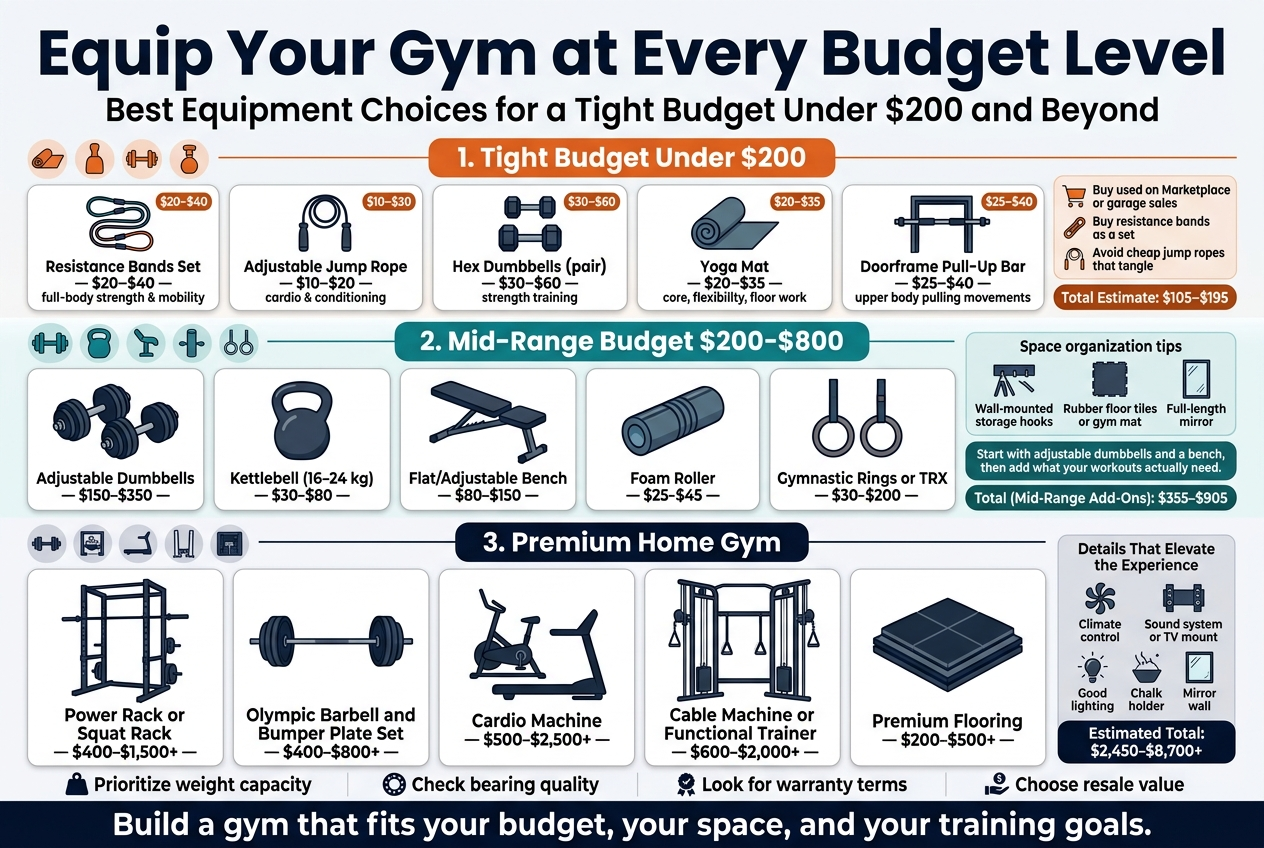
Best Equipment Choices for a Tight Budget Under $200
A tight budget doesn’t mean a weak workout. With under $200, you can put together a surprisingly effective home gym setup that covers strength, cardio, and flexibility — as long as you’re smart about what you buy.
The Core Picks That Stretch Every Dollar
Here’s the thing about budget equipment: you don’t need a lot of it. You need the right pieces. These are the items that give you the most training variety for the least money:
- Resistance Bands Set ($20–$40): A full set with multiple resistance levels is one of the best purchases you can make. You can train your back, chest, shoulders, arms, and legs — and they take up almost no space. Perfect for best home gym equipment for small spaces.
- Adjustable Jump Rope ($10–$20): Cardio doesn’t need a treadmill. A quality jump rope torches calories, improves coordination, and fits in a drawer.
- A Pair of Hex Dumbbells ($30–$60): Pick a weight that feels challenging for 10–12 reps on exercises like rows and presses. A single pair of 20–25 lb dumbbells covers a wide range of movements.
- Yoga Mat ($20–$35): Non-negotiable for floor work, stretching, core exercises, and protecting both you and your floor.
- Pull-Up Bar ($25–$40): A doorframe pull-up bar adds serious pulling strength work to your routine without taking up any floor space.
| Equipment | Estimated Cost | Primary Use |
|---|---|---|
| Resistance Bands | $20–$40 | Full-body strength & mobility |
| Jump Rope | $10–$20 | Cardio & conditioning |
| Hex Dumbbells (pair) | $30–$60 | Strength training |
| Yoga Mat | $20–$35 | Core, flexibility, floor work |
| Doorframe Pull-Up Bar | $25–$40 | Upper body pulling movements |
| Total Estimate | $105–$195 | Full-body training |
Tips for Shopping Smart on a Budget
- Check Facebook Marketplace, Craigslist, and local garage sales. Lightly used dumbbells and kettlebells often sell for a fraction of retail.
- Buy resistance bands as a set rather than individually — you’ll almost always save money and gain versatility.
- Avoid cheap no-name jump ropes that tangle or break fast. Spend the extra $5–$10 for a brand with decent reviews.
This is genuinely a solid cheap home gym workout space starter kit. You won’t be missing machines — you’ll be building real functional fitness.
Build a Well-Rounded Setup for a Mid-Range Budget
Somewhere between $200 and $800 is where your home gym starts to feel real. You have room to add variety, target specific muscle groups more intentionally, and make your training space more comfortable and effective.
What to Add at This Level
Once you have the basics from the budget tier, these additions take your setup to a much higher level:
- Adjustable Dumbbells ($150–$350): This is the single best upgrade you can make. A set like Bowflex SelectTech or PowerBlock replaces an entire rack of dumbbells and saves a ton of floor space. Ideal for anyone working with best home gym equipment for small spaces.
- Kettlebell ($30–$80): One or two kettlebells open up an entirely different style of training — swings, Turkish get-ups, goblet squats, and cleans. A 35 lb (16 kg) is a great starting point for most people.
- Flat/Adjustable Bench ($80–$150): A solid bench unlocks dozens of exercises — dumbbell press, step-ups, incline rows, tricep dips, Bulgarian split squats, and more.
- Foam Roller ($25–$45): Recovery matters. A foam roller keeps muscles loose and reduces soreness, especially as workout volume increases.
- Gymnastic Rings or TRX Suspension Trainer ($30–$200): These are wildly underrated. You can do push-ups, rows, dips, and more with just your bodyweight — and the instability activates muscles that machines never touch.
Organizing Your Space for Maximum Efficiency
At the mid-range level, you start thinking beyond just the gear and more about how the space flows. A few fitness room setup ideas that make a real difference:
- Wall-mounted storage hooks keep bands and jump ropes off the floor and accessible
- Rubber floor tiles or a gym mat protect flooring and reduce noise (especially important in apartments or upper floors)
- A full-length mirror is more than vanity — it helps you check form during lifts and makes the space feel larger
| Equipment | Estimated Cost |
|---|---|
| Adjustable Dumbbells | $150–$350 |
| Kettlebell (16–24 kg) | $30–$80 |
| Adjustable Bench | $80–$150 |
| Foam Roller | $25–$45 |
| Rings or TRX | $30–$200 |
| Floor Tiles (per pack) | $40–$80 |
| Total (Mid-Range Add-Ons) | $355–$905 |
Getting the Most Out of a Mid-Range Home Gym Setup
The goal here isn’t to buy everything at once. A smart approach is to start with adjustable dumbbells and a bench, train with those for a month, and then identify what’s actually missing from your workouts before spending more. This is one of the most practical home gym upgrade tips — let your actual training experience drive purchasing decisions rather than buying on impulse.
A well-thought-out mid-range home gym setup guide points toward versatility over volume. Five pieces of equipment you use are worth more than fifteen pieces collecting dust.
Create a Premium Home Gym for Those Who Can Invest More
When budget is less of a constraint, the goal shifts from “what’s the minimum I need” to “what’s going to make me want to train every single day.” A premium home gym is about quality, comfort, longevity, and building a space that rivals commercial gyms — sometimes surpassing them.
Anchor Pieces Worth Every Penny
These are the big-ticket items that transform a workout room into a serious training facility:
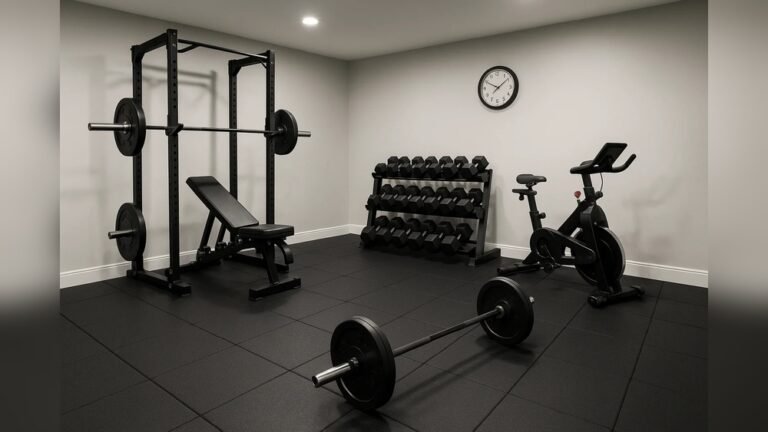
- Power Rack or Squat Rack ($400–$1,500+): The backbone of any serious strength gym. A solid power rack with safety bars lets you squat, bench press, overhead press, and do pull-ups safely — even when training alone. Look for brands like Rogue, REP Fitness, or Titan Fitness for quality that lasts decades.
- Olympic Barbell and Bumper Plate Set ($400–$800+): A quality barbell and bumper plates open up squats, deadlifts, bench press, cleans, and snatches. A 300 lb bumper set with a 20 kg bar covers most lifters for years.
- Cardio Machine ($500–$2,500+): Choose based on your preferences and injury history:
- Concept2 Rowing Machine — full-body, low-impact, holds its resale value well
- Assault AirBike — brutal conditioning in a short time, compact
- Treadmill or Incline Treadmill — great for walkers and runners who train in all weather
- Cable Machine or Functional Trainer ($600–$2,000+): Nothing fully replaces cables for isolation work, sports performance training, and rehab-style movements. A dual-cable functional trainer is incredibly versatile.
- Premium Flooring ($200–$500+): 3/4-inch thick rubber stall mats or commercial rubber flooring protect your floor, absorb impact from drops, and reduce noise significantly.
The Details That Elevate the Experience
A premium setup isn’t just about heavy equipment — it’s the environment that keeps you coming back:
- Climate control: A small wall-mounted AC unit or fan makes summer sessions bearable. A space heater does the same in winter.
- Sound system or TV mount: Training with good music or a mounted screen for workout videos changes the entire feel of a session.
- Good lighting: Bright, evenly distributed lighting reduces eye strain and makes the space feel energetic. LED shop lights are affordable and highly effective.
- Chalk and chalk holder: If you’re lifting heavy, chalk grip is a game-changer — and a wall-mounted chalk block holder keeps the mess contained.
- Mirror wall: Full-length mirrors allow form checks during every lift and make smaller spaces feel significantly larger.
Premium Home Gym Investment Overview
| Equipment | Budget Range |
|---|---|
| Power Rack | $400–$1,500+ |
| Olympic Bar + Bumper Plates | $400–$800+ |
| Cardio Machine | $500–$2,500+ |
| Functional Trainer / Cables | $600–$2,000+ |
| Premium Rubber Flooring | $200–$500+ |
| Mirror Wall | $150–$400+ |
| Climate Control | $100–$400+ |
| Audio/Visual Setup | $100–$600+ |
| Estimated Total | $2,450–$8,700+ |
Choosing Quality Over Brand Name
Spending more doesn’t automatically mean buying the most well-known brands. Some of the best affordable home gym equipment at the higher tier comes from companies like REP Fitness, Bells of Steel, or Fringe Sport — they offer near-commercial quality at a fraction of what you’d pay for top-name brands.
When shopping at this level, prioritize:
- Weight capacity and frame gauge on racks and benches — thicker steel equals longer life
- Bearing quality on barbells — needle bearings spin smoother and last longer than bushings
- Warranty terms — a quality manufacturer stands behind their products with at least a 1-year warranty, often lifetime on frames
- Resale value — brands like Rogue and Concept2 hold their value remarkably well if you ever decide to upgrade or sell
A premium home gym is a long-term investment. Done right, it pays for itself within a year compared to commercial gym memberships — and the convenience of training on your own schedule, with your own equipment, is something most people never want to give up once they experience it.
Expand and Upgrade Your Gym as Your Fitness Progresses
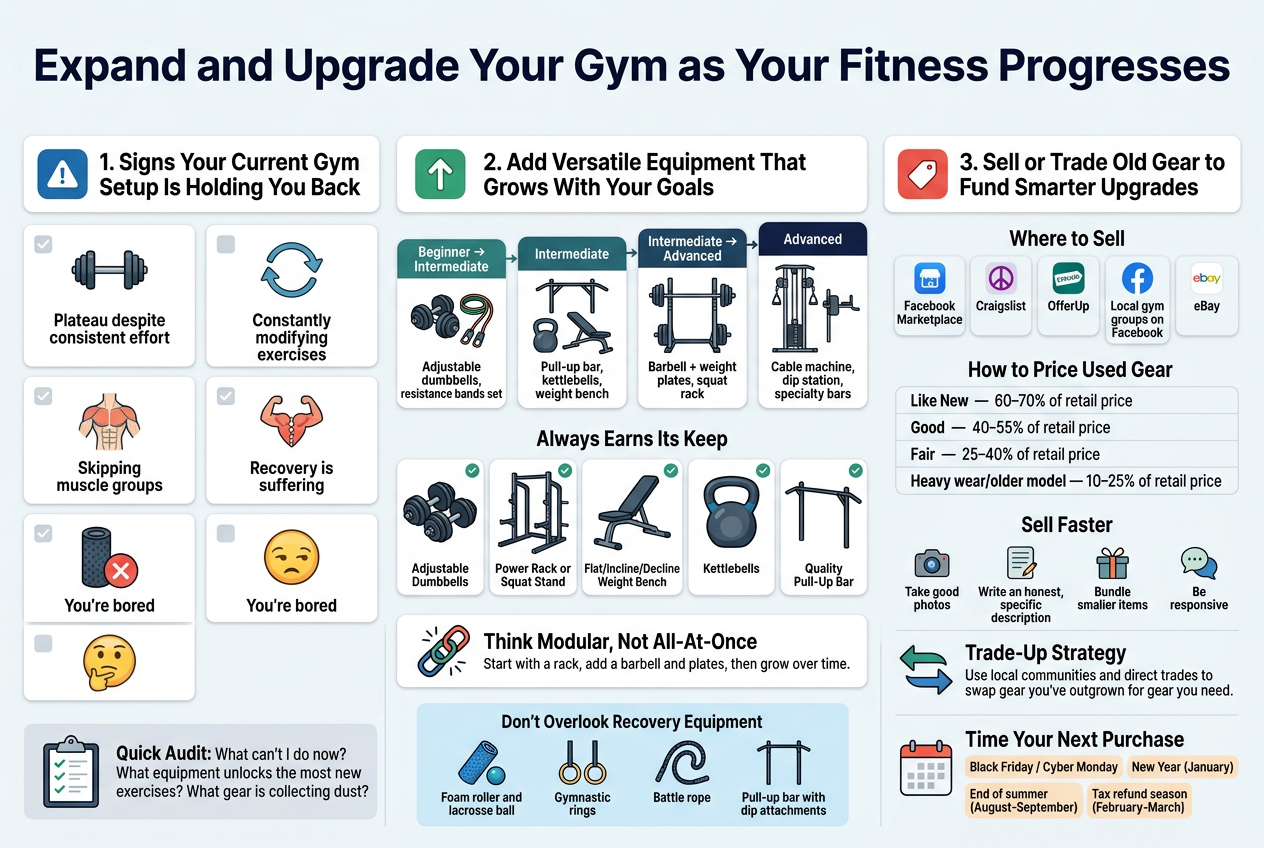
Recognize When Your Current Setup Is Holding You Back
There’s a moment in every home gym journey where you walk in, look around, and feel like your equipment just isn’t cutting it anymore. That feeling is actually a good sign — it means you’ve grown. The trick is learning how to tell the difference between a motivation slump and a genuine equipment limitation.
Here are some clear signals that your current home gym setup is genuinely holding back your progress:
- You’ve hit a plateau despite consistent effort. If you’ve been lifting the same weights for months and your strength gains have stalled, your resistance range may simply be too narrow.
- You’re modifying exercises constantly to make them harder. Doing 30+ reps of everything, adding pauses, slowing tempos — these are creative workarounds, but they only take you so far.
- You’re skipping certain muscle groups entirely. If you can’t train your back, legs, or shoulders properly because you’re missing key tools, your progress will become lopsided over time.
- Recovery is suffering due to missing equipment. No foam roller, no stretching mat, no way to do proper mobility work — these small gaps quietly chip away at your overall fitness.
- You’re bored. Workout boredom kills consistency. If your gym has no variety left to offer, your attendance will drop before you even realize it.
Once you spot these signs, resist the urge to buy everything at once. The smarter play is to upgrade strategically, one piece at a time, prioritizing the gaps that are costing you the most results.
Do a Quick Audit First
Before spending anything, take stock of what you already have and what’s actually missing. Ask yourself:
- What movements am I completely unable to do right now?
- What equipment would unlock the most new exercises for my goals?
- What’s collecting dust that I no longer use?
This simple audit keeps your home gym upgrade tips grounded in real need rather than gear lust.
Add Versatile Equipment That Grows With Your Goals
The best home gym equipment doesn’t just serve you today — it keeps delivering value as your fitness evolves. When you’re upgrading, think in terms of versatility and scalability rather than single-use gadgets.
Tier Your Upgrades Based on Your Training Stage
| Training Stage | Priority Upgrades | Why It Matters |
|---|---|---|
| Beginner → Intermediate | Adjustable dumbbells, resistance bands set | Covers a wide rep and resistance range without buying multiple items |
| Intermediate | Pull-up bar, kettlebells, weight bench | Opens up compound movements that drive serious muscle and strength gains |
| Intermediate → Advanced | Barbell + weight plates, squat rack | Unlocks heavy loading for squats, deadlifts, bench press |
| Advanced | Cable machine, dip station, specialty bars | Adds exercise variety and targets weak points more precisely |
The Equipment That Always Earns Its Keep
Some pieces of home gym equipment are just reliably worth the money at almost any budget level. These are the ones that fitness coaches consistently recommend for their return on investment:
-
Adjustable Dumbbells — A quality set like Bowflex SelectTechs or PowerBlocks replaces an entire dumbbell rack. If you started with a fixed set, upgrading to adjustable dumbbells is one of the single best home gym upgrades you can make. They fit well in small spaces and grow with you from beginner to advanced training loads.
-
A Power Rack or Squat Stand — If strength training is your goal, nothing upgrades your gym more than a solid rack. You can squat, bench, do pull-ups, rack pulls, overhead press, and more from a single piece of equipment. Even a basic squat stand is transformative.
-
A Flat/Incline/Decline Weight Bench — Pairs with your rack and dumbbells to triple the number of exercises available to you. Look for one rated to at least 600 lbs to ensure it holds up long-term.
-
Kettlebells — A few kettlebells in different weights cover conditioning, strength, and mobility work in ways dumbbells alone can’t. They’re excellent for anyone building a best home gym equipment for small spaces setup because they’re compact and wildly versatile.
-
A Quality Pull-Up Bar — Whether it’s a doorframe model or a wall-mounted bar, the pull-up is one of the best upper body exercises that exists. If you can’t do them yet, it doubles as a hanging station for core work and resistance band exercises.
Think Modular, Not All-At-Once
A modular approach to upgrading is one of the best cost-effective home gym solutions out there. You’re not trying to build a commercial gym in your garage overnight. You’re building a system that expands intelligently. Start with a rack, add a barbell and starter weight plates, then slowly grow your plate collection over time. This approach spreads the cost out, keeps your space from getting cluttered, and lets you test what you actually use before investing more.
Don’t Overlook Recovery Equipment
Upgrades aren’t only about lifting heavier. As your training intensity increases, recovery tools become more important:
- Foam roller and lacrosse ball for myofascial release
- Gymnastic rings for mobility work and bodyweight strength
- Battle rope for conditioning without needing a lot of space
- Pull-up bar with dip attachments for upper body pulling and pushing variety
These additions are relatively affordable and dramatically improve the quality of your workouts and long-term joint health.
Sell or Trade Old Gear to Fund Smarter Upgrades
Here’s something most people completely overlook when thinking about home gym upgrade tips — your old equipment is basically a funding source for your next purchase. The used fitness equipment market is enormous right now, and people are actively searching for exactly the beginner gear you may have outgrown.
Where to Sell Your Used Gym Equipment
- Facebook Marketplace — The most active platform for used fitness gear. Dumbbells, benches, and cardio machines move fast here, often within 24-48 hours of posting.
- Craigslist — Still effective, especially for larger items like treadmills or weight benches where local pickup is preferred.
- OfferUp — Growing platform with a smooth selling process, good for mid-range gear.
- Local gym groups on Facebook — Niche communities of buyers who know exactly what they want and will pay fair prices.
- eBay — Good for specialty or brand-name gear that has a national market, like select kettlebell brands or specific barbell types.
How to Price Your Used Gear
A common rule of thumb in the used equipment world:
| Condition | Pricing Guide |
|---|---|
| Like New (barely used) | 60–70% of retail price |
| Good (normal wear, fully functional) | 40–55% of retail price |
| Fair (cosmetic wear, still functional) | 25–40% of retail price |
| Heavy wear/older model | 10–25% of retail price |
Pricing too high means it sits forever. Pricing too low means you’re leaving money on the table. Check what similar items are selling for on Facebook Marketplace in your area before listing anything.
Tips for Selling Gym Equipment Faster
- Take good photos. Clean the equipment, shoot it in decent lighting, and photograph it from multiple angles. Listings with clear photos sell significantly faster.
- Write an honest, specific description. Mention the brand, model, weight capacity, any wear or damage, and dimensions. Buyers who know what they’re getting show up and follow through.
- Bundle smaller items. Can’t move those individual resistance bands? Bundle them with a jump rope and a foam roller and sell them as a starter kit. Bundles move faster and often net you more money overall.
- Be responsive. The used equipment market is competitive. Respond to messages quickly, and the sale is usually yours.
The Trade-Up Strategy
Another angle worth exploring is direct trades. Fitness communities on Reddit (r/homegym is a great example), local gym groups, and even neighborhood apps like Nextdoor are full of people who have gear you want and want gear you have. A straight trade means no cash changes hands and both parties walk away with something more useful.
For example, if you’ve outgrown your entry-level fixed dumbbells and someone nearby has a set of kettlebells they no longer use, a direct trade can be a win for both sides. This kind of community-driven approach to building a budget home gym is genuinely one of the most underrated strategies in the space.
Use Sales Tactically to Time Your Next Purchase
Once you’ve sold your old gear, resist the temptation to spend it immediately. Instead, wait for known sales windows:
- Black Friday / Cyber Monday — Fitness equipment sees some of the steepest discounts of the year during this period.
- New Year (January) — Retailers heavily discount gym equipment in January to catch resolution buyers.
- End of summer (August–September) — Outdoor and cardio equipment often drops in price as demand shifts seasonally.
- Tax refund season (February–March) — A surprisingly active time for used equipment deals as sellers try to cash in on impulse buyers.
Pairing the money from your gear sales with a well-timed purchase can stretch your budget significantly further than buying at full price on impulse. That’s the long game when it comes to building an affordable home gym that genuinely keeps pace with your fitness growth.
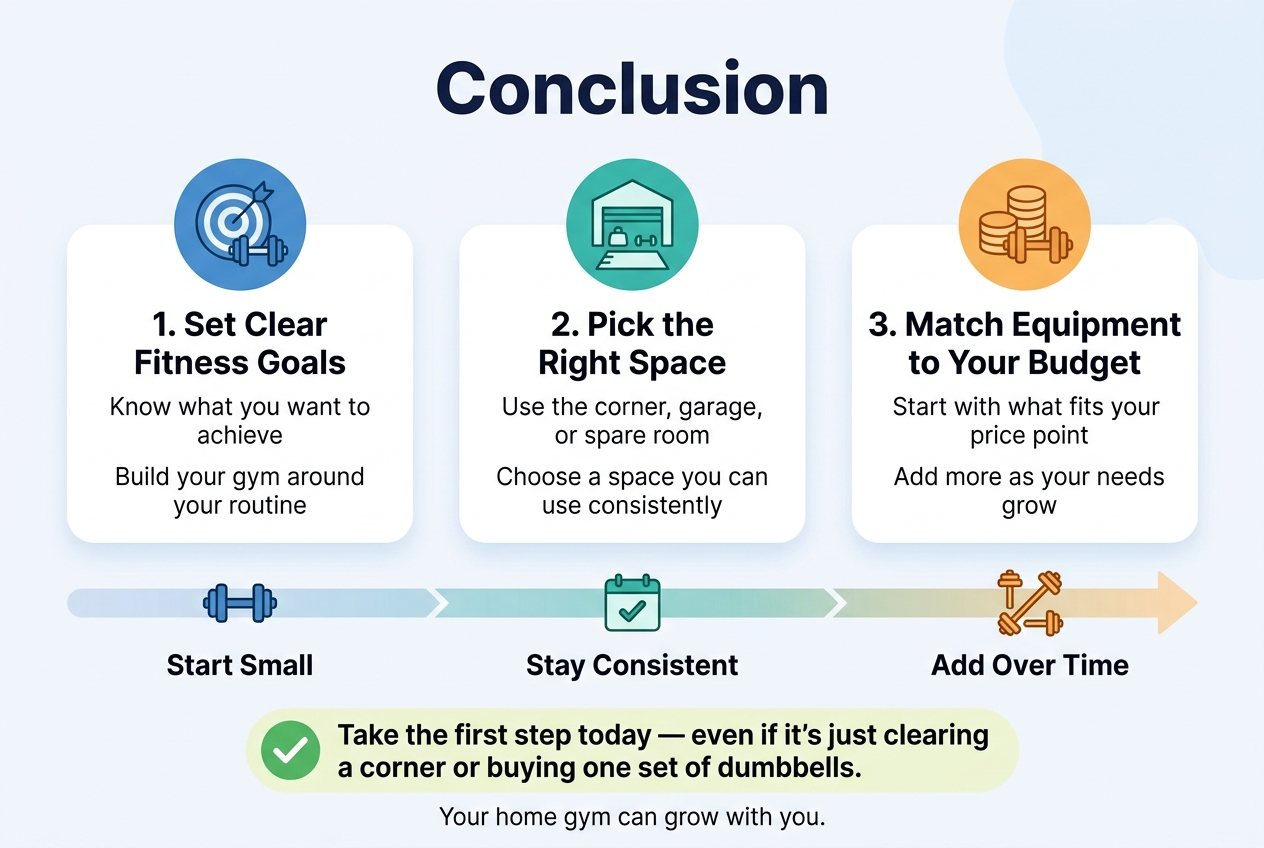
Building a home gym doesn’t have to be overwhelming or expensive. By starting with a clear picture of your fitness goals, picking the right space, and choosing equipment that fits your budget, you can create a setup that actually works for you. Whether you’re just getting started with a few basic pieces or you’re ready to go all in, there’s a path forward at every price point.
The best part? Your home gym can grow right along with you. Start small, stay consistent, and add equipment as your needs change. Take that first step today — even if it’s just clearing out a corner of your garage or ordering a single set of dumbbells. Your future self will thank you for it.